



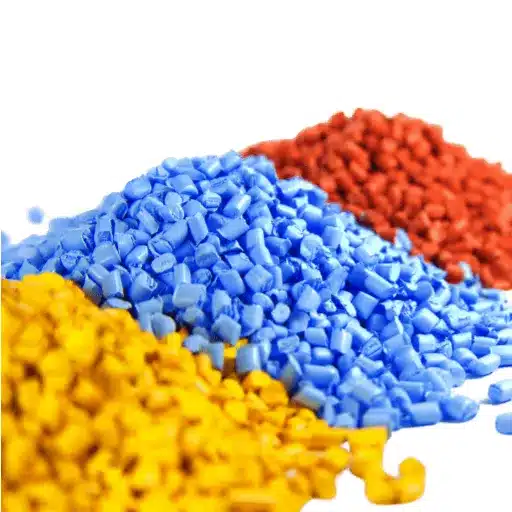


ABS does not melt the way you expect. The “melting point” quoted on datasheets and forums is actually a processing temperature, and confusing the two causes warped parts, burnt resin, and field failures that should never have happened.
Here’s the honest answer up front: ABS is an amorphous thermoplastic, so it has no true melting point. It softens gradually above its glass transition temperature of about 105 °C, and the 200 to 250 °C figure people call the “ABS melting temperature” is the melt temperature used in injection molding and extrusion. This guide explains every temperature that actually matters for ABS, from the softening point to the processing window to the degradation limit, broken down by grade, and how to verify thermal consistency when you source the resin.
We supply branded prime ABS in Suzhou, China, with full documentation on every batch. If you need a specific grade, request an ABS resin quote and our technical team will respond within 24 hours.
What Is the Melting Point of ABS?

ABS (acrylonitrile butadiene styrene) is an amorphous thermoplastic and has no true melting point. It softens gradually above its glass transition temperature of about 105 °C. The “melting temperature” quoted for ABS, commonly 200 to 250 °C, is the processing melt temperature used for injection molding or extrusion, not a physical melting point.
That is the answer behind the searches for “ABS plastic melting point” and “melting point of ABS,” but it deserves unpacking. If you’re a mold setter, a 3D printing operator, or a buyer comparing datasheets, the distinction changes how you work with the material.
Why ABS Has No True Melting Point
A polymer either melts or softens depending on how its molecular chains pack together. Semi-crystalline plastics like POM, PA66, and HDPE pack into ordered crystal regions that release a sharp melting endotherm when heated. ABS cannot do this.
ABS is a terpolymer. Its three monomers, acrylonitrile, butadiene, and styrene, bond together in a way that prevents regular crystalline packing. The chains are disordered, so heat breaks them apart gradually rather than at one discrete temperature. A differential scanning calorimetry (DSC) scan of ABS shows a glass transition step, not a melting peak. This is the same reason PC and PMMA behave the way they do. You can dig into the molecular detail in our ABS polymer structure guide, or check the British Plastics Federation profile of ABS for the official polymer classification.
What “Melting Temperature” Actually Refers To
When someone asks “what temperature does ABS melt,” they usually want one of four different numbers:
| Metric | Typical Value | What It Tells You |
|---|---|---|
| Glass transition temperature (Tg) | ~105 °C | The design ceiling; ABS loses rigidity above this |
| Heat deflection temperature (HDT) | 85 to 100 °C at 1.82 MPa | Load-bearing limit under stress |
| Vicat softening point | ~90 to 110 °C | The datasheet value that answers “when does it soften” |
| Processing melt temperature | 200 to 250 °C | The barrel/nozzle setting for molding and extrusion |
Ask a mold shop for the “melting point” and you’ll get the 200 to 250 °C processing range, because that’s the setting on the machine. Ask a design engineer and you’ll get the Tg. Both are correct; they’re just answering different questions.
The Temperatures That Matter for ABS
Five temperatures define the practical behavior of ABS in production and in service. Each one answers a different engineering question.
ABS Glass Transition Temperature (Tg): ~105 °C
Tg is the most important design number for ABS. Above roughly 105 °C, the polymer chains begin to move and the material loses its rigidity. It doesn’t collapse instantly, but it can no longer hold dimensions under load. Summer cabin temperatures in a parked car can exceed 90 °C, which is why interior trim parts are a classic high-heat ABS application rather than a standard-grade one.
ABS Heat Deflection Temperature (HDT)
HDT is the temperature at which a test bar deflects a set amount under a fixed bending load. It is measured per ASTM D648 or ISO 75 at two stresses. Standard ABS sits around 85 to 100 °C at 0.455 MPa and roughly 90 °C at 1.82 MPa. High-heat grades push HDT up to 110 to 120 °C, which is a meaningful upgrade for automotive and appliance parts.
Vicat Softening Point
If you want a single “softening temperature” for ABS, the Vicat value is the one to check. It runs about 90 to 110 °C and is measured per ASTM D1525 or ISO 306. It differs from HDT because the test applies no bending load, so it reports the temperature at which a flat needle penetrates the sample. Reference databases like eFunda’s ABS datasheet publish these values for a standard injection-molding grade.
Continuous Service Temperature
Real parts sit at temperature for years, not minutes. ABS has a continuous service rating of roughly 60 to 80 °C, with short-term excursions possible up to about 100 °C. This limit is lower than the HDT because long-term heat aging degrades mechanical properties and surface appearance even below the deflection point.
Thermal Degradation
Heat is a processing tool and a degradation risk at the same time. ABS starts to yellow, splay, and off-gas around 250 to 260 °C, and above roughly 300 °C it degrades severely with release of styrene and butadiene. Standard grades should stay below about 250 °C in the barrel. Exceeding the window is not just a cosmetic problem; it destroys mechanical properties and produces an unpleasant, hazardous odor in the work area.
ABS Melting Temperature by Processing Method

The right ABS processing temperature depends on how you form the part. Injection molding, extrusion, and 3D printing each use different windows.
Injection Molding
Most ABS injection molding runs a barrel and melt temperature of 220 to 250 °C, with some grades going up to 260 °C. Mold temperature sits at 40 to 80 °C, and rising to roughly 100 °C improves surface gloss and reduces molded-in stress.
| Parameter | Standard Range |
|---|---|
| Barrel / melt temperature | 220 to 250 °C (up to 260 °C for some grades) |
| Mold temperature | 40 to 80 °C (up to ~100 °C for gloss) |
| Pre-drying | 80 to 90 °C for 2 to 4 hours |
ABS is hygroscopic, meaning it absorbs moisture from the air. Moisture turns to steam in the hot barrel and causes splay, silver streaking, and weak parts. Dry the pellets at 80 to 90 °C for 2 to 4 hours before molding, and keep the hopper dry. The melt flow index (MFI) is typically reported at 220 °C under a 10 kg load, so that is the reference point when you compare grades.
Extrusion
Extrusion uses a progressive barrel profile from 180 to 240 °C, feeding the resin from the hopper toward the die at 220 to 240 °C. Sheet, profile, and film lines run cooler than molding because the residence time in the barrel is longer. Too hot a barrel in extrusion means the melt sags at the die lips.
3D Printing (FDM/FFF)
Filament users fight warpage, not melting. The nozzle runs at 220 to 250 °C (most filaments print cleanly around 235 to 245 °C), and the heated bed holds at 80 to 110 °C. An enclosure is strongly recommended. When ABS layers cool too quickly, the shrinking top layer peels away from the print surface. That is a cooling problem driven by Tg, not a melting problem.
Mold Temperature and Surface Finish
Mold temperature is your lever on surface quality. A hotter mold produces higher gloss and lower internal stress because the polymer relaxes before it freezes. A colder mold shortens cycle time but gives a matte finish and higher residual stress, which shows up later as warpage or stress cracking. If the application demands a Class A surface, expect to hold the mold near 80 to 100 °C and accept the longer cycle.
ABS Melting Temperature by Grade
Thermal performance is not a single number for ABS. It shifts with the additive package and the polymer architecture, so grade selection decides whether your part survives its environment.
| Grade | Tg (°C) | HDT 1.82 MPa (°C) | Processing Melt Temp (°C) | Best Fit |
|---|---|---|---|---|
| Standard / general purpose | ~105 | 85 to 95 | 220 to 250 | Enclosures, housings, consumer goods |
| High-heat ABS | ~105 to 115 | 110 to 120 | 240 to 260 | Automotive interior, appliances |
| Flame-retardant ABS (UL94 V-0) | ~105 | 85 to 95 | 220 to 245 | Electronics housings, connectors |
| Glass-fiber-reinforced ABS (GF20/GF30) | ~105 | 100 to 110 | 230 to 260 | Structural parts needing stiffness |
| ABS/PC blend | ~110 to 125 | 110 to 130 | 240 to 280 | High-heat parts, appliance bodies |
Standard ABS is the workhorse. It processes at 220 to 250 °C, offers HDT around 85 to 95 °C, and covers electronics enclosures and consumer goods. Most general-purpose grades fall in the MFI 10 to 50 g/10 min range at 220 °C/10 kg.
High-heat ABS trades some flow for temperature capability. HDT climbs to 110 to 120 °C and processing runs hotter at 240 to 260 °C. When the engineering team at a tier-one automotive supplier told us their dashboard trim was softening during a 95 °C soak test, the fix was not a different process. It was a high-heat ABS grade with a certified HDT baseline that the standard grade could not reach.
Flame-retardant ABS carries a UL94 V-0 rating and processes at 220 to 245 °C. It is the default for electronics housings and connectors where the standard grade would fail a flammability spec. We stock FR ABS grades with the UL94 documentation attached to the batch.
Glass-fiber-reinforced ABS adds stiffness and pushes HDT to about 100 to 110 °C. The fibers reduce warpage and creep, but they also wear tooling faster and raise the melt temperature to 230 to 260 °C.
ABS/PC blends are the thermal upgrade when ABS alone is not enough. HDT runs 110 to 130 °C and processing goes to 240 to 280 °C. They keep ABS’s impact strength while gaining polycarbonate’s heat resistance. If you are comparing these two, our polycarbonate glass transition temperature guide and Covestro Makrolon PC resin product page cover the PC side of the blend.
The SpecialChem ABS selection guide walks through the full grade family if you want to explore the options in depth. All of these values are grade-dependent, so verify against the manufacturer datasheet before you set a process or specify a part.
ABS vs. Other Engineering Plastics: Where Does It Sit?

ABS wins on impact strength, surface aesthetics, ease of processing, and cost. It loses on heat resistance. The table below puts it in context against the materials engineers most often compare it to.
| Material | Tg (°C) | HDT 1.82 MPa (°C) | Processing Melt Temp (°C) | Continuous Service (°C) |
|---|---|---|---|---|
| ABS | ~105 | 85 to 100 | 200 to 250 | 60 to 80 |
| PC | ~147 | ~130 | 280 to 320 | 115 to 130 |
| POM (copolymer) | ~-60 | ~110 | 180 to 230 | 82 to 115 |
| PA66 | 50 to 70 | 75 to 100 | 260 to 300 | 95 to 120 |
| HDPE | ~-110 | 60 to 85 | 180 to 280 | ~82 |
| PMMA | ~105 | 85 to 95 | 170 to 275 | 70 to 77 |
A note on reading this table: POM, PA66, and HDPE are semi-crystalline, so they have true melting points and their “processing melt temperature” reflects a genuine melt. ABS, PC, and PMMA are amorphous and soften continuously. The engineering plastic temperature guide compares all of these materials side by side in one chart. For a head-to-head look at the pairing engineers ask about most, see our HDPE vs ABS comparison.
When does ABS’s ~105 °C Tg become a problem? When the part carries a sustained load near that temperature, or lives above 60 to 80 °C continuously. A gear running hot and loaded is a POM or PA66 job, not an ABS one. If you are sourcing either, our POM resin supplier page is the right place to start. For transparent, impact-resistant parts at higher service temperatures, move to PC.
Why ABS Thermal Consistency Matters for Buyers
Thermal data is only useful if it is true for the batch you actually use. This is where procurement gets interesting, and where the difference between branded prime resin and unknown compound shows up.
Batch-to-Batch Variation Is a Red Flag
ABS producers publish consistent Tg, HDT, and MFI baselines for each grade. When a supplier’s thermal values drift between shipments, it usually means one of three things: off-spec blending, regrind contamination, or material that is not actually the branded grade it claims to be. Any of those will show up on your line as shifted processing windows, inconsistent shrinkage, or parts that fail a heat test that the previous batch passed.
What to Check on the Certificate of Analysis
When you source ABS, the COA is your thermal verification tool. Confirm four fields:
- Grade designation and manufacturer so you know exactly what you are buying.
- Melt flow index, reported at 220 °C/10 kg for ABS, as a flow consistency check.
- Vicat or HDT baseline if the manufacturer reports it, to confirm the thermal grade.
- Lot and batch number for traceability back to a single production run.
A COA is only as valuable as the brand behind it. That is why we supply branded prime ABS rather than commodity compound. Every batch from our Suzhou warehouse ships with a Certificate of Analysis, the MSDS, the commercial invoice, and the packing list. Minimum order quantity is 25 kg, pricing is FOB Shanghai, and our location near the Port of Shanghai keeps typical export lead times at 7 to 14 days depending on destination.
If you are evaluating a new supplier, ask for the COA before you order. If the numbers shift, walk away. Your production line cannot tolerate grade drift.
Frequently Asked Questions

What is the melting point of ABS in Celsius?
ABS has no true melting point. It softens around its glass transition temperature of about 105 °C, and it is processed at 200 to 250 °C. The “melting point in Celsius” people ask about is normally the processing temperature.
What is the melting point of ABS in Fahrenheit?
In Fahrenheit, the processing temperature is roughly 390 to 480 F, and the glass transition sits near 220 F. Again, ABS does not have a single melting point.
Does ABS melt in boiling water?
No. Boiling water is 100 °C, just below the ~105 °C Tg. ABS will soften and lose stiffness near that temperature, so a thin part may deform, but it will not melt in a pot of boiling water. Do not rely on ABS for hot-water plumbing; that is a POM or PA66 application.
Why does ABS soften instead of melt?
Because it is amorphous. The three monomers in ABS prevent the ordered molecular packing that gives semi-crystalline plastics a sharp melting point, so the material softens gradually as temperature rises.
What is the difference between ABS melting point and glass transition temperature?
“Melting point” implies a phase change from solid to liquid, which ABS never undergoes. Glass transition temperature is the point where the polymer softens and loses rigidity, about 105 °C for ABS. The two are frequently confused because people use “melting point” to mean the 200 to 250 °C processing temperature.
What temperature should I print ABS at?
Run the nozzle at 220 to 250 °C and the heated bed at 80 to 110 °C, with an enclosure to slow cooling and prevent warpage.
What is the ABS injection molding temperature?
Most grades mold at 220 to 250 °C barrel and 40 to 80 °C mold temperature. Higher heat grades and glass-filled grades run up to 260 °C.
Is ABS heat resistant?
Moderately. It holds up to about 60 to 80 °C continuously and deflects under load near 85 to 100 °C. For hotter environments, move to high-heat ABS, ABS/PC, PC, POM, or PA66.
What is the ABS material temperature range?
ABS stays rigid up to its glass transition of about 105 °C, resists continuous service from roughly -20 to 80 °C, processes at 200 to 250 °C, and degrades above about 250 °C.
What temperature does ABS degrade at?
Yellowing and off-gassing begin around 250 to 260 °C, with severe degradation above roughly 300 °C. Keep standard grades below 250 °C in the barrel.
Is ABS or PC more heat resistant?
PC. Our PC vs ABS comparison covers this in detail: polycarbonate has a Tg near 147 °C, an HDT around 130 °C, and continuous service to roughly 115 to 130 °C, all well above ABS. If heat resistance is the priority, PC or an ABS/PC blend is the right call.
Conclusion
There is no single ABS melting temperature, and knowing that is the difference between a part that works and one that warps. The numbers to remember: Tg around 105 °C, HDT at 85 to 100 °C, processing at 200 to 250 °C, continuous service at 60 to 80 °C, and degradation above 250 °C. Choose the grade to match the environment, not the other way around.
When you source ABS, verify the thermal data on the COA and buy from a supplier that stands behind batch consistency. We supply branded prime ABS with full documentation, a 25 kg minimum order, FOB Shanghai pricing, and a technical team that responds within 24 hours. Tell us your application and your temperature requirement, and we will help you specify the right grade.
Request an ABS resin quote and get a recommendation backed by real datasheets, not guesswork.


