



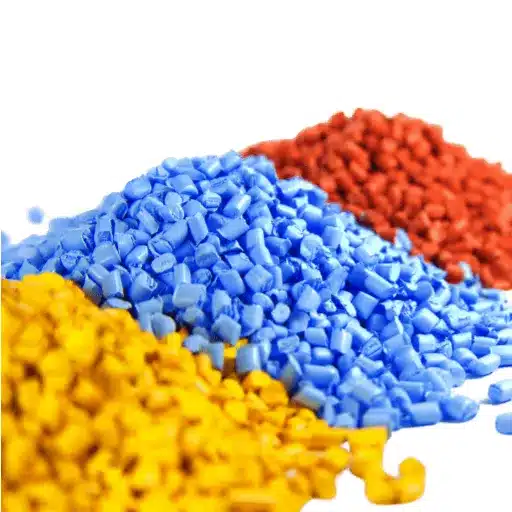


A sourcing engineer at an automotive Tier 1 supplier picked a POM grade for a small gear. She checked the datasheet, saw a melting point of 165°C, and approved it. The part looked fine on the bench.
Eighteen months later, under a hood that idles near 110°C, that gear had crept out of tolerance and failed a $300 warranty claim. The melting point had never been the problem. The heat deflection temperature, which for that grade was under 120°C at load, was the number she needed.
That confusion is the most common mistake in engineering plastic specification. Melting point, glass transition temperature, heat deflection temperature, processing temperature, and continuous service temperature each answer a different question, and most charts only give you one or two of them. This engineering plastic temperature guide compares all five across the major engineering thermoplastics, then shows you how to turn the data into a sourcing decision with certified, traceable documentation.
Here is what you will learn: what each temperature rating actually means, how ABS, PC, POM, PA66, HDPE, PMMA, PP, PBT, PPS, and PTFE compare across every one of them, and what to check on a supplier’s Certificate of Analysis before you commit to a temperature-critical grade.
What Are the Key Temperature Ratings for Engineering Plastics?

Every engineering plastic carries several thermal values, and they are easy to mix up because they sound similar. Each one describes a different physical event and serves a different purpose. If you only remember one thing from this guide, remember this: none of these numbers alone tells you how hot a part can run. You need the right number for the right question.
Glass Transition Temperature (Tg)
The glass transition temperature is the point at which the amorphous regions of a polymer begin to soften. Below Tg, the material is glassy, rigid, and dimensionally stable. Above Tg, the molecular chains gain mobility and the material becomes rubbery, which means lower stiffness, more creep, and dimensional drift.
For amorphous plastics like ABS, polycarbonate, and PMMA, Tg is the most important design limit. It is the temperature at which they begin to lose structural integrity, whether or not they are under load. For semi-crystalline plastics like POM, PA66, and HDPE, Tg matters less in practice because the crystalline regions carry the structure above Tg, but it still affects toughness and impact behavior.
Tg is measured by differential scanning calorimetry (DSC) under standards like ASTM D3418 and ISO 11357.
Melting Point (Tm)
The melting point is the temperature at which the crystalline regions of a semi-crystalline polymer liquefy. Only semi-crystalline plastics have a true melting point. Amorphous plastics have no distinct Tm because their chains never form crystals; they soften gradually through their Tg instead.
For processing, Tm tells you the minimum heat needed to melt the resin. For design, it is rarely the limiting factor, because most plastics lose their mechanical usefulness long before they melt.
Heat Deflection Temperature (HDT)
Heat deflection temperature, also called heat distortion temperature or deflection temperature under load (DTUL), measures how a loaded test bar behaves as temperature rises. A standard test bar is loaded in bending at a fixed stress, typically 0.46 MPa (66 psi) or 1.8 MPa (264 psi), and heated until it deflects 0.25 mm. The temperature at which that deflection occurs is the HDT.
HDT is a short-term comparison tool, not a design limit. It is measured under ASTM D648 or ISO 75, and the two load conditions give very different numbers for the same material. Always compare HDT values measured under the same load.
Processing Temperature and Mold Temperature
The processing temperature range is the window of melt temperatures recommended for injection molding or extrusion. It is always higher than the melting point, because the resin must flow easily to fill a mold. The mold temperature controls cooling rate, surface finish, and, for semi-crystalline plastics, the degree of crystallinity.
The processing window matters because it is bounded on the low end by poor flow and on the high end by thermal degradation. Some plastics have a narrow window; POM, for example, must not exceed about 230°C or it decomposes.
Continuous Service Temperature (CUT / RTI)
Continuous service temperature, also called continuous use temperature (CUT) or relative thermal index (RTI), is the maximum temperature a material can withstand for extended periods, often thousands of hours, without significant loss of mechanical or electrical properties. It is measured under UL 746 and is the number most engineers should design to for long-life applications.
A material can survive short excursions far above its CUT. The question is how long it can live there. HDPE, for example, melts around 130°C but should not be used continuously above about 82°C under load.
Key takeaway: Tg and Tm describe what happens to the polymer. HDT describes short-term load resistance. Processing temperature describes how to make the part. Continuous service temperature describes how long the part will last. Design with the fifth one, and you will avoid most temperature-related failures.
Amorphous vs. Semi-Crystalline Plastics: Why Some Don’t “Melt”
The single biggest source of confusion in plastic temperature data is the difference between amorphous and semi-crystalline polymers. It determines whether a material has a melting point at all, and it changes how you read every thermal chart.
Amorphous plastics have randomly arranged molecular chains that cannot form crystals. As temperature rises, they soften gradually through their glass transition. They have a Tg, they soften over a broad range, and they have no true melting point.
Common amorphous engineering plastics include ABS, polycarbonate (PC), PMMA (acrylic), and polystyrene (PS). Because they soften rather than melt sharply, their HDT sits roughly 10 to 20°C below their Tg.
Semi-crystalline plastics have regions of orderly, packed molecular chains surrounded by amorphous regions. The crystalline regions melt sharply at a distinct temperature (Tm), while the amorphous regions still pass through a Tg. Common semi-crystalline engineering plastics include POM (acetal), PA6 and PA66 (nylon), HDPE, PP, PBT, PET, PPS, and PTFE.
This distinction has practical consequences:
- Transparency. Amorphous plastics are usually transparent; semi-crystalline plastics are usually opaque or translucent because the crystalline regions scatter light.
- Softening behavior. An amorphous part softens progressively as temperature approaches its Tg, so stiffness and creep resistance fall off gradually. A semi-crystalline part stays stiff until it nears its melting point, then fails sharply.
- Processing. Semi-crystalline plastics need enough heat to fully melt the crystals, and their mold temperature controls crystallinity. Amorphous plastics just need enough heat to flow.
When someone asks “what is the melting point of ABS?” the correct answer is that ABS is amorphous and has no true melting point. It softens near 100°C and becomes freely flowable around 190 to 260°C in the barrel. That distinction, once you can see it, makes every temperature chart in this guide easier to read.
Engineering Plastic Melting Point Chart

Melting point applies to semi-crystalline plastics. For amorphous plastics, the table notes their softening behavior instead. Values are typical ranges; exact numbers depend on the specific grade and are verified against the manufacturer’s datasheet.
| Material | Structure | Melting Point (Tm) | Notes |
|---|---|---|---|
| HDPE | Semi-crystalline | 120–140°C | Highly crystalline; melts sharply |
| PP (polypropylene) | Semi-crystalline | 160–170°C | Commonly 165°C |
| POM (acetal, copolymer) | Semi-crystalline | 160–175°C | Typical 165°C |
| POM (acetal, homopolymer) | Semi-crystalline | 170–175°C | Delrin family, slightly higher |
| PA6 (nylon 6) | Semi-crystalline | 220–235°C | Hygroscopic |
| PA66 (nylon 66) | Semi-crystalline | 255–262°C | Higher than PA6 due to hydrogen bonding |
| PBT | Semi-crystalline | 223–230°C | Glass-filled grades process hotter |
| PET | Semi-crystalline | 245–260°C | |
| PPS | Semi-crystalline | 280–285°C | High-temperature engineering resin |
| PTFE | Semi-crystalline | ~327°C | Not melt-processable by standard molding |
| PEEK | Semi-crystalline | ~343°C | Extreme high-temperature option |
| ABS | Amorphous | No true Tm | Softens near ~100°C, flows 190–260°C |
| Polycarbonate (PC) | Amorphous | No true Tm | Softens near ~147°C, flows 280–320°C |
| PMMA (acrylic) | Amorphous | No true Tm | Softens near ~105°C, flows 170–275°C |
Two things stand out. First, melting point says almost nothing about service temperature. HDPE melts at 130°C but creeps badly at 60°C under load. Second, the highest-melting plastics are not always the best choice; PEEK and PPS demand expensive tooling and high energy, while PA66 or PC may clear your requirement at a fraction of the cost.
Engineering Plastic Glass Transition Temperature Chart
Tg is the design limit for amorphous plastics and a secondary consideration for semi-crystalline ones. Below Tg, the polymer is glassy. Above it, the amorphous regions soften and the part loses stiffness and creep resistance.
| Material | Structure | Glass Transition Temperature (Tg) |
|---|---|---|
| HDPE | Semi-crystalline | −70 to −110°C (below room temperature) |
| PP (polypropylene) | Semi-crystalline | −20 to −32°C (below room temperature) |
| POM (acetal) | Semi-crystalline | About −60°C (below room temperature) |
| PA6 (nylon 6, dry) | Semi-crystalline | 40–60°C |
| PA66 (nylon 66, dry) | Semi-crystalline | About 50°C |
| PPS | Semi-crystalline | About 90°C |
| PMMA (acrylic) | Amorphous | About 105°C |
| ABS | Amorphous | About 105°C |
| PTFE | Semi-crystalline | About 130°C |
| PEEK | Semi-crystalline | 143–145°C |
| Polycarbonate (PC) | Amorphous | About 147°C |
For semi-crystalline plastics with Tg below room temperature (HDPE, PP, POM), the amorphous regions are already soft in service, and the crystalline regions carry the structural load. That is why POM gears hold precision tolerances at 80°C even though POM’s Tg is far below zero.
For amorphous plastics (ABS, PC, PMMA), Tg is the ceiling for dimensional stability. Polycarbonate’s Tg of about 147°C is the highest of the common transparent amorphous plastics, which is why it appears in products that must survive warm environments, from headlamp lenses to medical devices.
Engineering Plastic Heat Deflection Temperature Chart

HDT measures short-term load resistance at temperature. The values depend heavily on the test load, so this table lists both standard conditions. Higher-load (1.8 MPa) values are always lower than lower-load (0.46 MPa) values for the same material.
| Material | HDT @ 0.46 MPa (66 psi) | HDT @ 1.8 MPa (264 psi) | Melting Point |
|---|---|---|---|
| HDPE | 85°C | 60°C | 130°C |
| PP (polypropylene) | 100°C | 70°C | 160°C |
| PMMA (acrylic) | 95°C | 85°C | ~130°C |
| ABS | 98°C | 88°C | Amorphous |
| POM (acetal copolymer) | 160°C | 110°C | 200°C |
| POM (acetal homopolymer) | 170°C | 124°C | 175°C |
| Polycarbonate (PC) | 140°C | 130°C | Amorphous |
| Nylon 6 (PA6) | 160°C | 60°C | 220°C |
| Nylon 66 (PA66, unfilled) | ~180°C | ~75–100°C | 260°C |
| PET | 70°C | 65°C | 250°C |
| PBT (glass-filled) | 193–195°C | 217–220°C | 225°C |
| PA66 (33% glass) | 245°C | 250°C | 260°C |
| PPS (glass-filled) | 260°C | 260°C | 285°C |
Note the striking effect of the 1.8 MPa load on nylon. Unfilled PA6 and PA66 look impressive at the low load but drop sharply under the high load. Glass reinforcement changes the story completely, which is why glass-filled grades dominate hot, load-bearing applications.
A good rule of thumb for short-term use: keep the service temperature roughly 10°C below HDT under the same load condition. For long-term use, ignore HDT and look at continuous service temperature instead.
Engineering Plastic Processing Temperature Chart
Once you have selected a material, the processing window determines how easily it molds and how much latitude your molder has. This table gives typical injection molding melt and mold temperature ranges.
| Material | Melt Temperature | Mold Temperature | Drying Required |
|---|---|---|---|
| HDPE | 180–280°C | 20–60°C | No |
| PP (polypropylene) | 190–270°C | 30–80°C | No |
| ABS | 190–270°C | 40–80°C | Yes, 80–85°C |
| PMMA (acrylic) | 170–275°C | 60–90°C | Yes |
| POM (acetal) | 180–230°C | 60–120°C | No |
| PC (polycarbonate) | 280–320°C | 80–120°C | Yes, ~120°C |
| PA6 (nylon 6) | 230–290°C | 40–90°C | Yes |
| PA66 (nylon 66) | 260–300°C | 40–100°C | Yes |
| PBT | 230–270°C | 40–80°C | Yes |
| PPS | 300–350°C | 120–180°C | Yes |
The processing warnings are as important as the ranges:
POM has a narrow processing window. Melt temperatures above about 230°C cause POM to decompose and release formaldehyde gas, which creates bubbles and voids in the part. This is why POM molders keep tight control of barrel temperature, and why our POM material preheating temperature guide emphasizes consistent thermal control.
PC must be dried. With moisture above roughly 0.015%, polycarbonate hydrolyzes in the barrel and produces splay marks and brittle parts. Dry at about 120°C before molding.
Nylons are hygroscopic. PA6 and PA66 absorb atmospheric moisture, which acts as a plasticizer and shifts dimensions and properties. Drying before processing and humidity-controlled storage are non-negotiable for consistent parts.
Continuous Service Temperature: The Number Designers Actually Need

Continuous service temperature (CUT), sometimes published as relative thermal index (RTI) under UL 746, tells you how hot a material can run for thousands of hours without significant property loss. This is the design number for parts that must survive years of service, from automotive underhood components to industrial machinery.
| Material | Continuous Service Temperature |
|---|---|
| PVC | ~60°C |
| ABS | 60–80°C |
| PMMA (acrylic) | 70–77°C |
| HDPE | ~82°C |
| POM (acetal) | 82–115°C |
| PP (polypropylene) | 100–130°C |
| PA66 (nylon 66) | 95–120°C (heat-stabilized to ~150°C) |
| PC (polycarbonate) | 115–130°C |
| PPS | 200–240°C |
| PTFE | ~260°C |
| PEEK | 250–260°C |
The contrast with the melting point table is the most instructive part of this guide. POM melts at 165°C but should not run continuously above about 115°C. HDPE melts at 130°C, yet its continuous limit is about 82°C.
PPS, meanwhile, melts at 285°C and runs at 200 to 240°C continuously. The materials with the highest service temperatures are the ones engineered for it, not merely the ones with the highest melting points.
For a ranking of high-temperature candidates, the thermoplastics selection triangle from Curbell Plastics groups materials by continuous service temperature, and AZoM’s guide to maximum continuous operating temperature gives a broader reference table.
How to Use Temperature Data for Material Selection
You now have five temperature columns. Here is how to collapse them into a decision.
Step 1: Define your continuous service temperature. What is the hottest sustained temperature your part will see? Use CUT for this, not melting point.
Step 2: Check the mechanical load at that temperature. If the part is load-bearing, compare HDT under the same load condition to your actual service temperature.
Step 3: Account for chemical and moisture exposure. PA66 absorbs moisture and shifts dimensions. POM resists fuels and oils but not strong acids. PC is strong but UV-sensitive.
Step 4: Confirm processability. Can your molder hold the required melt and mold temperatures? Does the resin need drying?
Step 5: Verify the grade, not just the family. Glass-filled PA66 and PPS behave completely differently from their unfilled versions. Confirm the exact grade meets your requirement.
The practical tiers for most engineering applications:
Below ~80°C continuous: ABS, POM, HDPE. Cost-effective workhorses. POM wins for precision, low friction, and fuel/oil resistance. HDPE wins for chemical resistance and cost. ABS wins for impact and appearance.
80 to 150°C continuous: PA66 and PC. PA66 (especially heat-stabilized) handles heat and mechanical load; PC adds transparency, impact, and dimensional stability. These two cover a huge share of demanding applications. See the PA66 resin page and polycarbonate resin page for grade options.
Above 150°C continuous: PPS and PTFE. PPS carries structural loads at high temperature with excellent chemical resistance. PTFE tops out near 260°C and wins where chemical inertness and low friction matter more than stiffness.
For applications above 260°C, you move into PEEK, PAI, and polyimide territory. These are premium materials with premium tooling and energy costs, and they are only justified when PPS and PTFE cannot clear the requirement.
Temperature Performance of Branded Grades: What the Datasheet Should Show
Thermal data is grade-specific, not family-specific. Within the same material family, a standard grade and a heat-stabilized grade can differ by 30°C or more in continuous service temperature. That is why the brand and grade number matter.
For polycarbonate, Covestro’s Makrolon® grades are the reference. Standard grades carry a Tg near 147°C; flame-retardant grades like Makrolon 6555 and 6557 are specified in electronics enclosures and connectors precisely because they hold dimensional stability and UL ratings at elevated temperatures.
For POM, the major branded copolymers are BASF Ultraform®, Celanese Hostaform®, and Polyplastics DURACON®. They share the same core chemistry and a processing ceiling near 230°C, but their heat stabilizer packages differ, and those differences show up only in long-term heat aging, not in short-term property tables. A POM supplier with manufacturer COA documentation can tell you which grade carries the stabilization your application needs.
For PA66, heat-stabilized grades from BASF Ultramid® and other manufacturers extend continuous service temperature well beyond the standard grade. If your application runs hot, specifying the heat-stabilized variant is often cheaper than moving to a higher-performance resin.
When you request a datasheet, check three things:
- Are the thermal values stated with a test standard? A melting point without a method (ASTM D3418 vs. ISO 11357) is hard to verify.
- Does the HDT value state the load? 0.46 MPa and 1.8 MPa give very different numbers.
- Is there a continuous service temperature or RTI value? Many datasheets omit it, but it is the number you design to.
Sourcing Consistent Thermal Performance from China
Temperature-critical parts fail when the resin does not match the specification, not when it is “the wrong plastic.” If you are sourcing engineering resins from China, thermal consistency from batch to batch is the single most important quality concern, and it comes down to three things: branded prime resin, manufacturer documentation, and lot traceability.
What to check on the Certificate of Analysis (COA). The COA should come from the manufacturer, not the supplier, and should reference a specific production lot. Confirm the melt flow index (MFI) matches the manufacturer’s published datasheet for that grade, because MFI correlates with processing behavior and thermal stability.
Cross-reference the lot number against the manufacturer’s format. An invented grade name, or a COA that cannot be traced to the manufacturer’s records, is a red flag.
Branded prime vs. off-spec resin. Off-spec and recycled resin is the main source of thermal surprises in imported material. It can look identical to prime resin in a pellet bag but carry a different Tg, a broader melting transition, or degraded heat stabilizers. The price gap between a genuine branded grade and an unbranded alternative is exactly the difference between predictable and unpredictable thermal performance.
Batch traceability. For automotive, medical, and food-contact applications, your customer may audit your material traceability records. Keep the COA for every lot, and verify on reorders that the MFI and thermal values remain consistent with your process baseline.
Yifuhui, a Suzhou-based engineering plastics supplier, supplies branded prime resin across 12+ material families, including BASF Ultraform® POM, Celanese Hostaform® POM, Polyplastics DURACON® POM, Covestro Makrolon® PC, and PA66, HDPE, and PTFE grades. Every shipment includes a manufacturer-issued COA traceable to production lot, with FOB Shanghai as the standard export term and a 25 kg minimum order for trial validation.
[Request a quote for your temperature-critical grade → Contact Yifuhui]
Frequently Asked Questions

What is the difference between glass transition temperature and melting point?
Glass transition temperature (Tg) is where the amorphous regions of a polymer soften. Melting point (Tm) is where the crystalline regions of a semi-crystalline polymer liquefy. Amorphous plastics like ABS and PC have a Tg but no true melting point. Semi-crystalline plastics like POM and PA66 have both.
Which engineering plastic has the highest melting point?
Among common engineering plastics, PEEK melts at about 343°C and PTFE at about 327°C. PPS melts at about 285°C. However, melting point is not the same as service temperature. For continuous high-temperature service, PTFE and PEEK are the top options, both rated around 250 to 260°C.
What temperature can engineering plastics withstand continuously?
It depends on the material. ABS is limited to about 60 to 80°C, POM to about 82 to 115°C, PA66 to about 95 to 120°C (higher when heat-stabilized), PC to about 115 to 130°C, and PPS to 200 to 240°C. Continuous service temperature (CUT) is the design number for long-life parts.
Is polycarbonate or ABS better for heat resistance?
Polycarbonate. PC has a Tg of about 147°C and a continuous service temperature of 115 to 130°C, while ABS softens near 105°C and is limited to about 60 to 80°C continuous. PC also carries higher HDT and better impact strength, which is why it is preferred for warm environments.
Does POM decompose at high processing temperatures?
Yes. POM must not be processed above roughly 230°C melt temperature. Above that, it decomposes and releases formaldehyde gas, creating bubbles and voids in the part. The processing window for POM is narrower than for most other engineering plastics.
How does glass-fiber reinforcement change HDT?
Dramatically, especially in crystalline resins. Unfilled PA6 has an HDT of about 60°C at 1.8 MPa; with 30% glass fiber it rises to about 200°C. PPS with glass reinforcement holds HDT above 260°C. The effect on amorphous resins like PC is more moderate.
Conclusion
The engineering plastic temperature guide boils down to one idea: use the right number for the right question. Melting point tells you how the resin is processed. Glass transition tells you where an amorphous plastic softens. HDT tells you short-term load resistance. Continuous service temperature tells you how long the part will last, and it is the number you should design to.
Start by defining your continuous service temperature. Then compare HDT under load, check chemical and moisture exposure, confirm the processing window fits your molder, and verify the exact branded grade against the manufacturer’s datasheet.
When you source from a supplier who provides manufacturer-issued COAs with lot traceability, the thermal data on the datasheet becomes a contract instead of a hope. That is the difference between a gear that fails a $300 warranty claim and a supply chain that holds tolerance for a decade.


