




Nylon 66 melts at roughly 260 °C, about 40 °C higher than nylon 6, and that single gap is why PA66 has become the default polyamide for underhood components, electrical connectors, and load-bearing parts. On paper it looks simple. In practice, the PA66 melting point is one of the most misread numbers in engineering plastics, because it isn’t the temperature your part can actually survive.
Here is the honest picture: PA66 melts around 260 °C, but an unfilled part deflects under load at only 70 to 100 °C, continuous service is rated near 80 to 120 °C, and absorbed moisture quietly shifts its glass transition and mechanical properties. Engineers and buyers who confuse the melting point with the service ceiling end up with crept, warped, or prematurely brittle parts. This guide lays out every temperature that matters for PA66, by grade, and explains how to verify thermal consistency when you source the resin.
We supply branded prime PA66 in Suzhou, China, with a Certificate of Analysis on every batch. If you need a specific grade for an underhood or connector application, request a PA66 resin quote and our technical team responds within 24 hours.
What Is the Melting Point of Nylon 66?

PA66 (nylon 66, polyamide 66) is a semi-crystalline thermoplastic with a sharp melting point of approximately 260 °C, typically listed between 255 and 265 °C on datasheets, with a literature value of 264 °C. It melts about 40 °C higher than nylon 6 (~220 °C), which is why PA66 is preferred where heat resistance and retained stiffness matter most.
That is the direct answer behind searches for “pa66 melting point,” “nylon 66 melting point,” and “polyamide 66 melting point.” The number is real and sharp because PA66 is semi-crystalline: its ordered crystal regions break down at one distinct temperature rather than softening gradually like an amorphous plastic. For the polymer-classification background, Wikipedia’s entry on nylon 66 is a reliable technical starting point.
Why PA66 Melts Higher Than PA6
The 40 °C gap between PA66 and PA6 comes from monomer chemistry. PA66 is made by polycondensing two six-carbon monomers, hexamethylenediamine and adipic acid. That gives a highly regular, symmetrical backbone in which every amide group lines up with a partner on the neighboring chain, producing dense inter-chain hydrogen bonding and a high level of crystallinity.
PA6, by contrast, is made by ring-opening polymerization of a single caprolactam monomer. Its chain is the same empirical formula but laid out less symmetrically, so fewer amide groups hydrogen-bond into tight crystals. Less crystallinity means less energy is required to disrupt the structure, and PA6 melts at roughly 220 °C instead.
More crystallinity is also why PA66 shows a sharper melting endotherm when measured by differential scanning calorimetry (DSC) per ISO 11357 or ASTM D3418. When you compare two datasheets, check that both melting points come from the same test method before you read anything into the difference.
Nylon 66 vs. Nylon 6: The One-Paragraph Thermal Difference
Same chemistry family, different monomer layout, meaningfully different thermal profile. PA66 melts about 40 °C higher, retains strength and stiffness further into the temperature range, and absorbs slightly less moisture than PA6. The practical consequence: PA66 is the higher-heat, higher-cost choice for underhood, connector, and structural parts, while PA6 remains a capable lower-cost option for interior and general mechanical components. The two families are not interchangeable in a hot application, so a full side-by-side belongs in a dedicated comparison once we publish it.
The Temperatures That Actually Matter for Nylon 66
Five temperatures define how PA66 behaves in production and in service. Each answers a different engineering question:
- Melting point (Tm): ~255 to 265 °C, the processing anchor.
- Glass transition temperature (Tg): ~50 to 65 °C dry, which moisture depresses.
- Heat deflection temperature (HDT): ~70 to 100 °C unfilled, ~235 to 250 °C glass-reinforced, the load-bearing limit.
- Continuous service temperature: ~80 to 120 °C, the long-term design ceiling.
- Thermal degradation onset: ~300 to 350 °C, the processing hard stop.
Melting Point (Tm): ~255 to 265 °C
PA66 transitions from solid to melt at about 260 °C, measured by DSC per ISO 11357 or ASTM D3418. It is the number you set your processing window from, not the number you design a part to. Datasheets will list slightly different values depending on the grade, the additive package, and the test method, so treat 255 to 265 °C as the practical range and verify against the manufacturer datasheet.
Glass Transition Temperature (Tg): ~50 to 65 °C Dry, and Why Moisture Moves It
This is the pa66 glass transition temperature section, and it is where most engineers get surprised. In a dry-as-molded part, PA66’s glass transition sits around 50 to 65 °C, which is already near the temperatures an underhood part may see. But PA66 is hygroscopic. Absorbed water hydrogen-bonds to the amide groups and acts as a plasticizer, loosening the polymer network and depressing Tg sharply toward near-ambient in conditioned parts.
The consequence is practical: a dry and a conditioned PA66 part behave differently. Datasheets that report strength, modulus, or Tg must state the conditioning state, dry-as-molded (DAM) versus conditioned at 50 percent relative humidity, or the numbers are not comparable. Moisture does not meaningfully change the melting point, but it changes how the polymer behaves between room temperature and the melting point.
Heat Deflection Temperature (HDT)
Heat deflection temperature is the temperature at which a test bar deflects a set amount under a fixed bending load, measured per ASTM D648 or ISO 75. This is the number engineers actually design to, and it depends heavily on reinforcement.
Unreinforced PA66 runs roughly 190 to 200 °C at 0.45 MPa, but only about 70 to 100 °C at 1.82 MPa. That is a fraction of its melting point.
Glass-reinforced PA66 GF30 or GF33 changes the story, jumping to about 235 to 250 °C at 1.82 MPa. That is why glass-filled PA66 dominates underhood and connector specifications. When a buyer searches “pa66 heat deflection temperature” or “pa66 gf30 heat deflection temperature,” the answer they almost always need is the reinforced value. The MatWeb datasheet for a Schulamid 66 GF33H grade documents a representative glass-filled profile.
Continuous Service Temperature
Real parts sit at temperature for years, not minutes. Standard unreinforced PA66 is rated for continuous service around 80 to 120 °C, with heat-stabilized grades extending life significantly at sustained temperatures, and glass reinforcement extending short-term capability. The key message bears repeating: the melting point near 260 °C is for processing, while HDT and continuous-use ratings are the design numbers.
A component at 110 °C underhood on standard PA66 is valid. A bearing running at 180 °C continuously is not, unless it is a heat-stabilized, reinforced grade specified for that duty. To see how HDT, melting point, and glass transition relate across materials, our engineering plastic temperature guide walks through all three side by side.
Thermal Degradation
PA66 begins to decompose around 300 to 350 °C in air, driven by thermo-oxidative chain scission. Keep the process melt below about 300 to 310 °C and the residence time short, roughly five minutes maximum at 280 °C and less at higher melt temperatures. Push past that and the polymer degrades, producing brown streaks, brittleness, and black specks that scrap the part and foul the mold.
Marcus, a process engineer at a connector molder in Mexico, found the degradation ceiling the expensive way. He left PA66 sitting in the barrel through a 20-minute line stoppage at 305 °C to avoid reheating the screw. The next two dozen parts came out brittle at the gate, and the black specks that appeared in the flow marks took a full purge cycle to clear.
Dropping the barrel setpoint to 285 °C and setting an automatic purge after any stoppage past four minutes fixed it. For PA66, residence time is a process variable, not an afterthought.
PA66 Thermal Properties at a Glance
| Property | Value (Unfilled) | Value (PA66 GF30) |
|---|---|---|
| Melting point (Tm), ISO 11357 / ASTM D3418 | ~255 to 265 °C | ~255 to 260 °C |
| Glass transition (Tg), dry-as-molded | ~50 to 65 °C | ~50 to 65 °C |
| HDT at 0.45 MPa (ISO 75 / ASTM D648) | ~190 to 200 °C | ~250 to 260 °C |
| HDT at 1.82 MPa | ~70 to 100 °C | ~235 to 250 °C |
| Continuous service temperature | ~80 to 120 °C | ~100 to 130 °C (HS grades higher) |
| Degradation onset (in air) | ~300 to 350 °C | ~300 to 350 °C |
| Density | ~1.14 g/cm³ | ~1.40 to 1.50 g/cm³ |
All values are grade-dependent, so verify against the manufacturer datasheet before you set a process or specify a part. The Röchling Sustamid 66 datasheet is a useful independent reference for an unreinforced PA66 baseline, and MakeItFrom’s polyamide 6/6 overview adds a comparative summary of the family.
PA66 Processing Temperature by Method

Most PA66 parts are injection molded, and the pa66 processing temperature window is narrower than the melting point range suggests.
Injection Molding
Set the melt roughly 20 to 30 °C above the melting point. That means a melt temperature of 270 to 300 °C for most grades, and never above about 300 to 310 °C where degradation accelerates.
| Parameter | Typical Setting |
|---|---|
| Melt temperature | 270 to 300 °C (grade-dependent; keep below ~300 to 310 °C) |
| Barrel rear | 250 to 285 °C |
| Barrel center | 270 to 300 °C |
| Barrel front | 265 to 300 °C |
| Nozzle | 260 to 310 °C |
| Mold temperature | 60 to 100 °C (up to ~120 to 140 °C for reinforced or surface-critical parts) |
Measure the actual melt with a pyrometer rather than trusting the barrel readout. PA66 freezes quickly, so use fast fill rates and low back pressure, and keep residence time short as described above. A warmer mold, 80 to 100 °C or higher, promotes crystallization, improves surface finish, and locks in dimensions, at the cost of a longer cycle.
Drying Before Molding: Not Optional
PA66 is hygroscopic, and this step is mandatory. Absorbed moisture hydrolyzes the polymer at melt temperatures, which drops molecular weight and produces splay, brittle parts, and inconsistent fill. Dry PA66 to a moisture content below 0.1 to 0.2 percent before molding, with flame-retardant grades stricter at below 0.1 percent.
The correct method is 80 to 90 °C for 4 to 6 hours in a dehumidifying or desiccant hopper dryer with a dew point of -20 °C or lower. Hot-air dryers are not recommended for hygroscopic nylon, because they cannot dry deeply enough.
Over-drying below about 0.02 percent can reduce flow, and molding above about 0.2 percent moisture causes splay and hydrolysis-driven degradation. If you’re unsure whether a bag of pellets has been exposed to humidity, dry them. The hour cost is trivial next to a scrapped production run.
Priya, a production manager at an electronics contract manufacturer, learned this on a connector program. Her team opened a pallet of PA66 that had sat by a loading dock in monsoon-season humidity and ran it straight to the hopper to hold the schedule. Within two hours every connector showed silver splay, and impact tests on the first molded parts came back brittle enough to fail on the bench.
She moved drying to the front of the process, 85 °C for five hours in the desiccant dryer to below 0.1 percent moisture, and added an incoming-moisture check on every new lot. Splay disappeared, and the brittle failures stopped. For PA66, drying is a process step, not a recommendation.
Mold Temperature, Shrinkage, and Dimensional Stability
Mold temperature is the lever on crystallinity. A hotter mold produces more complete crystallization, which improves long-term dimensional stability while increasing post-mold shrinkage. Unfilled PA66 shrinks roughly 1.0 to 1.5 percent linearly, with glass reinforcement cutting that figure substantially. Glass also raises rigidity and cuts warpage, which is why tight-tolerance electrical housings are almost always glass-filled.
Account for moisture growth in service. PA66 absorbs about 1.0 to 1.5 percent in 24 hours of immersion and reaches roughly 2.5 to 3.0 percent at 50 percent relative humidity equilibrium, lower than PA6 but still enough to move dimensions in a tight assembly. Design the clearances accordingly, or specify a conditioned, moisture-stabilized grade. Annealing around 150 to 180 °C can relieve molded-in stress, and conditioning brings parts to equilibrium properties before they ship.
PA66 Melting Point by Grade
Thermal performance is not a single number for PA66. It shifts with the reinforcement level and the additive package, so grade selection decides whether your part survives its environment.
Unreinforced / General-Purpose Grades
Unreinforced PA66 grades, such as BASF Ultramid A3K in the general-purpose injection-molding family, melt at about 260 °C and deliver a balance of strength, toughness, and wear resistance. They suit clips, gears, housings, and general mechanical parts in moderate heat. When a buyer specifies a base PA66 for a connector or a housing, this is the class they mean.
Glass-Fiber-Reinforced Grades (PA66 GF30 / GF33): The High-Heat Workhorses
Glass-filled grades keep the same melting point near 255 to 260 °C but transform the heat and stiffness story. PA66 GF30, such as the Ultramid A3EG6 class, lifts HDT at 1.82 MPa to about 235 to 250 °C, roughly triples stiffness, and sharply improves creep resistance. This is the grade family behind automotive brackets, radiator end tanks, engine covers, and connector housings, and it is where most commercial PA66 volume actually goes.
Flame-retardant variants rated UL94 V-0 pair the glass reinforcement with a halogen-based additive package for electrical connectors and fuse housings. RoHS and REACH documentation is required for EU electronics production, and a qualified supplier provides it with the shipment.
Heat-Stabilized and Specialty Grades
Sustained underhood heat defeats standard PA66 over time. Heat-stabilized (HS/HR) grades add copper-iodide or amine stabilizers that slow thermo-oxidative aging, letting the part retain far more of its tensile strength after thousands of hours at 150 to 210 °C. Where the application is a sliding or wearing part, lubricated grades with PTFE or MoS2 extend life in gears and bearings, and UV-stabilized versions serve exterior components.
| Grade Class | Melting Point | Key Thermal Characteristic | Best Fit |
|---|---|---|---|
| Unreinforced (Ultramid A3K class) | ~260 °C | Balanced strength, stiffness, toughness | Clips, gears, housings, general mechanical parts |
| PA66 GF30/GF33 (Ultramid A3EG6 class) | ~255 to 260 °C | HDT to ~235 to 250 °C at 1.82 MPa | Underhood brackets, radiator end tanks, connectors |
| Flame-retardant (UL94 V-0) | ~255 to 260 °C | FR rating plus glass reinforcement | Electrical connectors, fuse housings |
| Heat-stabilized (HS/HR) | ~260 °C | Retains strength far longer at 150 to 210 °C | Sustained underhood heat, cooling systems |
| Lubricated (PTFE/MoS2) | ~260 °C | Lower friction, wear resistance | Gears, bearings, sliders |
| UV-stabilized | ~260 °C | Retains properties under outdoor exposure | Exterior components |
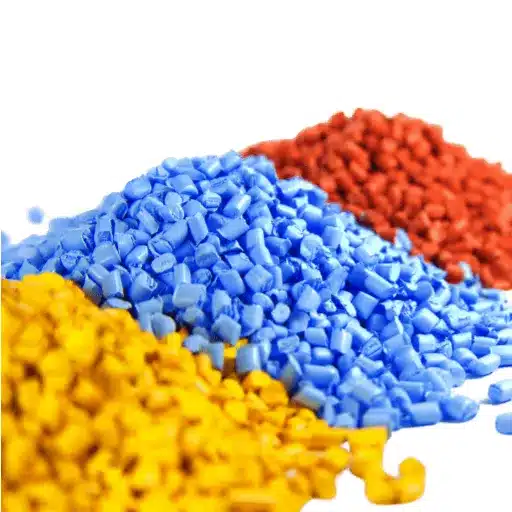
Grade examples above are illustrative of the classes we supply; we stock branded prime PA66, standard, glass-filled, and flame-retardant, from leading Japanese and European manufacturers, and can source BASF Ultramid PA66 through our authorized distribution channel with manufacturer COA documentation.
PA66 vs. Other Engineering Plastics: Where Does It Sit?

PA66 wins on heat resistance within the polyamide family and on strength and fatigue resistance over POM. It loses on moisture sensitivity and on sustained very-high heat, where PPA or PPS is the honest upgrade. The table puts it in context.
| Material | Tm (°C) | Tg (°C) | HDT 1.82 MPa (°C) | Processing Melt (°C) | Continuous Service (°C) |
|---|---|---|---|---|---|
| PA66 (unfilled) | ~255 to 265 | ~50 to 65 (dry) | ~70 to 100 | 270 to 300 | 80 to 120 |
| PA66 GF30 | ~255 to 265 | ~50 to 65 (dry) | ~235 to 250 | 270 to 300 | 100 to 180 (HS grades) |
| PA6 | ~215 to 225 | ~40 to 60 (dry) | ~55 to 80 | 240 to 260 | 70 to 110 |
| POM (copolymer) | ~165 | ~-60 | ~100 to 110 | 185 to 210 | 80 to 120 |
| PC | amorphous | ~147 | ~130 | 280 to 320 | 115 to 130 |
| ABS | amorphous | ~105 | ~85 to 100 | 200 to 250 | 60 to 80 |
The key comparison for a PA66 buyer is POM. PA66 melts about 80 to 100 °C higher and carries better short-term hot strength, which is why it replaces POM in hot underhood and connector duty. But POM wins on low friction, dimensional stability in humid service, and fuel and oil resistance, so it remains the right answer for precision gears and bearings, as covered on our POM melting point guide and POM resin supplier page.
For transparent or impact-resistant parts at higher service temperature, move to PC, detailed on our Covestro Makrolon PC resin page and polycarbonate glass transition temperature article. For the amorphous end of the spectrum, our ABS melting temperature guide covers ABS’s softening behavior.
The engineering plastic temperature guide compares all of these materials in one chart. Working rule: if your part runs hot and needs retained stiffness, PA66, especially glass-filled, is the in-family answer. If it runs above PA66’s sustained ceiling, escalate to PPA or PPS rather than overselling PA66.
Deciding between PA66, POM, or PC for a hot part? Send us the operating temperature, the load, and the chemical environment, and we’ll recommend a branded grade with the datasheet to back it up. Contact our technical team with your application details.
Why PA66 Thermal Consistency and Moisture Matter for Buyers
Thermal data is only useful if it is true for the batch you actually use. This is where procurement gets interesting, and where the difference between branded prime resin and an unknown compound shows up.
Batch-to-Batch Variation Is a Red Flag
Branded PA66 manufacturers publish consistent Tm, HDT, and MFI baselines for each grade. When a supplier’s values drift between shipments, it usually means off-spec compounding, regrind contamination, or material that is not the branded grade it claims to be. PA66’s narrow processing window means a shifted baseline breaks the molding process on the line, and moisture variation alone can cause splay and brittleness.
Carlos, a sourcing engineer at a European distributor, caught this on an incoming check of PA66 tagged as a BASF Ultramid grade. The spec called for an MFI near the published baseline, and the first two lots landed inside tolerance. The third measured nearly double. The supplier called it normal variation.
Carlos ordered a DSC scan, and the melting point came in several degrees below the grade baseline, with a broadening melt peak that pointed to regrind blended into the lot. The thermal check saved his customers from erratic fill and a wave of field failures.
What to Check on the Certificate of Analysis
When you source PA66, the COA is your thermal verification tool. Confirm four fields:
- Grade designation and manufacturer, so you know exactly which branded grade you are buying.
- Melt flow index, reported at 275 °C/5 kg for most PA66 grades, as a flow consistency check.
- Thermal baseline, including the melting point where the manufacturer reports it, plus HDT or Vicat if available, and note the conditioning state of any Tg or mechanical values.
- Lot and batch number, for traceability back to a single production run, plus RoHS and REACH statements where your market requires them.
A COA is only as valuable as the brand behind it. That’s why we supply branded prime PA66 rather than commodity compound, and why every batch from our Suzhou warehouse ships with a manufacturer-issued Certificate of Analysis, the MSDS, the commercial invoice, and the packing list.
Sourcing PA66 from China
If you are sourcing PA66 from China, buy branded prime resin from a supplier that can prove it. Our location in Suzhou, minutes from the Port of Shanghai, keeps export lead times at 7 to 14 days depending on destination, with FOB Shanghai as the standard term and a 25 kg minimum order. That makes trial orders practical: order 25 kg from the same lot your production material will come from, with the same COA, and qualify it before committing to volume. Our PA66 resin supplier page lists the branded grades and documentation we provide for automotive, electrical, and structural applications.
Frequently Asked Questions

What is the melting point of nylon 66 in Celsius?
PA66 melts at about 260 °C, typically listed between 255 and 265 °C on datasheets. Because it is semi-crystalline, it is a true, sharp melting point rather than a softening range.
What is the melting point of nylon 66 in Fahrenheit?
Roughly 500 °F. The 255 to 265 °C datasheet range corresponds to about 490 to 510 °F.
Why is the nylon 66 melting point higher than nylon 6?
PA66 is made from two symmetrical six-carbon monomers, hexamethylenediamine and adipic acid, which pack into dense hydrogen-bonded crystals. PA6 is made from ring-opened caprolactam with a less regular structure, so it crystallizes less and melts about 40 °C lower.
Is nylon 66 heat resistant?
Yes, within limits. PA66 melts at about 260 °C, but its continuous service rating is only 80 to 120 °C unfilled. Glass-reinforced PA66 GF30 lifts HDT to about 235 to 250 °C, and heat-stabilized grades extend service life at sustained temperature. It is heat resistant relative to POM and PA6, not relative to PPA or PPS.
What is the difference between nylon 66 and nylon 6?
Both are polyamides with the same empirical formula, but PA66 melts about 40 °C higher, retains stiffness further into the temperature range, and absorbs slightly less moisture. PA66 costs more and is the higher-heat choice; PA6 is the lower-cost alternative for interior and general parts.
Does nylon 66 absorb water?
Yes. PA66 is hygroscopic, absorbing about 2.5 to 3.0 percent at 50 percent relative humidity equilibrium. Absorbed water plasticizes the polymer, depresses its glass transition, and shifts mechanical properties, which is why PA66 must be dried to below 0.1 to 0.2 percent moisture before molding.
What is the glass transition temperature of nylon 66?
About 50 to 65 °C in a dry-as-molded part. Absorbed moisture depresses Tg toward near-ambient in conditioned parts, so always note the conditioning state when comparing Tg values.
What temperature should nylon 66 be processed at?
Injection molding melt temperature is 270 to 300 °C, with the mold held at 60 to 100 °C (higher for reinforced grades). Never exceed about 300 to 310 °C melt, where degradation accelerates.
Does nylon 66 need to be dried before molding?
Yes, always. Dry to below 0.1 to 0.2 percent moisture at 80 to 90 °C for 4 to 6 hours in a dehumidifying dryer. Molding wet PA66 causes splay, brittleness, and hydrolysis-driven degradation.
Is PA66 better than POM for high-heat parts?
For sustained heat, yes. PA66 melts about 80 to 100 °C higher than POM and carries better short-term hot strength. POM wins on low friction, dimensional stability in humid service, and fuel and oil resistance, so the right choice depends on the application.
Conclusion
The PA66 melting point is a true, sharp number near 260 °C, roughly 40 °C above nylon 6, and it is the anchor for processing, not for service. Process PA66 at 270 to 300 °C, dry it to below 0.2 percent moisture first, and hold the mold at 60 to 100 °C. Design to the numbers that reflect your real duty: HDT of roughly 70 to 100 °C unfilled or 235 to 250 °C for PA66 GF30, continuous service near 80 to 120 °C, and heat-stabilized or glass-filled grades where the part runs hot for years. Account for moisture in your dimensions and your datasheets, and never let the melting point convince you a part can survive temperatures its HDT and service rating cannot support.
When you source PA66, buy branded prime resin from a supplier that stands behind batch consistency. We supply branded prime PA66, standard, glass-filled, and flame-retardant, from leading Japanese and European manufacturers with manufacturer COA documentation, a 25 kg minimum order, and FOB Shanghai pricing. Tell us your application, your operating temperature, and your processing method, and we’ll recommend the right branded grade, even when the honest answer is PPA or PPS instead.
Request a PA66 resin quote and get a recommendation backed by real datasheets, not guesswork.