




ABS softens, PC softens, but POM actually melts, and that makes it more precise and more demanding to process than either of them. Polyoxymethylene (POM, or acetal) is one of the few engineering thermoplastics with a true, sharp melting point, and the narrow window between melt and decomposition is exactly where part quality is won or lost.
The honest answer up front: POM homopolymer melts at about 175 °C (range 172 to 184 °C), and POM copolymer melts at about 165 °C (range 160 to 175 °C). Those POM melting point numbers are real and sharp because POM is semi-crystalline. But the melting point is not the service ceiling.
POM is rated for continuous service around only 80 to 120 °C, and its processing window sits between roughly 185 and 230 °C before degradation sets in and formaldehyde is released. This guide covers every temperature that matters for POM, by family and by grade, and how to verify thermal consistency when you source the resin.
We supply branded prime POM in Suzhou, China, with a Certificate of Analysis on every batch. If you need a specific grade, request a POM resin quote and our technical team responds within 24 hours.
What Is the POM Melting Point?

POM (polyoxymethylene, or acetal) is a semi-crystalline thermoplastic with a true, sharp melting point. POM homopolymer melts at about 175 °C (range 172 to 184 °C). POM copolymer melts at about 165 °C (range 160 to 175 °C). Because POM is highly crystalline, it melts at a distinct temperature rather than gradually softening like amorphous plastics such as ABS or PC.
That is the answer behind searches for “acetal melting point” and “polyoxymethylene melting point,” but the difference between the two families matters as much as the numbers themselves. For the polymer-classification background, Wikipedia’s entry on polyoxymethylene is a solid technical starting point.
Why POM Has a True Melting Point (Unlike ABS or PC)
A polymer either melts or softens depending on how its chains pack. POM chains pack into ordered crystal regions, giving a crystallinity of roughly 70 to 85 percent. When heated, those crystals break down at one distinct temperature, releasing a sharp melting endotherm visible on a differential scanning calorimetry (DSC) scan run per ISO 11357 or ASTM D3418.
Amorphous plastics cannot do this. ABS and PC have disordered chains, so they soften gradually through their glass transition and never produce a melting peak. For that side of the spectrum, see our ABS melting temperature guide and polycarbonate glass transition temperature article. POM sits on the opposite end: a genuine crystalline melting point you can measure precisely, not a processing convention.
Homopolymer vs. Copolymer: Why the Melting Point Differs
The 10 to 15 °C gap between the two POM families comes from chemistry. Homopolymer (POM-H) is made from pure formaldehyde chains that pack into highly regular crystals. That regularity gives it a higher melting point, around 175 °C, along with higher tensile strength, stiffness, and surface hardness. The trade-off is lower thermal stability, because a pure homopolymer chain can “unzip” more easily at high temperature.
Copolymer (POM-C) introduces small ethylene-oxide comonomer blocks into the chain. Those blocks break up the crystal regularity, lowering the melting point to about 165 °C, but they also stabilize the molecule. Copolymer resists hot water and alkaline environments better, keeps a wider processing window, and holds its properties longer at elevated temperature. That’s why every major injection-molding POM brand, Ultraform, Hostaform, DURACON, KOCETAL, and FORMOCON, is a copolymer.
For the detail-oriented reader: the equilibrium melting point of pure POM homopolymer is about 190 °C in the literature, but datasheet values run lower because they are measured at a practical heating rate on commercial grades. Use the ISO 11357 value when comparing datasheets.
The Temperatures That Matter for POM
Five temperatures, anchored by the POM melting point, define how POM behaves in production and in service. Each one answers a different engineering question:
- Melting point (Tm): ~165 to 175 °C, the true melt temperature by family.
- Glass transition temperature (Tg): ~-60 °C, the cold-service floor.
- Heat deflection temperature (HDT): ~99 to 160 °C, the load-bearing limit.
- Continuous service temperature: ~80 to 120 °C, the long-term ceiling.
- Thermal degradation onset: ~220 to 230 °C, the processing hard stop.
Melting Point (Tm): ~165 to 175 °C
The melting point is the temperature at which POM transitions from solid to melt. Homopolymer runs about 175 °C, copolymer about 165 °C, measured by DSC per ISO 11357 or ASTM D3418. It is the anchor for setting your processing window, not a service limit.
Glass Transition Temperature (Tg): ~-60 °C
POM’s glass transition sits around -60 °C, far below room temperature. That’s why POM stays tough in cold service and why Tg is not the design constraint it is for ABS or PC; the practical cold-service floor is about -40 °C.
Heat Deflection Temperature (HDT)
HDT is the temperature at which a test bar deflects a set amount under a fixed bending load, measured per ASTM D648 or ISO 75 at two stresses. Unreinforced POM runs about 158 to 160 °C at 0.45 MPa and roughly 99 to 110 °C at 1.82 MPa. Glass-fiber-reinforced grades push HDT to about 160 to 168 °C for structural parts. To see how HDT, melting point, and Tg relate across materials, our engineering plastic temperature guide walks through all three.
Vicat Softening Point
The Vicat value, typically 150 to 165 °C per ISO 306 or ASTM D1525, is the other softening number on a POM datasheet. Check it alongside Tm when comparing grades.
Continuous Service Temperature
Real parts sit at temperature for years, not minutes. Unreinforced POM has a continuous service rating of roughly 80 to 120 °C, with short-term excursions to about 140 °C for glass-filled grades. This is the number that tells you whether a POM part survives its environment, and it is far below the melting point. A fuel system component at 110 °C underhood is valid; a bearing running at 150 °C continuously is not.
Thermal Degradation
POM begins to decompose around 220 to 230 °C, with copolymer holding on longer than homopolymer. The decomposition releases formaldehyde gas, which produces silver streaks (splay), corrodes tooling, and embrittles the part. Residence time matters as much as temperature: the risk grows after about 60 minutes in the barrel at 200 °C, and after 30 minutes at 210 °C. Never exceed about 230 °C melt, and purge the barrel if production is interrupted.
Daniel, a tooling engineer at a molding shop in Ohio, learned this the hard way. He pushed a POM run to 235 °C to chase a faster cycle, and within an hour every part carried silver streaks. A formaldehyde smell filled the work area, and the tool steel pitted after a single shift.
Pulling the barrel back to 210 °C and cutting residence time cleared the splay. For POM, the degradation ceiling is not a suggestion.
POM Thermal Properties at a Glance
| Property | Homopolymer (POM-H) | Copolymer (POM-C) |
|---|---|---|
| Melting point (Tm), ISO 11357 / ASTM D3418 | ~175 °C (172 to 184 °C) | ~165 °C (160 to 175 °C) |
| Glass transition (Tg) | ~-60 °C | ~-60 °C |
| HDT at 0.45 MPa (ISO 75 / ASTM D648) | ~158 to 160 °C | ~158 to 160 °C |
| HDT at 1.82 MPa | ~99 to 110 °C | ~100 to 110 °C |
| Vicat softening (ISO 306) | ~150 to 165 °C | ~150 to 165 °C |
| Continuous service temperature | ~80 to 115 °C | ~80 to 120 °C |
| Degradation onset | ~220 °C | ~230 °C |
| Crystallinity | 75 to 85% | 70 to 75% |
All values are grade-dependent, so verify against the manufacturer datasheet before you set a process or specify a part. The NETZSCH thermal characterization of POM copolymer is a good independent reference for the DSC behavior behind these numbers.
POM Processing Temperature by Method
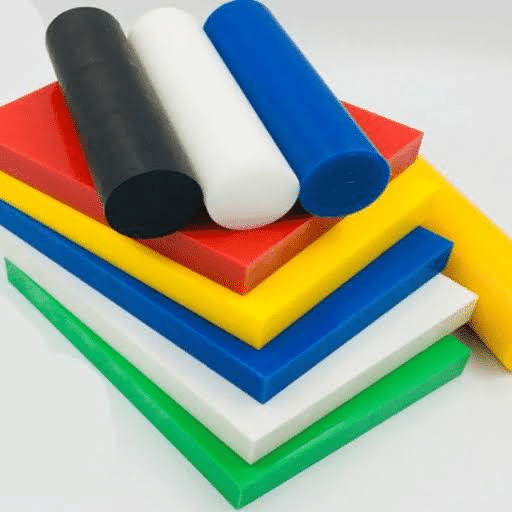
The right POM processing temperature depends on how you form the part, and POM is less forgiving than most because its window is narrow.
Injection Molding
Set the melt roughly 20 to 30 °C above the POM melting point. For copolymer, that means a melt temperature of 185 to 210 °C, with 195 to 210 °C typical. For homopolymer, use 195 to 230 °C, with 210 to 220 °C typical.
| Parameter | Homopolymer | Copolymer |
|---|---|---|
| Melt temperature | 195 to 230 °C (typical 210 to 220 °C) | 185 to 210 °C (typical 195 to 210 °C) |
| Barrel rear | 180 to 190 °C | 180 to 190 °C |
| Barrel center | 190 to 200 °C | 180 to 190 °C |
| Barrel front | 200 to 210 °C | 190 to 200 °C |
| Nozzle | 210 to 215 °C | 200 to 210 °C |
| Mold temperature | 40 to 120 °C | 40 to 120 °C |
Measure the actual melt with a pyrometer rather than trusting the barrel readout, because POM’s window is narrow. Hold the mold at 80 to 120 °C for precision parts to promote crystallization and cut post-mold shrinkage and warpage; 40 to 80 °C is enough for standard thin-wall parts. For a tooling-side process overview, see the Kehui Mold POM injection molding guide.
Extrusion
Extrusion uses a progressive barrel profile from about 170 to 200 °C, feeding the resin toward the die at 190 to 210 °C depending on grade. Residence time is longer than in molding, so keep the melt below about 210 °C.
Drying and Preheating
POM is not highly hygroscopic, so drying is generally optional if pellets are stored dry. If they have been exposed to humidity, dry at 80 to 100 °C for 2 to 4 hours and target moisture below 0.2 percent. We cover moisture pickup and hopper practice in our POM preheating temperature guide.
Mold Temperature, Shrinkage, and Dimensional Stability
Mold temperature is your lever on crystallinity. A hotter mold produces more complete crystallization, which locks in dimensions and cuts post-mold shrinkage. Unfilled POM shrinks about 1.8 to 2.5 percent linearly (homopolymer at the higher end), less for filled grades.
With low moisture absorption (about 0.2 percent versus 1.3 to 2.5 percent for PA66) and a low coefficient of thermal expansion, POM holds precision dimensions in humid, hot service. For machined parts, POM’s modest HDT means cutting heat can distort thin sections, as covered in our POM CNC machining guide.
POM Melting Point by Grade
Thermal performance is not a single number for POM. It shifts with the family and the additive package, so grade selection decides whether your part survives its environment.
Homopolymer Grades
Homopolymer grades, typified by DuPont Delrin, melt at about 175 °C and deliver the highest tensile strength, stiffness, and surface hardness. They are the first choice for precision gears, springs, and load-bearing mechanical parts in dry, controlled environments. Delrin is sold as semi-finished shapes rather than molding pellets, so for molding you’d specify a homopolymer-grade resin from a manufacturer that offers it. For the gear application, our plastic gears article maps material to part.
The MatWeb datasheet for a Delrin homopolymer grade documents the 178 °C melting point and the strength profile that sets this family apart.
Copolymer Grades
Copolymer grades melt at about 165 °C and are the default for most injection molding. They resist hot water and alkalis better, hold properties longer at elevated temperature, and process with a wider window, meaning lower scrap and more consistent parts. The standard branded grades we stock, all with manufacturer COA documentation, are BASF Ultraform N2320, Celanese Hostaform C27021, Polyplastics DURACON M90-44, Kolon KOCETAL K300, and Formosa FORMOCON FM090.
Filled, Lubricated, and UV-Stabilized Grades
Beyond the standard families, additives shift the thermal and mechanical baseline:
- Glass-fiber-reinforced POM raises HDT to about 160 to 168 °C and adds stiffness for structural parts, at the cost of some toughness and faster tool wear.
- Lubricated grades with PTFE or other additives lower friction further for bearings and wear parts, though at higher cost.
- UV-stabilized grades, such as FORMOCON FM270UV and FM130UV, hold mechanical properties under outdoor exposure that standard grades lose.
| Grade | Melting Point | Key Thermal Characteristic | Best Fit |
|---|---|---|---|
| Homopolymer (Delrin-type) | ~175 °C | Highest strength and hardness | Precision gears, springs, load-bearing parts |
| Copolymer (Ultraform N2320, Hostaform C27021, DURACON M90-44, KOCETAL K300, FORMOCON FM090) | ~165 °C | Better hot-water and alkaline resistance, wider window | Most injection molding, automotive underhood, plumbing |
| Glass-filled POM (GF25 etc.) | ~165 °C | HDT to ~160 to 168 °C | Structural parts needing stiffness |
| PTFE-lubricated POM | ~165 °C | Lower friction, wear resistance | Bearings, sliding parts |
| UV-stabilized POM (FM270UV, FM130UV) | ~165 °C | UV retention for outdoor use | Exterior clips, outdoor components |
POM Melting Point vs. Other Engineering Plastics

POM wins on low friction, dimensional stability, fatigue resistance, and chemical resistance to fuels and oils. It loses on sustained heat. The table below puts it in context.
| Material | Tm (°C) | Tg (°C) | HDT 1.82 MPa (°C) | Processing Melt (°C) | Continuous Service (°C) |
|---|---|---|---|---|---|
| POM (copolymer) | ~165 | ~-60 | ~100 to 110 | 185 to 210 | 80 to 120 |
| POM (homopolymer) | ~175 | ~-60 | ~99 to 110 | 195 to 230 | 80 to 115 |
| PA66 | ~260 | ~50 to 70 | ~150 (dry) | 270 to 300 | 80 to 120 |
| PC | amorphous | ~147 | ~130 | 280 to 320 | 115 to 130 |
| ABS | amorphous | ~105 | ~85 to 100 | 200 to 250 | 60 to 80 |
| HDPE | ~130 to 135 | ~-110 | ~60 to 85 | 180 to 280 | ~82 |
The key comparison for a POM buyer is PA66. It melts about 80 to 100 °C higher, around 260 °C, with a similar continuous service ceiling but better short-term hot strength. Where sustained heat defeats POM, PA66 is the honest upgrade, so we point buyers to our PA66 resin supplier page. For transparent or impact-resistant parts at higher service temperatures, move to PC, covered on our Covestro Makrolon PC resin page.
The engineering plastic temperature guide compares all of these materials in one chart. At the low-temperature end of the semi-crystalline family, our HDPE melting point guide covers HDPE’s ~130 to 135 °C baseline. Working rule: if your part runs below about 120 °C continuously and needs precision, low friction, and fuel or oil resistance, POM is the answer. Above that, escalate to PA66, PC, or a higher-heat material.
Why POM Thermal Consistency Matters for Buyers
Thermal data is only useful if it is true for the batch you actually use, and the POM melting point is the first number to verify when a new lot arrives. This is where procurement gets interesting, and where the difference between branded prime resin and unknown compound shows up.
Batch-to-Batch Variation Is a Red Flag
Branded POM manufacturers publish consistent Tm, HDT, and MFI baselines for each grade. When a supplier’s thermal values drift between shipments, it usually means off-spec compounding, regrind contamination, or material that is not actually the branded grade it claims to be. POM is one of the most-counterfeited engineering resins, and a shifted melting point breaks your molding process on the line, not on a spec sheet.
Ana, a quality engineer at a medical device manufacturer, caught this on a routine incoming check. Her BASF Ultraform N2320 spec called for an MFI near 9 g/10 min at 190 °C/2.16 kg, and the first two lots arrived at 8.5 and 9.2. The third measured 13.8. The supplier called it batch variation.
Ana ordered a third-party test, and the DSC scan showed a melting point nearly 6 °C below the grade baseline. The lot was blended with regrind. One field check saved her line from erratic fill and dimensional drift.
What to Check on the Certificate of Analysis
When you source POM, the COA is your thermal verification tool. Confirm four fields:
- Grade designation and manufacturer, so you know exactly which branded grade you are buying.
- Melt flow index, reported at 190 °C/2.16 kg for POM, as a flow consistency check.
- Thermal baseline, including the DSC melting point where the manufacturer reports it, plus HDT or Vicat if available.
- Lot and batch number, for traceability back to a single production run.
A COA is only as valuable as the brand behind it, which is why we supply branded prime POM rather than commodity compound, and why every batch from our Suzhou warehouse ships with a manufacturer-issued Certificate of Analysis, the MSDS, the commercial invoice, and the packing list.
Sourcing POM from China
If you are sourcing POM from China, buy branded prime resin from a supplier that can prove it. Our location in Suzhou, minutes from the Port of Shanghai, keeps export lead times at 7 to 14 days depending on destination, with FOB Shanghai as the standard term and a 25 kg minimum order. That makes trial orders practical: order 25 kg from the same lot your production material will come from, with the same COA, and qualify it before committing to volume. Our POM resin supplier page lists the branded grades we stock.
Frequently Asked Questions

What is the melting point of POM in Celsius?
POM homopolymer melts at about 175 °C (172 to 184 °C), and POM copolymer at about 165 °C (160 to 175 °C). Because POM is semi-crystalline, these are true melting points, not softening ranges.
What is the melting point of POM in Fahrenheit?
In Fahrenheit, the homopolymer melts around 345 to 363 °F and the copolymer around 320 to 347 °F. Roughly, call it 350 °F for homopolymer and 330 °F for copolymer.
Does POM melt in boiling water?
No. Boiling water is 100 °C, well below POM’s melting point of 165 to 175 °C. But POM’s continuous service limit is only 80 to 120 °C, so hot-water contact is a copolymer application, not a homopolymer one.
What is the difference between POM homopolymer and copolymer melting points?
Homopolymer melts about 10 to 15 °C higher, around 175 °C versus 165 °C, because its more regular crystal structure takes more heat to break down. The trade-off is lower thermal and hydrolysis resistance. Copolymer’s lower melting point comes with better stability in hot water and alkaline environments.
What temperature should POM be processed at?
Copolymer processes at 185 to 210 °C (typical 195 to 210 °C), homopolymer at 195 to 230 °C (typical 210 to 220 °C). Mold temperature runs 40 to 120 °C. Never exceed about 230 °C melt, where degradation begins.
What is the continuous service temperature of POM?
Roughly 80 to 120 °C for unreinforced grades, with short-term excursions to about 140 °C for glass-filled grades. The melting point is not the design ceiling; this service limit is what engineers actually design to.
POM vs PA66: which is more heat resistant?
PA66. It melts around 260 °C, about 80 to 100 °C higher than POM, and carries a similar continuous service rating with better short-term hot strength. Use PA66 where sustained heat defeats POM, but remember POM wins on friction, dimensional stability, and fuel and oil resistance.
Does POM need to be dried before molding?
Usually not, if it is stored dry. POM is not highly hygroscopic. If pellets have been exposed to humidity, dry at 80 to 100 °C for 2 to 4 hours and target moisture below 0.2 percent.
Why does POM smell like formaldehyde when overheated?
Because it is degrading. Above roughly 220 to 230 °C, POM releases formaldehyde gas as the polymer chain breaks down. That smell, along with silver streaks and tool corrosion, is the signal to lower the melt temperature and cut residence time.
Is POM or acetal the same material?
Yes. POM (polyoxymethylene) and acetal are the same material family; “acetal” is the common name, and “polyoxymethylene” the chemical name. It comes in homopolymer (POM-H) and copolymer (POM-C) forms with the property differences described above.
Conclusion
The POM melting point is real, sharp, and family-dependent: about 175 °C for homopolymer and 165 °C for copolymer. The numbers that should drive your design are different. Process copolymer at 185 to 210 °C and homopolymer at 195 to 230 °C, hold the mold at 40 to 120 °C, design to an HDT of roughly 100 to 160 °C, keep continuous service at 80 to 120 °C, and never push the melt past about 230 °C, where formaldehyde release starts. Choose the grade to match the environment, and verify the thermal data on the COA before you commit.
When you source POM, buy branded prime resin from a supplier that stands behind batch consistency. We stock Ultraform, Hostaform, DURACON, KOCETAL, and FORMOCON copolymer grades with manufacturer COA documentation, a 25 kg minimum order, and FOB Shanghai pricing. Tell us your application, your operating temperature, and your processing method, and we’ll recommend the right branded grade.
Request a POM resin quote and get a recommendation backed by real datasheets, not guesswork.