


Jake spent forty minutes spray-painting his ABS motorcycle fairing on a Saturday afternoon. By Wednesday, the finish was lifting at the edges in brittle curls. He had cleaned the part, shaken the can thoroughly, and applied what he thought were light coats. The problem wasn’t the paint — it was that no one told him ABS demands a specific aerosol chemistry and a controlled solvent exposure. The wrong spray paint, applied too wet, does not just peel. It crazes the surface, etches fine cracks into the plastic, and forces a complete restart.
If you are searching for the best spray paint for ABS plastic, you have already realized that not every can labeled “bonds to plastic” actually bonds to ABS. This guide compares six aerosol products that do — ranked by application, chemistry, and real-world durability — and details the technique that separates a finish that lasts years from one that fails in days.
What you will learn: which spray cans work on ABS without primer, which ones demand an adhesion promoter, how far to hold the can, how long to wait between coats, and why high-impact ABS reacts differently to solvent than plating-grade ABS. For the full surface-prep procedure — sanding grits, degreasing solvents, and primer selection — see our complete guide to how to paint ABS plastic.
Best Spray Paint for ABS Plastic at a Glance

| Spray Paint | Chemistry | Best For | Primer Needed? | Recoat Window | Price Tier |
|---|---|---|---|---|---|
| Krylon Fusion All-In-One | Acrylic-modified enamel | General DIY, hobby, indoor decor | No | 2 hours | $ |
| Rust-Oleum Painter’s Touch 2X Ultra Cover | Oil-based enamel | Budget projects, fast coverage | Recommended | 1 hour | $ |
| Rust-Oleum Automotive Plastic Paint | Acrylic enamel | Auto trim, bumpers, exterior ABS | Yes (plastic primer) | 1 hour | $$ |
| SEM Color Coat Aerosol | Flexible vinyl/acrylic | OEM interior trim, motorcycle fairings | Yes (SEM Adhesion Promoter) | 10 minutes | $$$ |
| Tamiya TS Spray Lacquer | Lacquer | Hobby models, Gundam, miniatures | Optional (Fine Surface Primer) | 15 minutes | $$ |
| U-POL Raptor Aerosol | 2-K urethane (twin-can) | Outdoor, industrial, marine ABS | Yes (etch primer) | 30 minutes | $$$ |
Skip ahead: If you already know your use case, jump to the detailed review. If you are not sure which chemistry fits your project, read the technique section first — the right product choice depends on how you plan to apply it.
Why Spray Paint on ABS Requires Caution
ABS is not polypropylene. That distinction matters because ABS has a surface energy of roughly 42 mN/m — high enough that paint adheres without flame or corona treatment — but it also contains a butadiene rubber phase that is vulnerable to ketone solvents. Many lacquers and some automotive aerosols carry those ketones. Apply them too heavily, and the solvent pools on the surface, swells the butadiene, and leaves a network of fine cracks called crazing.
High-impact ABS grades, which contain a higher butadiene content for toughness, are actually more sensitive to solvent attack than plating-grade ABS. If you are working with an unknown grade — a 3D-printed part, a salvaged enclosure, or imported components — assume it is high-impact and treat it accordingly. Start with dusting coats, especially under lacquer or automotive formulations.
Two hidden factors sabotage spray paint adhesion on ABS more often than the paint itself. The first is mold release residue left from injection molding. It is invisible, hydrophobic, and repels paint. The second is static cling. ABS is an insulator; aerosol mist carries a charge. The charged paint particles can cluster unevenly, creating thick spots that trap solvent. A quick wipe with a damp microfiber cloth before painting reduces static and improves coat uniformity.
The 6 Best Spray Paints for ABS Plastic
1. Krylon Fusion All-In-One — Best Overall Spray Paint for ABS
Krylon Fusion All-In-One is an acrylic-modified enamel formulated with a proprietary adhesion promoter resin. It is the closest thing to a genuine no-primer option for ABS. The chemistry bonds directly to the styrenic surface without a separate adhesion-promoter step, which makes it the default recommendation for general DIY, hobby projects, and indoor decor.
Best for: plastic furniture, cosplay props, game controllers, helmet shells, indoor enclosures.
Limitations: UV resistance is marginal. Unmodified ABS yellows under sustained UV exposure in 6 to 18 months, and the acrylic-modified enamel film on top does not add meaningful UV protection. For outdoor service, plan on a compatible UV-clear coat or accept a 2-to-3-year cosmetic lifespan. Avoid applications where the painted part will see sustained temperatures above 80 degrees Celsius — the paint film softens before the ABS substrate does, but the combined thermal stress accelerates adhesion loss.
Technique tip: two light coats at 8 to 10 inches. The 2-hour recoat window is non-negotiable; recoating too soon traps solvents. Full handling strength in 24 hours.
2. Rust-Oleum Painter’s Touch 2X Ultra Cover — Best Budget Spray Paint for ABS
Rust-Oleum 2X Ultra Cover is an oil-based enamel marketed as paint plus primer. It delivers excellent single-coat coverage and a hard, chip-resistant film at roughly half the per-can cost of specialty plastic paints. For quick hobby prototypes, one-off props, or indoor items that will not see abrasion, it is a pragmatic choice.
Best for: prototype mockups, quick refresh jobs, indoor decor, low-wear items.
Limitations: The cure is slow. Oil-based enamel can remain soft on flexible ABS substrates for 48 to 72 hours, and the generic multi-surface formula is less optimized for styrenic plastics than Krylon Fusion. On high-butadiene ABS, the slower solvent release increases the risk of solvent trapping if coats are applied too heavily. The “2X” coverage claim refers to pigment loading, not adhesion — do not interpret it as a license to skip surface prep.
Technique tip: apply a thin mist coat first, let it flash for a full hour, then follow with a second slightly wetter coat. Avoid a third coat unless absolutely necessary; excessive film thickness is the main cause of peeling with this product on ABS.
3. Rust-Oleum Automotive Plastic Paint — Best for Exterior ABS Car Trim
This is not the 2X Ultra Cover in a different label. Rust-Oleum Automotive Plastic Paint is formulated specifically for plastic substrates rather than universal multi-surface coverage. The resin system is tuned for the flexibility and thermal cycling that automotive ABS trim experiences — mirror housings, bumper inserts, door-handle bezels, and engine-bay accents.
Best for: exterior automotive trim, motorcycle fairings, bumpers, mirror housings.
Limitations: It is not a no-prep product. Textured ABS trim, in particular, benefits from scuffing to 400 grit and a dedicated plastic primer layer. Without that mechanical key, the paint can chip at stress points — door edges, bumper corners — within weeks. Color match is also limited compared to SEM’s OEM-code system.
Technique tip: scuff the ABS to a uniform matte finish with 400-grit wet-or-dry paper, clean with isopropyl alcohol, apply Rust-Oleum Specialty Plastic Primer, then follow with two light color coats at 1-hour intervals. Finish with an automotive clear coat for UV durability.
4. SEM Color Coat Aerosol — Best for OEM Automotive Interior ABS
SEM Color Coat is a flexible vinyl-acrylic aerosol designed for OEM interior color matching. It is specified in repair manuals for Ford, GM, and Toyota interior trim refinish — dashboard panels, door cards, center consoles, and armrests. The key feature is not the paint chemistry alone; it is the matched system that pairs SEM Color Coat with SEM Plastic Adhesion Promoter.
Best for: dashboards, door panels, center consoles, armrests, OEM interior repair.
Limitations: Do not skip the adhesion promoter. SEM Color Coat without the promoter performs no better than generic acrylic on ABS. The product is also priced at a premium — roughly three to four times the cost of consumer-grade cans. For a single interior panel repair, the cost is justified. For a full hobby project, it is overkill.
Maria, a product engineer at a consumer-electronics firm in Shenzhen, prototyped a handheld enclosure in ABS and needed a finish that matched the OEM supplier’s dashboard texture. She sprayed SEM Plastic Adhesion Promoter, waited the full 10-minute flash time, then applied two coats of SEM Color Coat in the manufacturer’s color code. The match was close enough to present to her client without re-tooling the injection-mold texture. The finish passed a 48-hour humidity-cycle test — a result she never achieved with consumer spray cans.
Technique tip: adhesion promoter at 6 to 8 inches, 10-minute flash, then 2 to 3 light SEM coats with 10 minutes between each. Allow 24 hours before handling. The short recoat window is an advantage — you can build a multi-coat finish in under an hour — but it also means the window closes fast. If you miss it, wait 24 hours and scuff before recoating.
5. Tamiya TS Spray Lacquer — Best for Hobby and Model ABS
Tamiya TS Series is a hot-solvent lacquer formulated for styrenic model-kit plastics — ABS, high-impact polystyrene (HIPS), and standard polystyrene. It bonds aggressively because the solvent system partially softens the substrate surface, creating a fused interface rather than a simple adhesive bond. On model-scale parts, this produces a glass-smooth, durable finish that resists handling wear.
Best for: scale models, action figures, Gunpla, miniatures, small hobby parts.
Limitations: The same solvent aggression that creates a strong bond can also craze thin or stressed ABS. This is the most technique-sensitive product on this list. A single heavy coat on a 3D-printed ABS part with thin walls can warp the geometry or frost the surface with micro-cracks. Always test on scrap first. The fumes are also significantly stronger than acrylic enamels; use a respirator and spray in a ventilated booth.
Technique tip: first two coats must be true dusting mists — hold the can at 10 to 12 inches, move fast, and aim for a translucent haze rather than a solid film. Allow 15 minutes between coats. After the surface is sealed, you can apply slightly wetter coats for coverage. Never apply Tamiya TS in temperatures below 15 degrees Celsius; the solvent does not flash properly and pools on the surface.
6. U-POL Raptor Aerosol — Best for Outdoor and Industrial ABS
U-POL Raptor is a two-component urethane delivered in a twin-can aerosol system. The resin and hardener mix at the nozzle, creating a cross-linked film that is chemically resistant, UV stable, and physically tough. No consumer-grade acrylic or enamel comes close to its durability on ABS for outdoor or industrial service.
Best for: outdoor enclosures, marine parts, off-road vehicle accessories, industrial prototypes exposed to chemicals or abrasion.
Limitations: This is not a casual DIY product. It requires an etch primer or adhesion promoter, a respirator with organic-vapor cartridges, and a controlled spray environment. The cost per can is roughly five to six times that of Krylon Fusion. The 30-minute recoat window is tight; if you miss it, you must wait a full 24 hours, scuff, and resume. The 72-hour full chemical cure is also the longest on this list.
Technique tip: etch primer first, 30-minute flash, then build the finish in 2 to 3 coats within the 30-minute window. Do not force-cure painted ABS above 60 degrees Celsius — the ABS Tg of roughly 105 degrees Celsius is not the limiting factor; the thermal expansion differential between the urethane film and the substrate is.
Spray Painting ABS Plastic: Technique That Prevents Failure
The product matters, but technique decides the outcome. Here is the application sequence that separates a professional finish from a redo.
Step 1 — Clean and Degrease
Wash the ABS part with dish soap and warm water to remove surface oils. Follow with a wipe-down using 90-percent or higher isopropyl alcohol on a lint-free cloth. Do not use acetone or MEK for cleaning — both attack ABS. After cleaning, handle the part with nitrile gloves. Skin oils transfer easily to ABS and cause fish-eye defects in the paint film.
Step 2 — Scuff for Mechanical Key
Lightly scuff glossy ABS surfaces with 320-to-400-grit wet-or-dry sandpaper. The goal is to matte the gloss, not to remove material. A uniform matte sheen gives the paint a mechanical anchor. Rinse the dust away, dry thoroughly, and wipe again with alcohol before moving to the next step.
Step 3 — Apply Adhesion Promoter When Needed
You can skip a separate adhesion promoter for Krylon Fusion All-In-One and some all-in-one formulas. For automotive refinish, lacquers, two-component urethanes, and 3D-printed ABS with layer lines, an adhesion promoter is mandatory. SEM Plastic Adhesion Promoter and Bulldog Adhesion Promoter are the two most reliable aerosol options. Spray a single light coat at 6 to 8 inches, then wait for the full flash time stated on the can — typically 5 to 10 minutes — before applying color.
Step 4 — Spray Technique
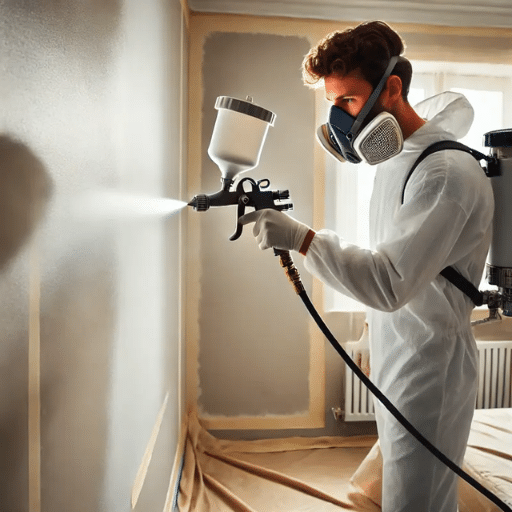
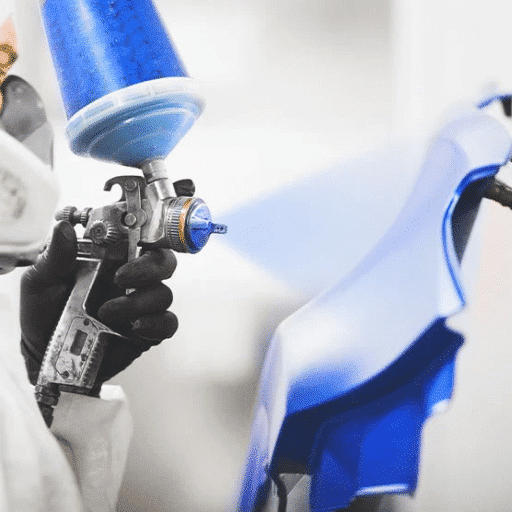
Hold the can 8 to 12 inches from the surface. Start your arm motion before you pull the trigger, and release the trigger after the pass ends. Overlap each pass by roughly 30 percent. Apply 2 to 4 light mist coats. Never attempt to cover the part in a single heavy wet coat — that is the most common cause of solvent attack and runs on ABS.
Recoat timing varies by chemistry. Lacquers like Tamiya TS allow recoating in 15 minutes. SEM Color Coat allows 10 minutes. Acrylic enamels like Krylon Fusion and Rust-Oleum require 1 to 2 hours. Two-component urethanes like U-POL Raptor have a 30-minute window, then a 24-hour gap. Read the can label and set a timer.
Spray in an environment between 18 and 27 degrees Celsius with humidity below 70 percent. High humidity causes blushing — a milky haze in the finish — particularly with lacquers and some fast-drying enamels.
Step 5 — Clear Coat and Cure
For durability, especially outdoors, finish with a compatible clear coat. Acrylic enamel clear coats work over Krylon Fusion and Rust-Oleum. Lacquer clear coats work over Tamiya TS. Two-component urethane clear coats work over U-POL Raptor. Never mix incompatible chemistries — lacquer clear coat over acrylic enamel will lift the base coat.
Cure times also vary. Acrylic and oil-based enamels reach handling strength in 24 to 48 hours but need 7 days for full chemical cure. Lacquers dry to the touch in 15 minutes and handle after 24 hours. Two-component urethanes cure to handling strength in 24 hours but need 72 hours for full chemical resistance. The ABS glass transition temperature of roughly 105 degrees Celsius means you can bake parts gently, but never exceed 80 degrees Celsius — the thermal stress differential between paint film and substrate causes adhesion loss.
Troubleshooting Spray Paint on ABS Plastic
| Problem | Likely Cause | Fix |
|---|---|---|
| Crazing or cracking | Solvent attack from lacquer or heavy wet coat | Switch to acrylic enamel; use dusting coats for first two layers |
| Fish-eye | Oil, silicone, or mold release residue | Strip to bare ABS, clean with IPA, re-prime |
| Orange peel | Too far, too hot, or too humid | Move to 8 to 10 inches; spray at 18 to 24 degrees C, under 60 percent humidity |
| Peeling at edges | No mechanical key; missed adhesion promoter | Scuff to 400 grit; apply plastic primer or adhesion promoter |
| Soft finish after 48 hours | Oil-based enamel slow cure or too thick | Wait 7 days; thin future coats and extend flash time |
| Blushing (milky haze) | High humidity during application | Wait for dry conditions; lightly scuff and recoat |
When to Upgrade from Spray Cans
Spray cans are the right tool for prototypes, one-off repairs, and hobby projects. They are not the right tool for production volume. If your operation paints ABS parts at scale — electronics enclosures, automotive interior components, consumer-goods housings — aerosol application becomes a bottleneck. Film thickness varies can to can, solvent exposure is inconsistent, and the per-part labor cost is unsustainable.
The better long-term approach is to specify a paintable ABS grade at the resin-selection stage and move to spray-line application with a two-component urethane or acrylic-urethane system. Paintable grades — low mold-release formulations, plating-grade ABS, or matte-surface grades — accept industrial finishes with less prep and more predictable adhesion. Yifuhui supplies branded ABS resin from BASF Terluran, INEOS Styrolution, and Chi Mei with full Certificates of Analysis and grade-selection guidance for painted-component applications. If you are specifying resin for a production program that includes a finishing step, request a quote on paintable-grade ABS resin — we will identify the grade that matches your paint system and processing conditions.
Frequently Asked Questions
Can you spray paint ABS plastic without primer?
Yes, with specific products. Krylon Fusion All-In-One is formulated with a built-in adhesion promoter that bonds directly to ABS in most cases. For all other spray paints — including Rust-Oleum 2X, automotive formulations, and lacquers — a dedicated plastic primer or adhesion promoter significantly improves durability. On 3D-printed ABS, primer is almost always necessary to fill layer lines. To learn more about Best Paint for ABS Plastic, please click to refer to our accompanying guide: Best Paint for ABS Plastic: 7 Tested Picks for Hobby, Auto, and Industrial Use (2026 Guide)
How long does spray paint take to dry on ABS plastic?
Dry-to-touch times range from 15 minutes for lacquers to 2 hours for acrylic enamels. Handling strength is typically 24 hours. Full chemical cure — the point at which the film reaches maximum hardness and solvent resistance — takes 7 days for acrylic and oil-based enamels, and 72 hours for two-component urethanes. Do not confuse dry-to-touch with fully cured.
Will Rust-Oleum 2X work on ABS plastic?
It will adhere, but it is not optimized for ABS. Rust-Oleum Painter’s Touch 2X Ultra Cover is a universal multi-surface enamel. It performs adequately on indoor, low-wear ABS items. For exterior automotive trim, flexible parts, or anything that will see abrasion, use Rust-Oleum Automotive Plastic Paint or a dedicated plastic primer beneath the 2X coat.
Can spray paint melt ABS plastic?
Not literally melt — ABS softens at roughly 105 degrees Celsius, well above ambient spray conditions. However, the solvents in lacquers and some automotive paints can swell and craze the butadiene rubber phase in ABS. The result looks like cracking or a frosted surface. Prevention is simple: use dusting coats for the first two layers, especially under lacquer.
How many coats of spray paint does ABS need?
Two to four light mist coats. One coat rarely gives adequate coverage or film thickness. More than four coats increase the risk of solvent trapping, runs, and adhesion failure. Each coat should be light enough that you can still see the substrate faintly through the wet film. Build coverage gradually.
Is Krylon or Rust-Oleum better for ABS plastic?
Krylon Fusion All-In-One is the better choice for direct-to-ABS application without primer. Its adhesion-promoter resin is specifically engineered for styrenic plastics. Rust-Oleum Painter’s Touch 2X offers better single-coat coverage and a harder final film, but it is a general-purpose product. For automotive applications, Rust-Oleum’s dedicated Automotive Plastic Paint line competes directly with Krylon Fusion.
Can you spray paint 3D-printed ABS parts?
Yes, but surface preparation is more critical than on injection-molded ABS. 3D-printed parts have layer lines, slight porosity, and variable density that affect paint adhesion. Start with filler primer to level the layer lines, then sand to 400 grit before applying color. Acrylic enamels and water-based acrylics are safer than lacquers on thin-walled prints.
Conclusion
The best spray paint for ABS plastic is not a single product — it is the product that matches your application, your environment, and your technique. Krylon Fusion All-In-One wins for general DIY because it eliminates the primer step without sacrificing adhesion. SEM Color Coat wins for automotive interior repair because it flexes with the substrate and matches OEM color codes. U-POL Raptor wins for outdoor and industrial service because its two-component urethane film outlasts every consumer-grade alternative. Tamiya TS wins for hobbyists who need a glass-smooth finish on model-scale parts.
What all six products have in common is that they fail if you apply them wrong. Clean the part. Scuff to a matte finish. Use light coats at the correct distance. Respect the recoat window. And if you are finishing ABS at production scale, stop buying cans and start specifying paintable-grade resin for your line. To learn more about Painting ABS Car Trim, please click to refer to our accompanying guide: Painting ABS Car Trim: A Complete Guide for Interior and Exterior Parts