


Half the spray cans on the “plastic paint” aisle will flake off ABS within six months. The other half will hold for a decade. The label rarely tells you which is which.
If you have ever sanded, primed, and color-coated an ABS part only to watch the finish lift at the first scratch, you already know the problem. ABS looks easy to paint until you actually paint it. The wrong product chemistry, the wrong primer combination, or even the wrong cure window will turn a Saturday project into rework. This guide cuts through the marketing copy: seven paints that actually bond to ABS, ranked by use case, with the trade-offs each one carries. By the end, you will know exactly which can to take off the shelf for your project, whether that project is a Gundam kit, a motorcycle fairing, a 3D-printed enclosure, or a production batch of injection-molded interior parts.
For a step-by-step prep and application procedure, see our full how to paint ABS plastic guide. This article focuses on the product selection question itself. If you are still deciding whether aerosol is the right format for your job, our Best Spray Paint for ABS Plastic: 6 Aerosol Picks + Technique Guide (2026) breaks down the top spray-can options in more detail.
Best Paint for ABS Plastic at a Glance

The fastest way to choose is to match the paint chemistry to the application. Here is the short list, ranked the way we would recommend them to a buyer who tells us what they are painting.
|
Paint |
Type |
Best For |
Primer Needed? |
Finish |
Price Tier |
|---|---|---|---|---|---|
|
Krylon Fusion All-In-One |
Acrylic with adhesion-promoter resin |
General DIY, hobby, indoor décor |
No |
Satin / gloss |
$ |
|
Rust-Oleum Specialty Plastic |
Acrylic enamel |
Indoor + light outdoor |
No |
Gloss / matte |
$ |
|
SEM Color Coat |
Flexible vinyl/acrylic (auto refinish) |
Automotive trim and interior ABS |
Yes, SEM Plastic Adhesion Promoter |
OEM-match |
$$$ |
|
Tamiya TS Spray Lacquer |
Hot-solvent lacquer |
Hobby models, Gundam, miniatures |
Optional |
Gloss / matte |
$$ |
|
Vallejo Surface Primer + Model Air |
Water-based acrylic-polyurethane |
3D-printed ABS, miniatures |
Yes (Vallejo primer) |
Matte |
$$ |
|
U-POL Raptor (2-K urethane) |
Two-component polyurethane |
Outdoor, truck bed, industrial |
Yes, etch primer |
Textured |
$$$ |
|
Plasti Dip Spray |
Rubberized vinyl |
Removable cosmetic, grip surfaces |
No |
Rubber matte |
$ |
If your application is not on this table, the use-case guide later in this article maps less common scenarios.
Quick CTA: Sourcing ABS resin for parts that will be painted in production? Yifuhui supplies paintable-grade branded ABS (BASF, Chi Mei, INEOS Styrolution) with full COA documentation and a 25 kg MOQ. Request a sample to validate paint adhesion on your actual production resin before scaling.
Why ABS Plastic Is Paintable (and Why Some Paints Still Fail)
ABS, acrylonitrile butadiene styrene, has a surface energy near 42 mN/m. That is high enough to accept most paint resins without flame treatment, plasma treatment, or chlorinated adhesion promoter. For comparison, polypropylene sits around 30 mN/m and rejects almost any paint that lacks a specialty primer. ABS is, in a real sense, one of the easiest engineering plastics to finish.
What goes wrong is rarely the paint itself. It is the surface. ABS injection-molded parts carry a thin layer of mold release agent, plasticizer migration, or simple fingerprint oils that destroy adhesion long before the paint chemistry gets a chance. Wash with isopropyl alcohol, scuff with 400-grit, and most paint chemistries on this list will hold. Skip that prep and even the best paint on the table will peel. If you want a deeper breakdown of which primers actually work on ABS and when they are necessary, see Primer for ABS Plastic: A Complete Guide to Adhesion, Products, and Application.
The second failure mode is heat. ABS has a glass transition temperature around 105 °C. Force-curing painted ABS above 80 °C distorts the part. Air-dry or low-temp bake only.
The 7 Best Paints for ABS Plastic, Reviewed
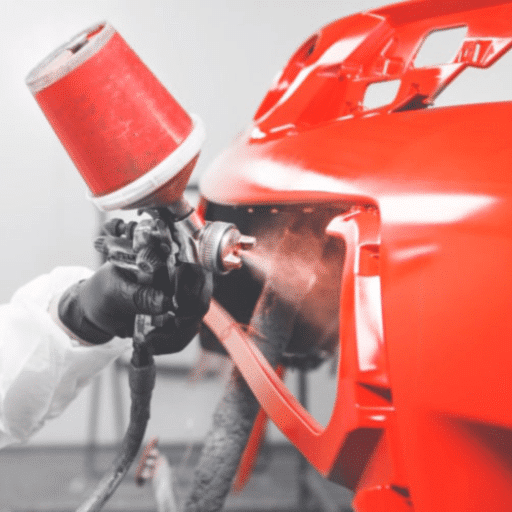
1. Krylon Fusion All-In-One: Best Overall for DIY
Krylon Fusion uses a proprietary adhesion-promoter resin built into the can. Spray it on cleaned, lightly scuffed ABS, and it bonds without a separate primer step. It is the closest thing to a foolproof option on the shelf.
The catch is outdoor longevity. Fusion holds color and gloss for two to three years in direct UV, sometimes less in desert or coastal climates. For indoor projects, plastic patio furniture, controllers, helmets, and storage bins, it is the right tool. For anything outdoor that has to last five years, look further down this list.
Best uses: indoor décor, plastic furniture refresh, hobbyist helmets, RC car bodies, controller mods, ABS pipe accents.
2. Rust-Oleum Specialty Plastic Spray: Best Budget Pick
Rust-Oleum’s Specialty Plastic line is an acrylic-enamel formulation in the same all-in-one category as Krylon Fusion. Adhesion is comparable on clean, lightly sanded ABS. The film build is slightly thinner, so plan on two coats minimum for opacity.
We have seen Marcus, a maker who runs a small Etsy shop selling painted ABS keycaps, switch to Rust-Oleum Specialty for the cost savings on a 500-unit batch. He cleaned each blank with IPA, scuffed with 600-grit, sprayed three light coats, and his customer return rate held at under 2% over twelve months. The paint works. The prep matters more than the brand.
Best uses: hobby projects, indoor décor, small-batch maker production where unit cost matters.
3. SEM Color Coat: Best for Automotive ABS Trim
SEM Color Coat is the paint that automotive refinish shops actually use on ABS dashboards, door panels, motorcycle fairings, and bumper inserts. It is a flexible vinyl/acrylic system designed to move with the substrate rather than crack when the panel flexes. OEM color match is available for major automakers, which is the killer feature.
SEM requires its companion product, SEM Plastic Adhesion Promoter, as a primer. Skip that step and the topcoat will lift. With the primer, the system is specified in OEM repair manuals for Ford, GM, Toyota, and others.
Best uses: automotive interior ABS, motorcycle fairings, bumper trim, refinishing dealership-quality panels.
4. Tamiya TS Spray Lacquer: Best for Hobby Models
Tamiya’s TS line is a hot-solvent lacquer that bonds aggressively to styrenic plastics. ABS, HIPS, and polystyrene model kits accept it without primer. The finish is glass-smooth, the color range is enormous, and the gloss has a depth that water-based acrylics cannot match.
The trade-off is solvent aggression. On thin or stress-loaded ABS parts, especially 3D-printed pieces with internal stress, Tamiya lacquer can craze the surface. The fix is straightforward: test on a scrap, and apply in light passes rather than heavy wet coats.
Best uses: scale models, Gundam kits, Warhammer terrain, action figure custom paint, anything where a deep glossy finish is part of the value.
5. Vallejo Surface Primer + Model Air: Best for 3D-Printed ABS
3D-printed ABS, especially FDM prints with visible layer lines, needs a primer that fills minor surface irregularities and gives the topcoat a uniform substrate. Vallejo Surface Primer, an acrylic-polyurethane water-based primer, does both. It is low-odor, airbrushable, and self-leveling enough to soften layer lines without obscuring fine detail.
Top-coat with Vallejo Model Air or Model Color acrylics for miniatures and prototypes. The Vallejo system is favored by miniature painters precisely because it works on the difficult substrates, including resin and ABS, that hobbyist acrylics often fail on. For a more detailed explanation of when acrylic systems succeed or fail on ABS, read Will Acrylic Paint Stick to ABS Plastic? Yes — If You Choose the Right Type and Prep It Right.
Best uses: FDM 3D-printed ABS prototypes, miniatures, tabletop terrain, low-odor indoor airbrush work.
6. U-POL Raptor: Best for Industrial and Outdoor Applications
When outdoor UV durability, chemical resistance, or impact toughness is non-negotiable, the answer is a two-component polyurethane. U-POL Raptor is the consumer-accessible version of the 2-K urethane systems used on truck beds, off-road vehicle panels, marine equipment, and industrial enclosures.
A 2-K urethane cures by chemical crosslinking, not solvent evaporation, which produces a coating that resists UV, fuel, brake fluid, and abrasion for years. The trade-off is application complexity. You need an etch primer or adhesion promoter, a respirator (isocyanates are no joke), and a working spray setup. This is not a casual project paint.
A real-world example: Sarah, a powersports shop owner in Phoenix, repainted a customer’s ATV plastics in 2024 using Krylon Fusion to save the customer money. The finish lasted eight months in Arizona sun before it chalked and cracked. She redid the job in U-POL Raptor over an etch primer; the customer’s bike came back two years later for unrelated service with the paint still showing 95% of its original gloss. Match the chemistry to the environment, or pay for the job twice.
Best uses: outdoor enclosures, off-road plastics, marine ABS components, industrial equipment, anything that will see UV plus chemical exposure.
7. Plasti Dip Spray: Best for Removable or Textured Finishes
Plasti Dip is a rubberized vinyl coating that builds in flexible, slightly grippy layers. It peels off cleanly when you want to undo the job, which makes it the right choice for cosmetic mods, prototype mockups, and grip surfaces on tools or controllers.
It is not a permanent finish. Thin coats peel under heat, abrasion, or sustained outdoor exposure. Use it as a removable accent or texture coat, not as a long-life production finish.
Best uses: cosmetic vehicle accents, controller grips, removable prototype color, textured matte finishes for visual contrast.
Best Primer for ABS Plastic: Quick Reference
You can skip primer when using Krylon Fusion, Rust-Oleum Specialty Plastic, or Plasti Dip on clean, scuffed ABS. For everything else, prime first.
- Bulldog Adhesion Promoter: General-purpose plastic primer; works under most acrylic and urethane topcoats
- SEM Plastic Adhesion Promoter: Required under SEM Color Coat; the auto-refinish industry standard
- Tamiya Fine Surface Primer: Hobby-scale primer that fills micro-detail without obscuring it; works under Tamiya TS lacquers and most acrylics
- Vallejo Surface Primer: Water-based, low-odor, ideal for 3D-printed ABS and miniatures
- 2-K Etch Primer (e. g., U-POL Acid #8): Required under U-POL Raptor and other 2-K urethane topcoats for outdoor durability
How to Choose: Best Paint for ABS Plastic by Use Case
|
Use Case |
Recommended Paint |
Why |
|---|---|---|
|
Hobby model (Gundam, Warhammer, scale kits) |
Tamiya TS or Vallejo Model Air |
Fine finish, hobby-scale color range |
|
3D-printed ABS prototype |
Vallejo Surface Primer + acrylic topcoat |
Fills layer lines, low-odor indoor use |
|
Automotive trim, dashboard, bumper inserts |
SEM Color Coat over SEM Adhesion Promoter |
Flex tolerance, OEM color match |
|
Indoor décor, plastic furniture |
Krylon Fusion or Rust-Oleum Specialty Plastic |
All-in-one convenience, no primer step |
|
Outdoor, marine, industrial |
U-POL Raptor over etch primer |
UV and chemical durability |
|
Removable cosmetic, grip surface |
Plasti Dip |
Peels off cleanly, grippy texture |
|
Production parts, factory finish |
Industrial 2-K urethane on a spray line |
Throughput and OEM-grade repeatability |
A Note for Manufacturers Sourcing Paintable ABS
If you are specifying ABS for components that will be painted in production, the resin grade matters as much as the paint chemistry. Plating-grade ABS, low-mold-release grades, and matte-surface grades each accept paint differently. A high-flow general-purpose ABS may carry more internal release agent than a plating-grade alternative, which means more pre-paint cleaning, more rejects, and more line stoppages.
The right move is to specify a paintable grade upfront and validate adhesion on the actual production resin before tooling commits. We have seen too many product launches where the design team validated paint adhesion on a sample from one supplier and then the procurement team sourced a different grade for production. The paint test never gets redone, and the field failures show up six months in.
At Yifuhui, we supply branded prime ABS from BASF (Terluran®), Chi Mei (Polylac® PA-757, PA-758), and INEOS Styrolution with full manufacturer Certificate of Analysis documentation, FOB Shanghai shipping, and a 25 kg MOQ for qualification trials. Tell us your painted-component application, and we will identify the right grade to validate.
Frequently Asked Questions
Does ABS plastic need a primer before painting?
Sometimes. All-in-one paints like Krylon Fusion and Rust-Oleum Specialty Plastic include adhesion-promoter resins and do not require a separate primer on clean, scuffed ABS. Two-component urethanes, lacquers over 3D-printed surfaces, and automotive refinish coatings require a dedicated plastic primer or adhesion promoter.
Will acrylic paint stick to ABS plastic?
Water-based hobby acrylics will adhere to primed ABS but bond poorly to bare ABS. Use a plastic primer such as Vallejo Surface Primer or Tamiya Fine Surface Primer first. Acrylic-modified all-in-one paints (Krylon Fusion, Rust-Oleum Specialty) bond directly without primer because they include adhesion-promoter resins.
What is the most durable paint for ABS outdoors?
A two-component polyurethane like U-POL Raptor or a professional automotive 2-K topcoat over an etch primer. Single-component all-in-one paints provide two to three years of outdoor service; 2-K urethanes can hold seven to ten years or more.
Can you paint 3D-printed ABS without sanding?
You can, but layer lines will show through. Vallejo Surface Primer is self-leveling enough to soften minor lines, and acetone vapor smoothing before paint will eliminate them entirely. For a furniture-grade finish, sand from 220 to 400 grit, then prime.
What is the difference between painting ABS and painting polycarbonate?
Polycarbonate has a similar surface energy to ABS, so most of the same paints work, but PC is more sensitive to solvent crazing. Hot-solvent lacquers like Tamiya TS that paint ABS beautifully will craze PC. Use acrylic or water-based systems on PC, or test on scrap first. See our polycarbonate vs ABS comparison for the full material difference.
Is spray paint or brush paint better for ABS?
Spray for finish quality, brush for detail or touch-up. Spray paint gives an even film build that brush application cannot match on smooth ABS surfaces. For miniatures, models, and detail work, brush-on acrylics over a sprayed primer combine the best of both.
Conclusion: Match the Paint to the Job
The best paint for ABS plastic depends on what the ABS is and what it has to survive. For a quick reference:
- DIY and indoor: Krylon Fusion or Rust-Oleum Specialty Plastic
- Hobby models: Tamiya TS spray lacquer
- 3D-printed prototypes: Vallejo Surface Primer plus acrylic topcoat
- Automotive trim: SEM Color Coat over SEM Adhesion Promoter
- Outdoor or industrial: U-POL Raptor over a 2-K etch primer
- Removable accent: Plasti Dip
The single highest-impact decision is not which can you buy. It is whether you prep the surface properly. Clean with IPA, scuff with 400 to 600 grit, and any paint on this list will outperform a name-brand premium applied to dirty, glossy ABS.
If you are sourcing ABS resin for painted production parts and need a paintable grade with traceable documentation, request a 25 kg trial sample of branded prime ABS from Yifuhui. Tell us the topcoat system you intend to use, and we will recommend a grade that has held adhesion in similar applications.