


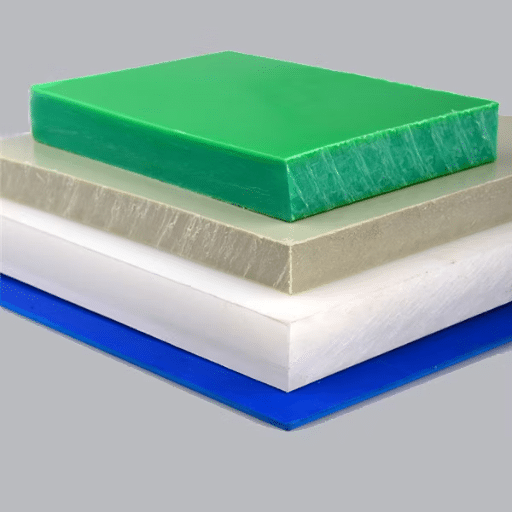

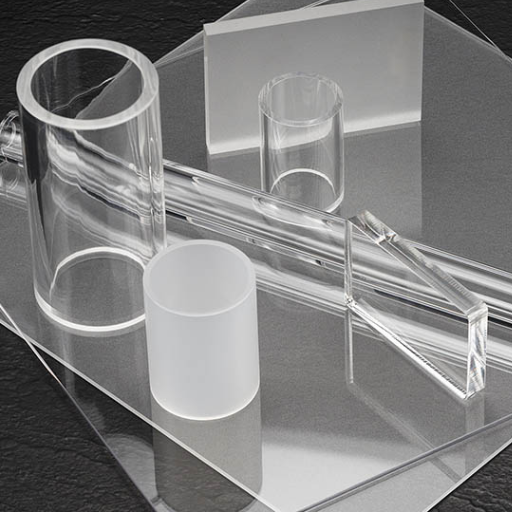



A wear plate cut from HDPE reads Shore D 65 to 70. The UHMWPE sheet beside it reads about D 64, softer by any measure. Put both in a sand-slurry chute and the softer sheet outlasts the harder one by roughly eleven to one.
That inversion is the whole story of HDPE hardness. HDPE is the most-specified polyolefin in the world. Its hardness is real, measurable, and one of the softest values in the engineered-plastics chart by design. For a wear part, it’s also almost never the number that decides the design.
This guide gives HDPE hardness on every scale it’s reported on, and explains why crystallinity rather than molecular weight sets the value. It also shows why abrasion resistance doesn’t follow hardness, and covers what belongs on a drawing and what to check on a certificate of analysis. For the full field of materials, see our complete guide to plastics hardness.
What HDPE Hardness Actually Measures

HDPE hardness is resistance to indentation by a defined indenter under a defined load. It’s a surface test, and it answers one question: how much does this surface resist being pressed. It isn’t stiffness, which is a modulus, and it isn’t toughness, which is impact energy. Above all, it isn’t abrasion resistance, which is the property most people actually want when they look up a hardness value.
HDPE makes that distinction unusually sharp. It reads low on every hardness scale and still absorbs impact that would crack a harder plastic, with notched Izod above 150 J/m (ASTM D256) and elongation at break above 800%.
Why HDPE is quoted on the Shore D scale
HDPE is measured on Shore D, the durometer range reserved for the harder thermoplastics. The test presses a 30° truncated cone into the surface under a 5 kg spring load, defined in ASTM D2240, ISO 868, and ISO 7619-1. Shore D is what prime manufacturers print on pellet, pipe, and blow-molding datasheets, which makes it the default scale on a purchase order. Our Shore hardness scale explained article covers the instrument mechanics.
Specifying HDPE and need a hardness value you can defend? Request a datasheet for your grade, with the scale, the standard, and the test condition stated.
Why a Rockwell R value appears on some HDPE datasheets
Sheet and semi-finished-shape suppliers often report HDPE on Rockwell R instead, usually to ASTM D785: a 1/2-inch (12.7 mm) steel ball under a 60 kgf major load. Ensinger lists its TECAFINE® HDPE sheet at Rockwell R 54 and Shore D 67 in the same table , two standards and one material with no stated bridge between them.
Those figures do not convert. A Rockwell R reading and a Shore D reading come from different indenters under different loads, so stacking them in one chart produces a comparison that means nothing.
HDPE hardness is a crystallinity measurement with a density label on it
One sentence makes every number in this guide make sense: HDPE hardness is a crystallinity measurement wearing a density label. Indentation microhardness rises with the thickness of the crystalline lamellae, and lamellar thickness rises with crystallinity. Density is the fast, cheap, commercial proxy for crystallinity, which is why datasheets quote it and why hardness tracks it.
Two HDPE samples with identical density but different cooling histories can still read differently, because what the test feels is the crystal structure, not the density number itself.
HDPE Hardness Values: Shore D, Rockwell R, and Ball Indentation
No single page publishes HDPE across all three scales, because each buyer asks for one number and each datasheet prints one number. Here is the full set, with how often each scale actually appears on HDPE data.
| Scale | HDPE value | Test method | How often HDPE datasheets report it |
|---|---|---|---|
| Shore D | 60–70, typically 61–68 | ASTM D2240 / ISO 868 | Almost always, on pellet, pipe, and sheet grades |
| Ball indentation | ≈50 MPa (range 43–57 MPa, H 132/30) | ISO 2039-1 / DIN 53456 | Sometimes, mostly European and semi-finished grades |
| Rockwell R | roughly R40–R75 | ASTM D785 / ISO 2039-2 | A minority of grades; many publish no Rockwell value |
| Rockwell M | Not applicable | ASTM D785 | Avoid: M-scale HDPE listings are almost always errors |
HDPE Shore D hardness: 60 to 70, typically 61 to 68
HDPE Shore D hardness is the number to use. The family band is 60 to 70, and individual commercial grades cluster tighter at 61 to 68. MatWeb’s overview of seven carbon-black-filled HDPE grades reports Shore D 59.0 to 68.0 with an average of 64.3 .
Named production grades land inside that band. Hostalen® ACP 5231 D publishes D 62 (ISO 868), Marlex® HMN TR-942 D 61, NOVAPOL® HE-Y449-AC D 61, Baystar™ CD-492 D 63, and HI-ZEX™ 5000SR D 64. Use the family band to judge whether HDPE is feasible at all, and the grade datasheet, with its standard and condition, on the drawing.
HDPE Rockwell hardness: roughly R40 to R75, and often missing
HDPE Rockwell hardness is where most comparisons go wrong. Published values span a wide range: YUHWA HIDEN® P600 at R 40, Ensinger TECAFINE HDPE at R 54, and LOTTE HDPE 5200B at R 60, all to ASTM D785. Sheet products reach R 75.
That 35-point spread isn’t measurement noise, and it isn’t a family constant. It reflects real differences in density, comonomer, and specimen preparation, plus the fact that Rockwell R is a coarse test on a soft material. Treat any HDPE Rockwell value as approximate and grade-specific.
Never publish a narrow band such as R60 to R80 as though it were typical. The data doesn’t support it, and many HDPE grades report no Rockwell value at all. The Rockwell hardness of plastics guide explains the scale in full.
HDPE hardness in MPa: ball indentation near 50 MPa
HDPE hardness in MPa comes from ball indentation, ISO 2039-1 or DIN 53456, where a steel ball is pressed into the specimen and the result is reported as a stress. Commercial HDPE reads about 50 MPa, spread across 43 to 57 MPa. LyondellBasell’s Hostalen® GD 4755 publishes 51 MPa, Lupolen® 5261ZS 47 MPa, and Lupolen® 5031L 50 MPa, all to ISO 2039-1.
Ball indentation appears mainly on European grades and semi-finished shapes, and it is the most useful figure when you need to compare a polyolefin against POM, PA66, or PC on a single stress basis.
HDPE hardness chart: why the value is a band
HDPE is semi-crystalline, so its surface properties vary with how the part crystallized. Crystallinity runs from 75% to 95% depending on grade and cooling rate, and every point of that range moves the reading. A tolerance band, not a single figure, is the honest specification.
Tomás, a design engineer at a conveyor-component maker in Valencia, learned that from a rejected drawing. His team specified “HDPE, hardness 65” with no scale named. The first supplier shipped sheet certified at Rockwell R 65, a much harder reading on a different test, and the parts machined differently from the prototype. Rewriting the callout as Shore D 62 to 66 by ASTM D2240, plus density 0.955 to 0.960 g/cm³ ended the ambiguity.
What Sets HDPE Hardness: Density, Crystallinity, and Grade

Density and hardness are correlated in polyethylene, which is why density is so often used as a hardness shorthand. However, the correlation is real but indirect, and the distinction matters when a part fails.
Crystallinity is the control; density is only the proxy
Indentation microhardness is an increasing function of lamellar thickness, and lamellar thickness increases with crystallinity. Calleja and Rueda first mapped that relationship for HDPE in the Journal of Materials Science in 1986. Faster cooling produces thinner lamellae and a lower reading on the same resin.
The lever works in reverse as well. In a rotomolded HDPE study, raising the crosslinker content dropped density from 0.930 to 0.913 g/cm³, reduced crystallinity, and pulled both Shore A and Shore D down with it.
The polyethylene hardness ladder
Set the family side by side and the density story is visible in a single glance.
| Material | Density (g/cm³) | Shore D |
|---|---|---|
| LDPE | 0.910–0.940 | ~42 |
| MDPE | 0.926–0.940 | 50–60 |
| HDPE | 0.940–0.970 | 60–70 |
| UHMWPE | 0.930–0.945 | ~64 |
A controlled compression-molding study puts the two extremes in one table, with LDPE at Shore D 42 against HDPE at Shore D 68 . The bottom row is the anomaly that sets up the next section: UHMWPE sits at a lower Shore D than HDPE despite being the tougher material, because its wear performance comes from chain length rather than crystallinity. The HDPE vs LDPE comparison covers the density ladder in more detail.
Grade class moves the number slightly
Hardness shifts with grade class even inside HDPE. Pipe grades classified under ISO 9080 show the pattern: PE80 reads Shore D 57 and PE100 reads Shore D 59 at 20 °C, with densities of 0.950 to 0.957 against 0.955 to 0.961 g/cm³. PE80 and PE100 are MRS strength classes, 8.0 and 10.0 MPa, not density bands, so reading “PE100” as “harder HDPE” is reading a pressure rating as a surface property.
Here is the fact that makes the rest of this guide necessary: changing molecular weight has little effect on HDPE hardness, and a large effect on wear. UHMWPE carries a molecular weight in the millions, against HDPE’s tens to hundreds of thousands. Its Shore D lands at or below an HDPE wear plate’s.
Hardness is insensitive to how long the polymer chains are. Abrasion resistance is dominated by it.
Why HDPE Abrasion Resistance Does Not Follow Hardness
If hardness predicted wear, an HDPE wear plate at Shore D 65 to 70 would beat UHMWPE at D 64. It does not, and the evidence is unusually direct for a materials question.
The sand-slurry number: HDPE 11.0 against UHMWPE 1.0
A tribology study run under identical conditions (23 °C, 1750 rpm, 7.5 hours, sand to water 3:2) reports a sand abrasion index where lower is better.
| Material | Sand abrasion index |
|---|---|
| UHMWPE | 1.0 |
| Nylon 6 | 5.0 |
| Fluororesin | 6.5 |
| Polyacetal (POM) | 6.5 |
| HDPE | 11.0 |
HDPE wore eleven times faster than UHMWPE in the same rig . A separate ETH Zurich study measuring abrasive wear coefficients in 10⁻⁴ mm³/Nm reaches the same ordering: UHMWPE grades at 2.64, 2.79, and 3.33 against HDPE at 4.00 and 4.60 .
What it means in service
The field numbers are blunt. A South Australian iron-ore slurry line replaced HDPE wear sections every 4 to 6 weeks; after switching to UHMWPE, the same sections ran 12 to 16 months. A poultry-processing plant respecified its conveyor guides from HDPE to UHMWPE and cut its wear rate by roughly 80%, and a comparative pipeline study credited UHMWPE with a 14.5% reduction in power consumption from lower friction.
Treat those as reported field experience rather than controlled trials. The indices above are the primary evidence; the field numbers show what the ordering looks like on a maintenance calendar.
Priya, a maintenance engineer at a fertilizer blending plant in Gujarat, ran that experiment by accident. Her chute liners were HDPE, replaced on a five-week cycle for two years. During one shutdown, a single high-wear zone was respecified in UHMWPE. Fourteen months later that zone was still in service while the downstream HDPE sections had been replaced eleven more times.
The practical rule, and the honest middle path
The gap is not constant. For example, on an impact-dominated wear test, PE100 ran only about 3:1 behind UHMWPE, while on a more abrasion-specific test UHMWPE’s advantage became effectively unbounded, as reported in the University of Western Australia’s work on polyethylenes for wear applications. As the wear profile shifts from impact toward pure sliding abrasion, the molecular-weight advantage grows.
The instruction that follows is short. For an HDPE wear part, specify molecular weight or abrasion data, not hardness. A Shore D number isn’t a wear specification and says almost nothing about how long a part will last in abrasive service.
The usual right answer is a combination. HDPE is cheaper, stiffer, and easier to machine and weld, so it suits the structure and light-to-medium sliding wear. UHMWPE belongs in the high-wear zones as a liner, sized by duty:
- 6 to 12 mm for light sliding wear
- 15 to 25 mm for continuous heavy flow
- 30 mm or more over steel backing where impact is severe
Choosing between HDPE and UHMWPE for a wear zone? Tell us your abrasive, velocity, and particle size and we will recommend the material for the liner and for the structure. We supply both sides.
Is HDPE Harder Than PP, UHMWPE, PVC, or ABS?

Comparison questions are the most common reason people look up HDPE hardness. Most have a clean answer, and one does not.
HDPE versus PP: close, grade-dependent, and genuinely disputed
Datasheet values generally place PP a few points above HDPE on Shore D, with cutting-board data showing HDPE at D 70 against PP at D 78. Scratch testing points the same way, rating PP as the least marked of the common polyolefins, though HDPE scars readily and holds visible grooves in use.
Other published sources argue the opposite, attributing a harder surface to HDPE’s higher crystallinity. However, the difference is small, it’s grade- and method-dependent, and the sources conflict. Specify the grade’s own datasheet value rather than the family, and don’t treat scratch behavior as a reliable discriminator. The HDPE vs PP comparison covers the rest of the property set.
HDPE versus UHMWPE: same Shore D, different decade
This is the pair worth understanding. HDPE wear plate reads D 65 to 70 and UHMWPE reads about D 64, so hardness calls them equivalent. The wear data calls them an order of magnitude apart, and in the opposite direction from the numbers.
HDPE versus ABS, PC, POM, and PA66
HDPE is softer than every common engineering plastic, and the scale letters matter as much as the values.
| Material | Rockwell | Shore D | Scale note |
|---|---|---|---|
| HDPE | roughly R40–R75 | 60–70 | Shore D is the published scale |
| PP | R80–R100 | 70–75 | Same family, a few points higher |
| ABS | R90–R110 | 70–80 | Rockwell R |
| POM copolymer | M76–M80 | 80 | Rockwell M, not R |
| PC | M70–M80 | 80–88 | Rockwell M, not R |
| PA66 (dry) | R119–R120 | 80–85 | Falls to about R104 conditioned |
Comparing HDPE’s Rockwell R value against POM’s or PC’s M value is the most common error in these charts. The engineering plastic hardness comparison puts the full field side by side, and the POM hardness guide covers the acetal values.
HDPE Hardness, Temperature, and Moisture
Temperature moves HDPE’s hardness steadily. Moisture, unusually for a polymer, does not move it at all.
Softening and stiffening
HDPE’s Vicat softening point runs 121 to 128 °C (ASTM D1525 / ISO 306), and its melting temperature sits near 130 to 135 °C. There’s no useful hardness above the softening point, so a hardness specification only means something well below it.
Below room temperature, modulus and strength both increase, and the material becomes stiffer and harder. What it also becomes is more sensitive to notches and to fast loading. There is no sharp brittle transition temperature: ASTM D746 brittleness figures for HDPE run below −60 °C, and often below −118 °C. Sub-zero handling failures still happen, because a notch or a sharp impact turns stiffness into fracture.
The glass transition temperature of HDPE sits near −120 °C, and that figure matters less here than it sounds.
Moisture does not move HDPE’s number
This is the cleanest contrast in the hardness family and the reason HDPE is easier to specify than nylon. HDPE’s water absorption is under 0.01%, so it doesn’t take on water in service and its hardness reading doesn’t drift with humidity.
Set that against PA66, which absorbs around 2.5% water and loses roughly 16 Rockwell points between dry-as-molded and conditioned states. Our PA66 hardness guide covers that mechanism. For a polyolefin, the hardness number has no shelf life.
Branded HDPE Grades and Their Hardness Baselines
Prime manufacturers publish hardness with the scale and the method attached, and that combination is what makes their data usable on a drawing.
| Grade | Representative hardness |
|---|---|
| LyondellBasell Hostalen® ACP 5231 D | Shore D 62 (ISO 868) |
| LyondellBasell Hostalen® GD 4755 / GD 7255 LS | 51 MPa / 52 MPa ball indentation (ISO 2039-1) |
| LyondellBasell Alathon® H5220 | Shore D up to 69 (ASTM D2240) |
| NOVA Chemicals NOVAPOL® HE-Y449-AC | Shore D 61 (ASTM D2240) |
| Chevron Phillips Marlex® HMN TR-942 / 9005 | Shore D 61 / 62 |
| Baystar™ CD-492 pipe resin | Shore D 63 (ASTM D2240) |
| Prime Polymer HI-ZEX™ 5000SR | Shore D 64 (ISO 868) |
The band is narrow on purpose. Prime blow-molding and pipe grades cluster between D 61 and D 64, with higher-density injection grades reaching D 66 to 69. A figure well outside that range is worth verifying against the manufacturer’s own datasheet.
The producers behind these grades are the ones Yifuhui supplies: LyondellBasell, NOVA Chemicals, SABIC, TotalEnergies, SCG, Braskem, REPSOL, and Dow. See our certified HDPE resin page for the current grade list, and the HDPE plastic material guide for the wider property set.
Sourcing Consistency: Keeping an HDPE Spec Meaningful

Because HDPE hardness moves with crystallinity rather than moisture, a drifting reading tells you something specific about the resin rather than about how it was stored.
What makes HDPE hardness drift lot to lot
Four causes cover most cases, and they’re worth monitoring because the drift signal is small:
- A density or crystallinity shift
- A comonomer change
- Regrind blended into virgin
- A different cooling history in the molded part
One study measured domestically recycled HDPE at Shore D 58.78 against a virgin floor of 60, a drop of just over one point for a change in feed that matters to a validated part.
Grace, an incoming-inspection lead at a pipe-fittings molder in Johor, caught a lot that way. An incoming Shore D reading came back at 58.8 against a validated band of 60 to 70. The documentation showed a density of 0.942 g/cm³ with a melt flow rate above the specified window, a combination consistent with regrind content. The lot was rejected before it reached a die.
Specifying HDPE, and what to verify on a COA
Put density and melt flow rate on the drawing, with the test conditions: MFI at 190 °C and 2.16 kg to ASTM D1238 or ISO 1133. If hardness is specified at all, add the scale, the standard, the specimen thickness, and the test temperature. For pipe grades, name the MRS class (PE80 or PE100) instead of a hardness band.
On the certificate of analysis, check four fields:
- Density
- Melt flow rate
- Grade designation
- Lot number
Density and MFI together describe the crystallinity and processability that set hardness. If both are inside specification, an off-band hardness reading is more likely a specimen-preparation or conditioning artifact than a resin problem.
How Yifuhui supplies hardness-consistent HDPE
We hold branded prime HDPE from the Hostalen®, Alathon®, NOVAPOL®, Marlex®, SABIC®, and Baystar™ families, with traceable lots and manufacturer-issued COA documentation that includes density and melt flow rate. Minimum order is 25 kg, FOB Shanghai, so the band you validated is the band you reorder. See our HDPE resin supplier page for datasheets on your grade.
Frequently Asked Questions

What is the hardness of HDPE?
HDPE hardness is Shore D 60 to 70, typically 61 to 68 on commercial grades (ASTM D2240 / ISO 868). The same material reads about 50 MPa by ball indentation (ISO 2039-1) and roughly Rockwell R40 to R75 on the minority of grades that report a Rockwell value.
Is HDPE hard or soft?
Soft by design. HDPE is softer than PP, ABS, PC, POM, and PA66, and harder than LDPE and PTFE. Its low hardness is the trade it makes for toughness, chemical resistance, and cost, and it isn’t a defect.
What is the Rockwell hardness of HDPE?
Roughly R40 to R75 depending on grade and specimen, with published values including R40 (YUHWA HIDEN® P600), R54 (Ensinger TECAFINE HDPE), and R60 (LOTTE HDPE 5200B) to ASTM D785. Many HDPE grades publish no Rockwell value at all, so treat any Rockwell figure as approximate.
Is HDPE harder than PP?
Close, and the published sources conflict. Datasheet values usually place PP a few points above HDPE (HDPE D 70 against PP D 78 in cutting-board data), while some sources argue the reverse from crystallinity. Specify the grade’s own datasheet value rather than the family.
Is HDPE harder than UHMWPE?
Usually slightly, on the Shore D scale: HDPE wear plate at D 65 to 70 against UHMWPE at about D 64. In sand-slurry abrasion, UHMWPE lasts roughly eleven times longer. Hardness and wear resistance are different properties, and in polyethylene they point in opposite directions.
Is HDPE harder than ABS?
No. ABS reads Shore D 70 to 80 and Rockwell R90 to R110, both above HDPE’s range. HDPE is harder than LDPE and PTFE and softer than every common engineering plastic.
Does HDPE hardness change with moisture?
No. HDPE absorbs under 0.01% water, so it does not take on moisture in service and its hardness does not drift with humidity. That is the opposite of PA66, which absorbs about 2.5% and drops roughly 16 Rockwell points when conditioned.
Conclusion
HDPE hardness comes down to one number and one warning. The number: Shore D 60 to 70, typically 61 to 68, with about 50 MPa by ball indentation and a Rockwell R range of roughly R40 to R75 where it is reported at all. The warning: HDPE is one of the softest values in the engineered-plastics chart, and that softness is deliberate.
What sets the number is crystallinity, with density acting as its proxy. What does not set it is molecular weight, which is exactly why molecular weight decides wear. The same chain-length difference that leaves UHMWPE at a lower Shore D than HDPE gives it roughly an eleven-to-one advantage in sand slurry and a service life measured in months rather than weeks.
Specifying HDPE for a wear part, a machined component, or a pipe application? Request a quote for branded prime HDPE (Hostalen®, NOVAPOL®, Marlex®, SABIC®, Baystar™), 25 kg minimum order, manufacturer-issued COA with density and melt flow rate on every lot, FOB Shanghai, response within 24 hours. Browse the current HDPE resin grades or send us the application and we will recommend the grade.


