



Quotes for Polyplastics DURACON® POM grade M90-44 on 5 November 2026 ran from US1,530toUS1,530toUS3,410 per tonne. Most listings name the grade and little else: not the plant that polymerised the lot, and not the duty the shipment will carry.
On price alone, the cheapest looks like a 55% saving. On the documents, it can be the more expensive order. Two Taiwanese lots of the same grade enter China at 3.8% or at 32.6%, and the resin is not what separates them. What separates them is whether the seller still writes the old company name on the export declaration.
If you are looking for a Polyplastics DURACON POM supplier, the grade code is only the first question. The suffix sets the formulation, the plant sets the origin, and the company name on the export declaration sets the duty rate at the Chinese border. That rate follows the plant that made the resin, not the brand on the bag.
This guide decodes the DURACON grade system, verifies the core grades against the datasheet, explains who owns the brand now, maps the four plants, and shows how origin and the 2026 rate changes affect your landed cost. If you are sourcing rather than specifying, the POM resin page carries the stocked range and the quote form. For the wider qualification checklist, the POM resin supplier guide covers documentation, Incoterms and audits.
Send us the grade code → and we will decode the suffix, the plant and the rate.
What Polyplastics DURACON POM Is, and Who Owns It Now
DURACON® is a registered trademark. It is Polyplastics’ trade name for polyoxymethylene copolymer, written POM-C or acetal copolymer. It isn’t a homopolymer, it isn’t a synonym for POM in general, and it isn’t Delrin. The POM homopolymer vs copolymer guide covers the chemistry; the short version is that the copolymer backbone resists hydrolysis and hot water better, which is why DURACON is specified across Japanese and Korean automotive, appliance and industrial supply chains.
The ownership is where most pages are out of date.
Polyplastics was built as a Celanese joint venture. The Japanese company was established in 1962 as an import and sales business, the manufacturing company followed in May 1964 as a 55/45 venture between Dainippon Celluloid and Celanese, and Japanese production began at Fuji in 1968. Daicel later bought Celanese’s 45% stake for US$1.575 billion, closing on 9 October 2020, and Polyplastics became a wholly owned Daicel company.
Then came the change that matters for a purchase order. On 1 April 2026 Daicel absorbed Polyplastics’ entire engineering plastics business through an absorption-type company split and now operates it as its High Performance Polymers (HPP) strategic business unit. Polyplastics itself remained as a shareholding company and was renamed HPP Holdings Co., Ltd.
The operating subsidiaries were renamed with it: Polyplastics Taiwan became Daicel HPP Taiwan Co., Ltd., Polyplastics USA became Daicel HPP USA, Inc., and the Malaysian company became Daicel HPP Malaysia Sdn. Bhd. The product site moved from polyplastics.com to hpps.daicel.com. Daicel DURACON datasheets are the same documents under a new letterhead. Daicel’s own announcement of the split states that supply of products and services continues under Daicel.
What didn’t change: the DURACON brand, the grade codes and the properties. What did change: the name on the invoice, on the COA letterhead and on the export declaration; and, for Taiwanese and Malaysian lots, the anti-dumping rate. More on that below. For the wider POM family, the POM material guide covers the homopolymer and copolymer chemistry this page only summarises.
How to Read a DURACON Grade Code
DURACON codes look arbitrary until you see the rule behind the number. They aren’t, and a buyer who knows the rule can spot a mismatched quote in seconds.
The M-number is ten times the nominal MFR
M25 is 2.5 g/10 min, M90 is 9, M140 is 14, M270 is 27, M450 is 45. The medical PM grades follow the same rule: PM09S01N is 9, PM27S01N is 27.
That single rule catches a common error. One Chinese distributor page we reviewed prints M270-44 in the title and MFR 9 in the table, which is M90’s number under an M270 code. If a quote says M270-44 and quotes MFR 9, it is either the wrong grade or the wrong datasheet.
The suffix: a formulation family, not a flow class
| Suffix | Family |
|---|---|
| -44 | Standard general purpose |
| -45 | Weather / UV stabilised |
| -48 | Antistatic (M90-48, M270-48) |
| -57 | Food-contact and drinking-water compliant |
The letter families: GH, GB, TR, CH, NW, TF and SF
The letter after the number tells you the reinforcement or the modification. GH is glass fibre (GH-25 carries 25% glass and the part marking >POM-GF25<). GB is glass bead, and the catalogue grade is GB-25R, not GB-25, which is distributor shorthand. TR is talc, CH is carbon fibre and conductive, NW / JW / LW are lubricated sliding grades, TF and SF are elastomer-modified impact grades, HP is high rigidity, CP is creep resistant (CP15X), PM is medical and LV marks a low-VOC variant.
Two traps sit in the letters. First, TF does not mean PTFE. TF-20 is an impact-modified grade at 45 MPa tensile and 17 kJ/m² notched Charpy, marked >POM-I<.
Second, an S after the number is not a different product: M90S is M90-44 with a different colour number. Do not quote M90S as an upgrade.
Polyplastics doesn’t publish a formal decoder for the suffixes. The pattern above is what the datasheets show, and the page states it as observed, not official.
DURACON Grade Table: Verified Values
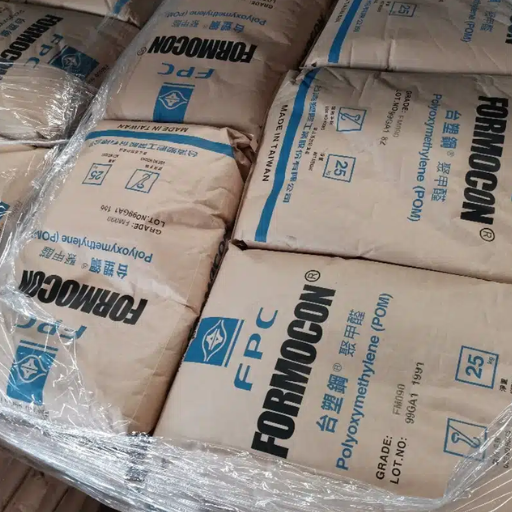
These are typical datasheet values from the current Polyplastics DURACON POM grade catalogue, not specifications. The table covers the DURACON grades buyers ask for most, including DURACON M90-44 and DURACON GH-25. Melt flow rate (MFR, g/10 min) and melt volume rate (MVR, cm³/10 min) are different measurements at 190 °C/2.16 kg and must not be compared directly. Heat deflection temperature (HDT) is ISO 75 at 1.8 MPa; the ASTM D648 figures printed beside them in distributor tables run 10–15 °C higher.
| Grade | Type | MFR / MVR | Density | Tensile | Modulus | HDT | Shrinkage |
|---|---|---|---|---|---|---|---|
| M90-44 | Standard | 9.0 / 8.0 | 1.41 | 62 MPa | 2,700 MPa | 95 °C | 2.3 / 2.1% |
| M25-44 | High viscosity | 2.5 / 2.2 | 1.41 | 59 MPa | 2,500 MPa | 90 °C | 2.7 / 2.3% |
| M140-44 | High flow | 14 / 12 | 1.41 | 62 MPa | 2,700 MPa | 100 °C | 2.2 / 2.3% |
| M270-44 | High flow | 27 / 23 | 1.41 | 63 MPa | 2,800 MPa | 100 °C | 2.2 / 2.2% |
| M450-44 | Super high flow | 45 / 38 | 1.41 | 63 MPa | 2,800 MPa | 100 °C | 2.0 / 2.0% |
| M90-45 | UV stabilised | 9.0 / 8.0 | 1.41 | 62 MPa | 2,700 MPa | 95 °C | 2.4 / 2.0% |
| M90-57 | Food / drinking water | 9.0 / 8.0 | 1.41 | 66 MPa | 2,700 MPa | 95 °C | 2.2 / 2.3% |
| GH-25 | 25% glass fibre | 2.5 / 1.8 | 1.59 | 136 MPa | 8,500 MPa | 162 °C | 0.60 / 1.0% |
| GB-25R | 25% glass bead | 7.0 / 5.0 | 1.59 | 59 MPa | 4,000 MPa | 110 °C | 1.9 / 1.6% |
| TR-10D | 10% talc | 39 / 31 | 1.48 | 57 MPa | 3,700 MPa | 112 °C | 1.8 / 1.8% |
| CH-10 | 10% carbon fibre | 4.0 / 3.3 | 1.44 | 116 MPa | 8,800 MPa | 163 °C | 1.1 / 0.90% |
| NW-02 | POM + PE sliding | 20 / 18 | 1.36 | 52 MPa | 2,350 MPa | 85 °C | 2.4 / 2.3% |
| JW-03 | Lubricated, high flow | 46 / 39 | 1.40 | 54 MPa | 2,600 MPa | 98 °C | 2.0 / 1.9% |
| TF-20 | Impact modified | 8.0 / 7.0 | 1.37 | 45 MPa | 1,700 MPa | n/v | 2.0 / 1.9% |
| SF-20 | High impact, softest | n/v | 1.28 | 33 MPa | 1,300 MPa | 62 °C | 2.3 / 1.9% |
| HP90X | High rigidity | 9.0 / 8.0 | 1.41 | 68 MPa | 2,950 MPa | 100 °C | 2.1 / 2.4% |
Three notes on reading this table.
M90-57 is not a certified M90-44. At the same 9 g/10 min flow it gives 66 MPa tensile and 9.0 kJ/m² notched Charpy against 62 MPa and 6.0 kJ/m² for M90-44. If your application is food or drinking water, quote the -57 data, not the standard grade’s.
GH-25 is where the market data goes wrong most often. The catalogue says MFR 2.5. At least one marketplace page prints 12. A glass-filled grade at MFR 12 would flow like an unfilled high-flow grade; it does not exist.
Where the n/v cells come from. Shrinkage for the sliding, mineral, carbon-fibre and impact grades is not on the open catalogue sheet, so it is taken from the same UL Prospector records as the rest of the row. The few cells still marked n/v are values neither the catalogue nor the material databases publish, and this page leaves them blank rather than copying a broker’s number.
For the cross-brand flow ladder and the troubleshooting matrix, see the POM injection molding grade page. That page owns the selection decision; this one owns the DURACON-specific data.
DURACON vs Delrin vs Hostaform
DURACON and Hostaform are both POM copolymer (POM-C). Delrin is POM homopolymer (POM-H). That single difference drives most of the practical behaviour.
DURACON vs Delrin: POM-C against POM-H
The copolymer backbone ends in a stable ester group rather than a hydroxyl end group, which is why POM-C resists hydrolysis, hot water and dilute alkalis better than POM-H. POM-H is slightly stiffer and stronger, and it machines well and holds tolerance. In a part that sees hot water or steam, POM-H is the risk and POM-C is the default.
DURACON vs Hostaform: same chemistry, different approvals
Against Hostaform, DURACON’s differences are less about chemistry and more about the grade range and the approvals. DURACON’s OEM approvals (Ford, GM, Hyundai and Stellantis specifications appear on the UL Prospector record, alongside the domestic Japanese OEM chain) are why a Japanese Tier 1 will specify M90-44 by name and require a deviation to use anything else. The BASF Ultraform POM page covers the third major copolymer brand.
Equivalent grades are similarity scores, not cross-references
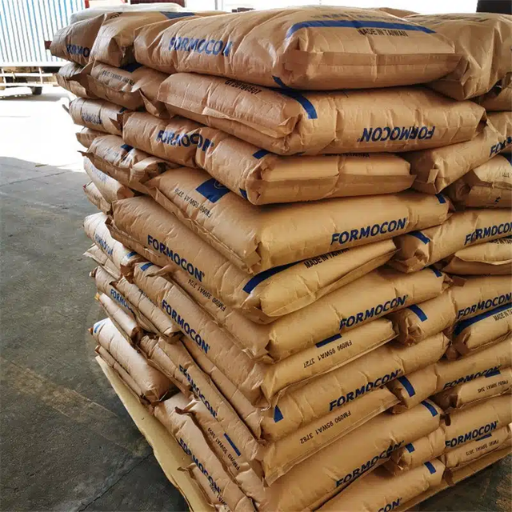
Grade equivalences are the most misused table in this market. Databases map M90-44 to Hostaform C9021, KEPITAL F20-03, FORMOCON FM090, TENAC-C 4520, KOCETAL K300 and Delrin 500P. Those are similarity scores from property data, not manufacturer cross-references. Substituting one for another voids the OEM approval on the part, and in a regulated application it also voids the declaration the approval was built on.
Two corrections worth carrying into any internal document. The -44 suffix has no official published meaning. It is a formulation family observed across datasheets, not a flow code.
And M450-44 is not a high-viscosity grade; it is a super-high-flow grade at 45 g/10 min. The high-viscosity, extrusion and blow-moulding grade is M25-44 at 2.5.
Where DURACON Is Made: Fuji, Kaohsiung, Kuantan and Nantong

DURACON is polymerised at four sites, all in Asia. There is no DURACON polymerisation plant in Europe or the Americas.
| Site | Country | POM since | Capacity |
|---|---|---|---|
| Fuji | Japan | 1968 | 100,000 t/y from 1995 |
| Dafa, Kaohsiung | Taiwan | 1992 | 20,000 t/y at start |
| Kuantan | Malaysia | 2000 | 30,000 t/y at start; 123,000 t/y reported after the 2013 expansion |
| Nantong | China | 2005; current line 2024 | 90,000 t/y |
Three things about this table are routinely stated wrong.
Nantong has a gap in its history. The original 60,000 t/y line, built as PTM Engineering Plastics, was shut in 2021 after the Nantong development zone ordered a chemical plant in the north district to stop. For roughly three years Polyplastics supplied the Chinese market mainly from Kaohsiung. The 90,000 t/y line that started at the end of November 2024 is a new line after a shutdown, not a continuously operating replacement. Any statement that DURACON has been made in China without interruption since 2005 is wrong, and any China-origin claim dated before late 2024 needs checking.
The Chinese plant is a joint venture. DP Engineering Plastics (Nantong) is 70% Polyplastics and 30% Global Polyacetal, a Mitsubishi Gas Chemical subsidiary, with capital of US$187 million. The site polymerises; a separate company, now Daicel HPP (Nantong) Ltd., compounds.
Compounding is not polymerisation. A lot compounded in China from imported Japanese resin does not become Chinese-origin. The goods stay in the same tariff heading, so there is no change in tariff classification, and China’s origin rules let customs disregard processing carried out to circumvent an anti-dumping measure. If a seller says “made in China” about a compounded lot, ask for the polymerisation site, not the compounding site.
Polyplastics publishes no current group capacity, and its own history page records only the Kuantan startup figure and a 2016 compound expansion. The Kuantan POM total rests on trade reporting of a 2013 expansion, not on the company history. The figures above are each site’s last published nameplate and are not additive into a reliable group total: the Nantong number dates from 2024 and the Fuji figure from 1995. Treat any group number you see quoted as a sum of dated nameplates, not as a current statement.
China Anti-Dumping Duty on DURACON: Two Measures, Two 2026 Successions
China applies two separate anti-dumping measures to POM copolymer, and the rate follows where the polymer is made, not the brand. A Japanese-origin lot and a Malaysian-origin lot of the same grade are assessed under different measures.
The 2025 measure: Japan, Taiwan, the EU and the US
The first measure covers Japan, Taiwan, the EU and the US. MOFCOM Announcement No. 25 of 2025, effective 19 May 2025 and running five years, sets these rates:
| Origin | Producer | Rate |
|---|---|---|
| Japan | Polyplastics Co., Ltd. | 35.5% |
| Japan | Asahi Kasei Corporation | 24.5% |
| Japan | All other Japanese companies | 35.5% |
| Taiwan | Polyplastics Taiwan Co., Ltd. | 3.8% |
| Taiwan | Formosa Plastics Corporation | 4.0% |
| Taiwan | All other Taiwan companies | 32.6% |
| EU | Celanese Production Germany GmbH & Co. KG | 34.5% |
| EU | All other EU companies | 34.5% |
| US | Ticona Polymers, Inc. | 74.9% |
| US | All other US companies | 74.9% |
The Korea, Thailand and Malaysia measure
The second measure covers Korea, Thailand and Malaysia. It began as Announcement No. 61 of 2017 and was continued by the expiry review in Announcement No. 38 of 2023, effective 24 October 2023 and running to 23 October 2028:
| Origin | Producer | Rate |
|---|---|---|
| Malaysia | Polyplastics Asia Pacific Sdn. Bhd. | 8.0% |
| Malaysia | All other Malaysian companies | 9.5% |
| Korea | Korea Engineering Plastics Co., Ltd. | 30.0% |
| Korea | Kolon Plastics, Inc. | 6.2% |
| Korea | All other Korean companies | 30.4% |
| Thailand | Thai Polyacetal Co., Ltd. | 18.5% |
| Thailand | All other Thai companies | 34.9% |
The 2026 successions, and the old-name trap
Kolon’s rate had already moved once before. Announcement No. 22 of 2024 transferred it from Kolon Plastics, Inc. to Kolon ENP, Inc. on 20 June 2024. On 5 June 2026, MOFCOM Announcement No. 22 of 2026 transferred the Malaysian rate to Daicel HPP Malaysia Sdn. Bhd. at 8.0%, and the Korean Kolon rate to Kolon Industries, Inc. at 6.2%. On 21 August 2026, Announcement No. 36 of 2026 transferred the Japanese rate to Daicel Corporation at 35.5% and the Taiwanese rate to Daicel HPP Taiwan Co., Ltd. at 3.8%.
Here is what most quotes get wrong. The succession decisions do not simply retire the old names. They expressly name the old companies and assign each of them the residual “all other companies” rate. The bad rate is written into the decision:
| Shipment declared as | Rate |
|---|---|
| Polyplastics Co., Ltd. (Japan, old name) | 35.5% (same number, documentation risk only) |
| Polyplastics Taiwan Co., Ltd. (old name) | 32.6% against 3.8% under the new name |
| Polyplastics Asia Pacific Sdn. Bhd. (old name) | 9.5% against 8.0% under the new name |
| Kolon ENP, Inc. (Korea, superseded name) | 30.4% against 6.2% under Kolon Industries |
For Taiwan the swing is 28.8 percentage points, decided entirely by which company name appears on the export declaration. A buyer comparing two Taiwanese quotes for the same grade can be looking at two different duty outcomes without knowing it.
The “modified POM” exemption is narrower than traders say
The measure states that homopolymer POM and modified POM under the same tariff lines fall outside scope, and the market has read that as a blanket pass for glass-filled and impact grades. MOFCOM rejected the argument that the national GB definition of “modified plastics” carves anything out. Scope is judged on the product description and a set of simultaneous property indicators:
- MFR at 190 °C/2.16 kg, by band
- Melting point 160 °C up to but not including 170 °C
- Density 1.38–1.43 g/cm³
- Yield stress of at least 58 or 60 MPa, depending on band
- Nominal strain at break of at least 20% or 15%, depending on band
- Tensile modulus of at least 2,400 MPa
- Notched Charpy impact of at least 5.5, 4.5 or 3.0 kJ/m², depending on band
- HDT at 1.8 MPa of at least 85 °C
On its datasheet, GH-25 at 1.59 g/cm³ and SF-20 at 1.28 g/cm³ sit outside that density window. That is a datasheet comparison, not a ruling. Customs applies the indicators grade by grade on the technical data you submit, and a declaration under the wrong code is the importer’s liability.
The documents decide the rate
Under GACC Announcement No. 9 of 2001, the importer must submit a certificate of origin when declaring goods identical to the dumped product, plus the original manufacturer’s invoice. If the goods come through a trader, the commercial invoice must show the manufacturer’s name and the original invoice number. If origin cannot be established, the highest rate for the product applies. The eight-digit tariff lines are 39071010 and 39071090. The ten-digit declaration code is set nationally by GACC and changes with each measure’s implementing announcement, so confirm the current code with your broker rather than copying one from a website.
Scope box: both measures apply to imports into China. They do not apply to a buyer in the US, EU, India or Southeast Asia importing Chinese-origin resin into their own market.
This is a sourcing guide, not legal or customs advice. Duty treatment depends on the origin, producer and exporter named at import. Confirm with your broker, or request an advance ruling from the competent customs district at least three months before import.
DURACON Properties and Processing Window

What is DURACON M90-44?
DURACON M90-44 is the standard-viscosity, general-purpose grade of Polyplastics DURACON POM. It is an unfilled acetal copolymer with a nominal melt flow rate of 9 g/10 min, and it is the grade most buyers mean when they say DURACON, across automotive, appliance and industrial parts.
Datasheet values for the same grade:
| Property | Value |
|---|---|
| Density | 1.41 g/cm³ |
| MFR / MVR (190 °C/2.16 kg) | 9.0 g/10 min / 8.0 cm³/10 min |
| Tensile stress at yield | 62 MPa |
| Tensile modulus | 2,700 MPa |
| Flexural strength / modulus | 87 MPa / 2,500 MPa |
| Notched Charpy impact | 6 kJ/m² |
| HDT at 1.8 MPa | 95 °C |
| Rockwell hardness | M80 |
| Water absorption, 24 h | 0.50% |
| Mould shrinkage | 2.3% flow / 2.1% cross-flow |
| Flammability | UL94 HB, UL file E45034 |
The processing window is narrower than a lot of shop-floor settings assume. Dry at 80–90 °C for 3–4 hours. Melt at 190–210 °C. Mould at 60–80 °C, with 80 °C typical. Injection pressure 50–100 MPa, screw speed 100–150 rpm.
The mould temperature is the value most often set wrong. A tool run at 100–120 °C will fill, and it will produce a part, with a different cycle time and a different shrinkage from the one the tool was cut for. POM does not need a hot mould the way an engineering polyamide does.
POM degrades by unzipping from the chain ends above roughly 220–230 °C. The warning sign is a formaldehyde smell at the nozzle; if you smell it, the residence time or the set temperature is too high. Purge with polyethylene or polypropylene, not with the material you are running.
Food-Contact and Medical Grades: M90-57, WK2001 and the PM Series
Food contact in DURACON is grade-specific, variant-specific and plant-specific. That is three levels of “it depends”, and most catalogue pages collapse them into the words “food grade”.
The food-contact variant is WK2001, and it is listed under NSF/ANSI 51. The current listing, company C0207179, now reads Daicel Corporation (itself a useful proof that the corporate change happened), and the listed facility is Pahang D.M., Malaysia, the Kuantan plant. Eight products are listed: EX-09 WK2001 and WK2001BG, M25-44 WK2001, M270-57 WK2001 and WK2001BG, M90-44 WK2001, and M90-57 WK2001 and WK2001BG.
Every entry is natural colour, covers all food-contact types, is rated to 250 °F and is repeated-use only. The -57 entries and both EX-09 WK2001 variants additionally exclude foods containing more than 15% alcohol.
So “food grade DURACON” isn’t a grade. It is a named variant, made at a named plant, under a named listing, with conditions. If a quote offers you M90-44 for a food application without WK2001, it is not the same material.
Medical is a separate family. PM09S01N and PM27S01N carry ISO 10993 and USP Class VI documentation and an FDA drug master file, and are validated for steam at 121 °C and 135 °C and for ethylene oxide. Gamma and electron-beam sterilisation are not recommended. The PM range is not implant grade, and a standard M grade is not a substitute in a device.
Both 21 CFR 177.2470 in the US and EU 10/2011 in Europe govern the copolymer. The declaration has to match the grade, the variant and the plant on the lot you receive.
DURACON POM Supplier: Price, MOQ and Lead Time
DURACON prices spread wide because the quote is rarely for the same thing twice. Grade suffix, plant, colour code, declaration, packaging, lot size and whether the seller is a stockholder, a trader or a relabeller all move the number.
Observed listings on 5 November 2026, labelled as observations rather than a market price:
| Basis | Range |
|---|---|
| M90-44, Japan origin, export FOB | US$1,610–2,730/t, dense cluster US$2,350–2,400 |
| M90-44, all origins and labels | US$1,530–3,410/t |
| M90-44 WK2001 | US$1,810–2,400/t |
| GH-25 | US$2,640–4,800/t |
| M25-44 | US$2,600–3,520/t |
| M90-44, domestic China | ¥12.00–30.50/kg, most offers ¥13.50–18.00 |
Two things about that table. RMB domestic and USD FOB are different markets and cannot be compared line by line. And the origin field in Chinese listings is unreliable: most pair a “Japan origin” claim with 是否进口:否, which means “not imported”.
That label may mean the seller is not the importer, or that the resin is domestic; either way it is not a certificate of origin. Only the COO plus the manufacturer’s invoice settles it.
Almost no listing commits to a COA or a COO in its text. A shipment package that states what documents travel with the lot (COA matched to the production lot, TDS at the current revision, SDS, COO, REACH and RoHS declarations where required, and the anti-dumping declaration) is worth more than a 5% price difference, because the 28.8-point Taiwan swing is larger than any price negotiation on this page.
For the cost drivers behind these numbers, see the POM resin price guide. For container maths and volume terms, the bulk POM resin page covers packaging and MOQ.
Our own terms: 25 kg trial bags, stock 7–14 days, indent 30–45 days, EXW, FOB Shanghai or CIF. Confirm the current schedule at enquiry.
Frequently Asked Questions
Is DURACON still a Polyplastics brand, or is it Daicel now?
Both names are current in different senses. DURACON is still the Polyplastics brand, and Polyplastics grade names still appear on datasheets and approvals. The legal entity still exists: it was renamed HPP Holdings Co., Ltd. on 1 April 2026, as Daicel’s own announcement of the split records. The operating business, including DURACON, now sits in Daicel Corporation’s High Performance Polymers SBU, so expect Daicel on new COAs and export declarations.
Does DURACON POM pay China’s anti-dumping duty?
It depends on where the polymer was made, not on the brand. A shipment still declared under an old company name is assessed at the residual rate for that origin.
| Origin | Producer named on the declaration | Rate |
|---|---|---|
| Japan | Daicel Corporation | 35.5% |
| Taiwan | Daicel HPP Taiwan Co., Ltd. | 3.8% |
| Malaysia | Daicel HPP Malaysia Sdn. Bhd. | 8.0% |
| China, sold domestically | Not an import | No duty |
Is DURACON a homopolymer or a copolymer?
DURACON is an acetal copolymer, POM-C. Its polymer backbone ends in a stable ester group rather than the hydroxyl end group of POM homopolymer, so it resists hydrolysis, hot water and dilute alkalis better than Delrin. Every DURACON grade, including the glass-filled and medical families, is a copolymer.
Is DURACON the same as Delrin?
No. Delrin is POM homopolymer, now an independent company after DuPont sold a majority stake to TJC in 2023. DURACON is POM copolymer.
What is DURACON POM used for?
It goes into automotive fuel-system and interior parts, appliance components, plumbing and water-contact parts, power tools, gears, bearings and precision moulded parts. The copolymer backbone is why it holds up in hot-water and fuel-contact applications where a homopolymer would hydrolyse.
What is the difference between DURACON M25-44, M90-44 and M270-44?
The M-number is ten times the nominal melt flow rate, so the three grades differ in flow, not in chemistry. Higher flow fills thinner walls at lower pressure, but it leaves a narrower processing window.
| Grade | MFR (g/10 min) | Wall section it fills |
|---|---|---|
| DURACON M25-44 | 2.5 | Thick sections, rod, sheet and extrusion |
| DURACON M90-44 | 9 | General-purpose injection moulding |
| DURACON M270-44 | 27 | Thin walls, long flow paths, multi-cavity tools |
Is DURACON M450-44 a high-viscosity grade?
No. M450-44 is a super-high-flow grade at 45 g/10 min, for micro parts and high-cavity tooling. M25-44 is the high-viscosity grade.
What do the -44, -45, -48 and -57 suffixes mean?
Observed families rather than published definitions: -44 standard, -45 weather stabilised, -48 antistatic, -57 food-contact and drinking-water compliant. Creep resistance sits in the CP series, such as CP15X, not in a -48 suffix. Polyplastics does not publish a formal decoder.
What is DURACON GH-25, and how much glass fibre does it contain?
A 25% glass-fibre reinforced grade, part marking >POM-GF25<, at 136 MPa tensile and 8,500 MPa modulus, with HDT at 162 °C.
Which DURACON grades are food-contact approved?
The WK2001 variants: EX-09, M25-44, M90-44, M90-57 and M270-57, all listed under NSF/ANSI 51 at the Pahang plant in Malaysia, natural colour, repeated use only, with no foods above 15% alcohol for the -57 entries and both EX-09 WK2001 variants.
Is there a medical-grade DURACON?
Yes: PM09S01N and PM27S01N, with ISO 10993, USP Class VI and FDA DMF/MAF documentation. They are not implant grades.
Can DURACON POM be gamma sterilised?
The PM-series documentation recommends steam and ethylene oxide and does not recommend gamma or electron beam. Confirm the sterilisation method against the device file before you specify.
What are DURACON’s melting point and maximum continuous use temperature?
Melting point is in the 160–170 °C range, and the HDT at 1.8 MPa for the standard grades is 90–100 °C. Continuous use temperature depends on load and environment; use the HDT and the datasheet curve, not a single number.
Can DURACON POM be machined or glued?
Yes to machining, and the high-viscosity M25-44 is the usual choice for rod and sheet. Bonding works with surface preparation; mechanical fastening is more common in structural parts.
Where can I buy DURACON POM in 25 kg bags?
Ask for the grade code, the plant and the declaration requirements together. A supplier who can answer all three in one reply is quoting material they can document. Send us the grade code and we will answer with the plant and the rate.
Request a DURACON POM Supplier Quote
Send us the grade code, the colour, the volume and the destination. If the part is regulated, tell us which declaration you need (food contact, medical, or the anti-dumping documentation for a Chinese import), and we will confirm what travels with the lot.
We supply Polyplastics DURACON POM through established channels. Where your qualification process requires a brand authorization letter, tell us at enquiry and we will confirm exactly what documentation we can provide for that brand.