
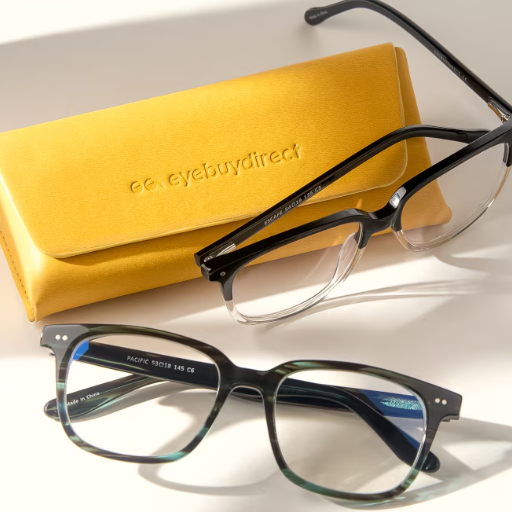
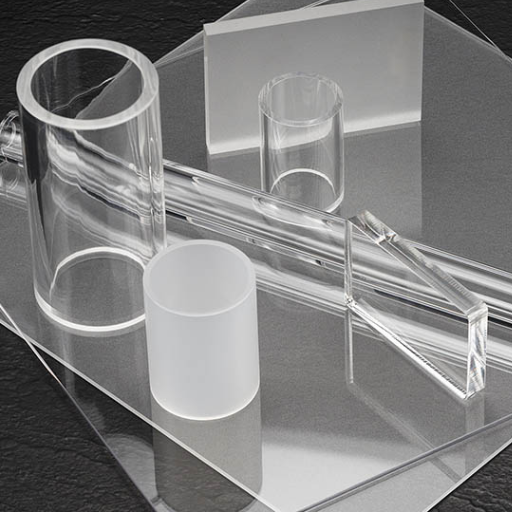



A clear plastic part looks identical whether it costs two dollars a kilogram or twelve. Under a light it is the same. In the hand it is the same. The difference only shows up months later, when one part is still water-clear and the other has gone hazy, or when a batch fails incoming inspection against a spec nobody read carefully.
That gap is what this guide closes. PMMA material, short for polymethyl methacrylate and sold everywhere as acrylic, is the clearest, hardest, most UV-stable transparent thermoplastic on the market. It’s also one of the easiest to get wrong, because “clear acrylic” is not a specification.
By the end you’ll know what PMMA is at the molecular level, the properties engineers actually specify against, how cast sheet differs from the pellets used in injection molding, which grade bands fit which parts, and how to verify that what you buy is genuine branded PMMA rather than relabeled compound. Along the way we’ll name the branded grades we stock, from Mitsubishi Acrypet to Trinseo ALTUGLAS. If you already know your application and just need a certified grade, request a quote and our team replies within 24 hours.
What Is PMMA Material?
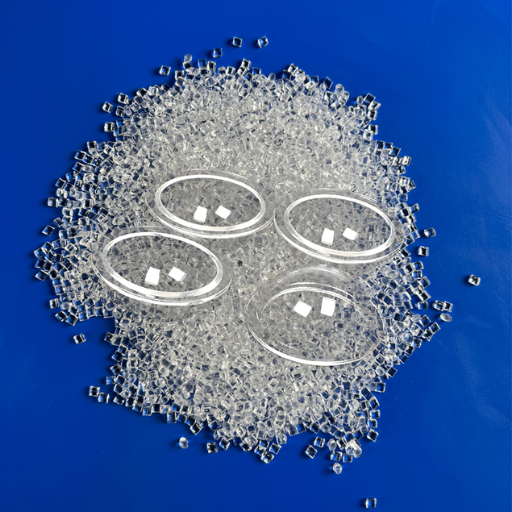
PMMA material is a transparent, amorphous thermoplastic made by polymerizing methyl methacrylate (MMA) monomer. It is known commercially as acrylic or acrylic glass, and by the trade names Plexiglas and Lucite.
The chemistry explains the clarity. MMA monomer has a bulky methyl and ester side group hanging off the carbon backbone, and that bulk keeps the polymer chains from packing into ordered crystals. Light passing through finds no crystalline boundaries to scatter it, which is why PMMA transmits more visible light than almost any other plastic, and more than typical glass.
PMMA is made three ways, and each route feeds a different market. Bulk polymerization produces cast sheet and rod, the highest-clarity form. Suspension polymerization produces beads that are compounded into pellets for injection molding and extrusion. Emulsion polymerization produces fine particles for coatings and paints. When an engineer says “PMMA resin,” they almost always mean the pellet form, and that is the form we supply.
“PMMA” and “acrylic” are the same polymer. Acrylic is the commercial name; polymethyl methacrylate is the chemical one. The terminology gets tangled in sourcing documents, so we broke the naming down separately in our guide on PMMA vs acrylic.
Key Properties of PMMA Material
The table below is the fastest way to see what PMMA material does. Every row comes from a standard test, so you can drop it straight into a specification.
| Property | PMMA Material | Test Standard |
|---|---|---|
| Light transmission | 92 to 93% | ASTM D1003 |
| Refractive index | ~1.48 to 1.49 | ASTM D542 |
| Haze | under 2% (under 1% optical grades) | ASTM D1003 |
| Tensile strength | 50 to 77 MPa | ASTM D638 / ISO 527 |
| Flexural modulus | ~3.2 GPa | ASTM D790 / ISO 178 |
| Rockwell hardness | M80 to M100 | ASTM D785 |
| Notched Izod impact | ~15 to 20 J/m (notch-sensitive) | ASTM D256 / ISO 180 |
| Heat deflection temperature | 75 to 100 °C (grade-dependent, at 0.45 MPa) | ASTM D648 / ISO 75 |
| Glass transition (Tg) | ~105 °C | ASTM D3418 |
| Density | 1.17 to 1.20 g/cm³ | ASTM D792 |
| Water absorption | ~0.3 to 0.4% in 24 hours (hygroscopic) | ASTM D570 |
| Flammability | UL94 HB (combustible, does not self-extinguish) | UL94 |
| Melt flow index (injection grades) | ~4 to 14 g/10 min | ASTM D1238 / ISO 1133 |
Optical Properties
PMMA transmits 92 to 93% of visible light, the highest of any transparent thermoplastic and close to glass at 93 to 95%. Haze sits under 2% in standard grades and under 1% in optical grades, and the refractive index runs near 1.49.
Those numbers frame the design. A lens, a light guide, or a display cover is optical equipment, and the grade you specify sets the transmission, the haze, and the color you start from. That starting point is a buyer’s problem too, which is why optical PMMA is always qualified against a datasheet rather than a description. The technical breakdown from SpecialChem is a useful reference for the polymer itself.
Mechanical Properties
PMMA is the hardest common transparent thermoplastic. Rockwell hardness runs M80 to M100, tensile strength lands between 50 and 77 MPa, and flexural modulus sits near 3.2 GPa. It machines and polishes to an optical finish more easily than most plastics.
The weak point is impact. PMMA is notch-sensitive and fails by brittle fracture, which is the single reason it does not appear in safety glazing. If your part must take a hit, that is a polycarbonate conversation from the start. We ran the full comparison in PMMA vs polycarbonate.
Designing an optical or transparent part? Tell us the light transmission, haze, and impact conditions your application needs, and we will match a certified PMMA grade against real datasheet values. Request a spec-matched quote and we respond within 24 hours.
Thermal Properties
PMMA is amorphous, so it has no true melting point. Instead it softens gradually as it crosses its glass transition temperature of about 105 °C, and its heat deflection temperature runs 75 to 100 °C depending on grade. Continuous service typically stays between 65 and 95 °C.
This is where beginners get caught. A part can look fine at room temperature and creep or distort in a warm enclosure, because PMMA has no sharp melting line to warn you. We unpacked the softening behavior in PMMA melting point, and the transition itself in PMMA glass transition temperature. For a cross-material view of how those limits compare, see our engineering plastic temperature guide.
Density and Weight
PMMA density runs 1.17 to 1.20 g/cm³, roughly half the weight of glass. That lightness is a real engineering advantage, and in automotive glazing it cuts component weight by an estimated 40 to 50%, which matters for fuel economy and for the range of an electric vehicle.
Weather, UV, and Chemical Resistance
PMMA filters UV below roughly 300 to 400 nm on its own, so it needs no additive package to survive sunlight. Test data puts yellowing under 5% after 5,000 hours of QUV-A exposure, and outdoor signage and skylights in acrylic hold their clarity for years.
Chemically, PMMA resists dilute acids, dilute alkalis, alcohols, aliphatic hydrocarbons, and mineral oils. It’s attacked by ketones, esters, chlorinated hydrocarbons, ethers, and aromatics, which show up as crazing and surface damage.
| Chemical Group | Example | PMMA Resistance |
|---|---|---|
| Dilute acids | Vinegar, dilute sulfuric acid | Good |
| Dilute alkalis | Dilute sodium hydroxide | Good |
| Alcohols | Ethanol, methanol | Limited |
| Aliphatic hydrocarbons | Kerosene, gasoline | Good |
| Mineral oils and greases | Motor oil | Good |
| Ketones | Acetone, MEK | Poor (dissolves) |
| Esters | Ethyl acetate | Poor (dissolves) |
| Chlorinated hydrocarbons | Methylene chloride | Poor (dissolves) |
| Aromatics | Toluene, benzene | Poor (swells and crazes) |
That solvent list is why the sign industry uses acrylic bonding cement, itself a solvent, to weld PMMA edges, and why you never clean an acrylic window with acetone. One safety note worth repeating: standard PMMA burns and rates UL94 HB, so it does not belong anywhere a flame rating is mandatory.
Forms of PMMA Material: Cast, Extruded, and Pellets
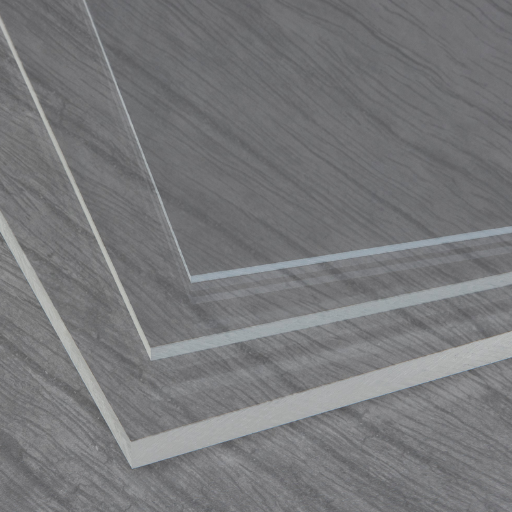
Most head-term guides treat PMMA as one material. It is not. The form you buy sets the price, the properties, and the supplier you work with, and the three forms follow almost completely separate supply chains.
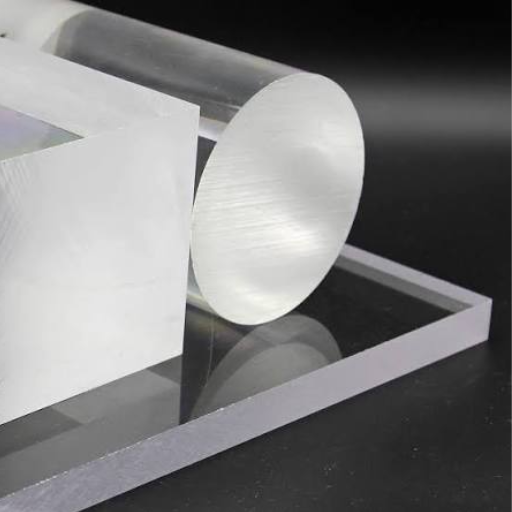
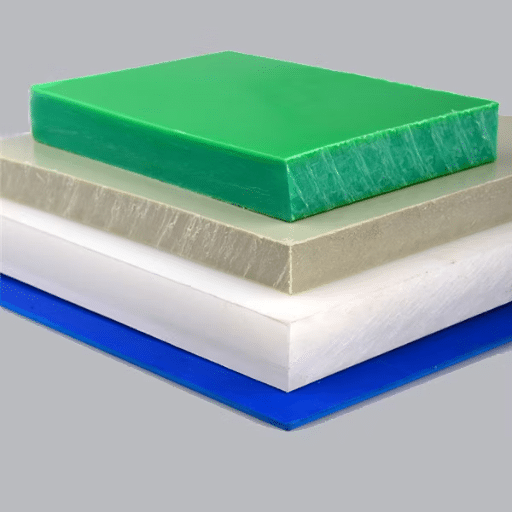
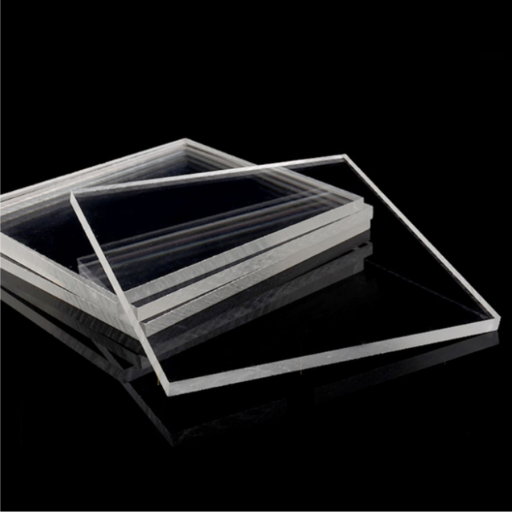
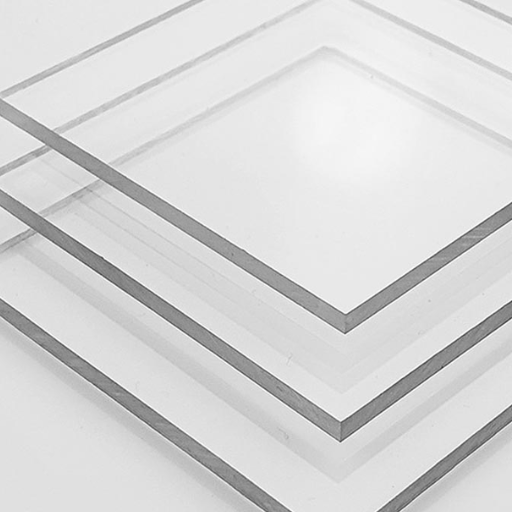
Cast sheet is made by pouring MMA monomer between glass plates and polymerizing it in place. Molecular weight is high, residual stress is low, and the optics are the best available. This is the PMMA of museum cases, aquariums, and thick glazing.
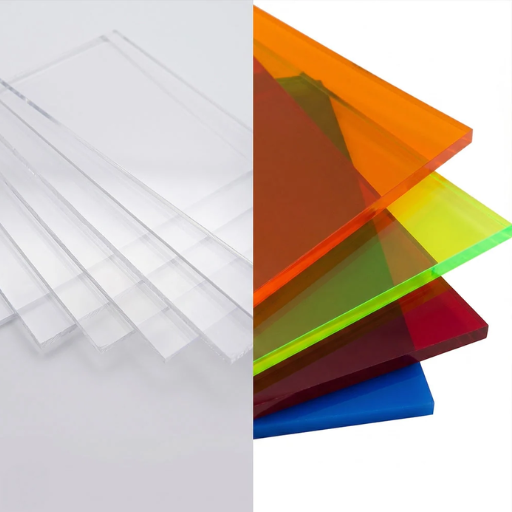
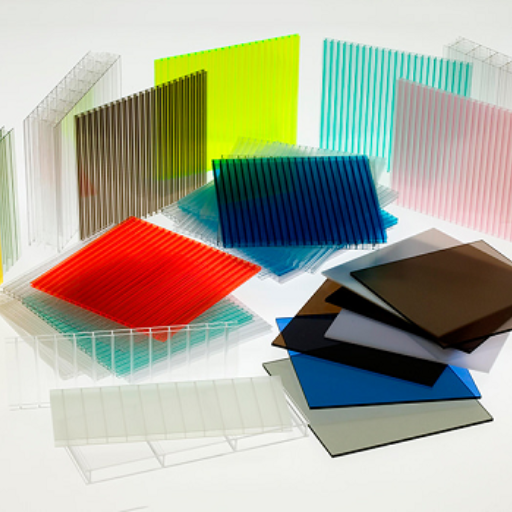
Extruded sheet is made by pushing molten PMMA pellet through a die. It is cheaper and more uniform in thickness, with slightly lower optical purity and higher internal stress. It suits signage, point-of-sale displays, and general fabrication.
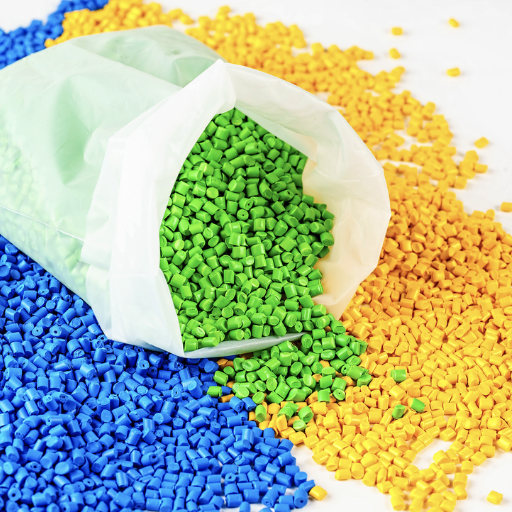
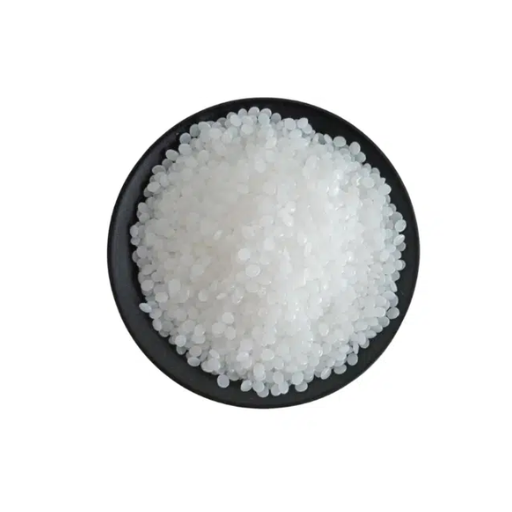
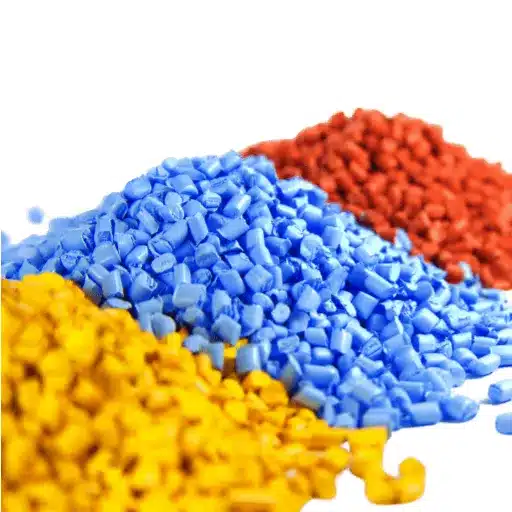
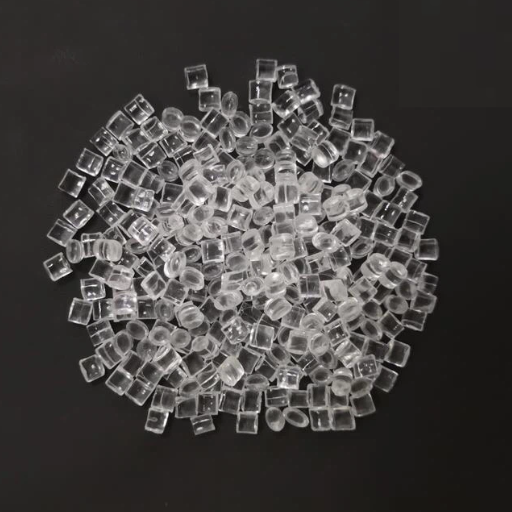
Pellets are the injection-molding and extrusion feedstock. This is the form a molder buys by the 25 kg bag, and it’s the form we supply. If your process is injection molding, extrusion, or compounding, you’re a pellet buyer even if every article you have read talks about sheet.
| Form | How It Is Made | Best Optics | Typical Use | Who Buys It |
|---|---|---|---|---|
| Cast sheet | MMA poured between glass plates | Highest | Aquariums, museum cases, thick glazing | Fabricators, glaziers |
| Extruded sheet | Molten pellet pushed through a die | Good | Signage, point-of-sale, general fabrication | Fabricators, sign makers |
| Pellets | Suspension polymerization, then compounded | Grade-dependent | Injection molding, extrusion, compounding | Molders, compounders |
That distinction matters at the point of purchase. Google’s head results for “PMMA material” assume sheets and glazing. A molder sourcing pellets needs melt flow data, grade numbers, and a Certificate of Analysis, none of which a sheet product page will give.
The mix-up costs real money. A display maker in Shenzhen once quoted a project against cast-sheet prices, then discovered the part had to be injection molded in an optical grade. The sheet supplier could not help, because sheet and pellet PMMA sit in entirely different supply chains, and the molder had to restart qualification with a pellet source. Knowing which side of that line your part falls on is the first sourcing decision, ahead of price and ahead of grade.
PMMA Grades for Injection Molding
Within the pellet world, the grade number carries the specification. Melt flow index (MFI) is the fastest way to sort them, because it predicts how the material behaves in a thin wall, a long flow path, or a thick part. All values below are approximate and should be confirmed against the current manufacturer datasheet.
| Grade Type | MFI (g/10 min) | Best For | Example Grades |
|---|---|---|---|
| High-flow | ~10 to 14 | Thin walls, micro-features, Fresnel lenses | LG Chem IF850, Acrypet VH |
| General-purpose | ~4 to 6 | Standard optical parts, lenses, covers | Acrypet MD, ALTUGLAS VS |
| Heat-resistant | ~1.5 to 2.3 | High-temperature proximity, thick parts | PLEXIGLAS NTA-3 |
| Impact-modified | ~2 to 8 | Consumer, appliance, auto interior | Acrypet MF, PLEXIGLAS NTA-5 |
High-Flow Grades (MFI ~10 to 14 g/10 min)
High-flow PMMA fills thin walls and long flow paths before it freezes. It is the right choice for Fresnel lenses, light-pipe ribs, thin display parts, and micro-features where standard grades will short-shot. LG Chem IF850 and Mitsubishi Acrypet VH are common examples. High flow runs at lower melt temperatures and shorter cycles, which helps cycle time but gives up some heat resistance.
General-Purpose Grades (MFI ~4 to 6 g/10 min)
General-purpose grades balance flow, optical quality, and mechanical strength. They cover the majority of lenses, covers, and display parts where wall sections are moderate. Mitsubishi Acrypet MD sits here, alongside Trinseo ALTUGLAS VS and comparable Röhm PLEXIGLAS grades.
Heat-Resistant Grades (MFI ~1.5 to 2.3 g/10 min)
Heat-resistant grades push heat deflection temperature above 95 °C by raising molecular weight and narrowing the flow. They need higher mold temperatures and slower cooling, and they’re the answer when a part sits close to a heat source. They fit injection molding less easily than general-purpose grades, so confirm the flow path before specifying them.
Impact-Modified Grades (MFI ~2 to 8 g/10 min)
Impact-modified PMMA blends in rubbery particles to raise notched impact well above standard acrylic, at the cost of some clarity and surface hardness. They suit appliance panels, automotive interior trim, and safety covers where a slight haze is acceptable. Mitsubishi Acrypet MF and PLEXIGLAS NTA grades fall into this group.
Choosing between these bands is the part most buyers get wrong, and it is where a mis-specified grade turns into rework. We go deeper on grade selection and sourcing in our acrylic PMMA resin sourcing guide.
Processing PMMA Material: Drying, Temperature, and Mold Design
PMMA behaves well in injection molding once you respect three things.
Drying is not optional. PMMA is hygroscopic. Damp pellets flash to steam at the gate, and the result is silver streaks, bubbles, and haze that fail optical inspection. Dry at 80 to 100 °C for 2 to 6 hours and hold moisture under 0.04% before the material reaches the barrel.
Melt and mold temperatures are moderate. Melt temperature runs 210 to 280 °C and mold temperature 35 to 90 °C. Acrylic runs cooler than polycarbonate, which means less energy and faster cooling, but the hot-material handling still demands attention on shear and residence time.
Mold shrinkage is low, between 0.2 and 0.6%. Low shrinkage helps tolerance control, and for optical parts it also raises a process rule: polish every surface the light will touch, and never gate directly onto an optical face. A gate mark on a lens is scrap.
| Parameter | Setting |
|---|---|
| Drying temperature and time | 80 to 100 °C for 2 to 6 hours |
| Moisture target | under 0.04% |
| Melt temperature | 210 to 280 °C |
| Mold temperature | 35 to 90 °C |
| Mold shrinkage | 0.2 to 0.6% |
| Screw back pressure | Low, to limit shear at the screw |
A molder in Zhejiang once ran a display-cover batch that came out with faint silver streaks and measurable haze, failing the customer’s optical spec even though every barrel temperature was on target. The dryer had been set to 60 °C overnight. The acrylic never dried properly. A switch to a desiccant dryer at 85 °C for three hours cleared the streaks on the next shift. The lesson is simple and expensive to learn twice: dry to spec, not to habit.
PMMA Material Applications by Industry
PMMA shows up wherever clarity, hardness, and UV stability carry the design.
Automotive lighting. Taillight covers and light lenses use PMMA for its UV-stable clarity and surface hardness. Headlamp lenses more often use hard-coated polycarbonate for impact resistance against road debris, so the two materials split the light fixture between them.
Optics and displays. Light guides, lenses, and display covers depend on PMMA’s 92 to 93% transmission and low haze. Optical-grade PMMA is specified where every lost photon shows up as inefficiency.
Medical and dental. Medical-grade PMMA is biocompatible and appears in intraocular lenses, bone cement, and dentures. These applications require grade-specific documentation, not just the material family.
Construction and signage. Glazing, skylights, signage, and barriers use PMMA for clarity that survives years outdoors without yellowing.
Consumer and industrial. Housings, tumblers, and lighting diffusers use PMMA where a hard, clear, UV-stable surface matters at consumer cost.
A useful way to read that list is as a grade map. Optical applications point to optical grades with tight haze control. Exterior parts point to UV-stable grades. Anything near heat points to heat-resistant grades. The material family gets you into the conversation; the grade decides whether the part works.
| Application | What It Demands | Grade Direction |
|---|---|---|
| Light guides and lenses | High transmission, low haze | Optical general-purpose or high-flow |
| Display covers | Scratch resistance, clarity | General-purpose, hard surface |
| Automotive taillights | UV-stable clarity | UV-stable, heat-resistant |
| Medical and dental | Biocompatibility, documentation | Medical-grade with FDA or ISO 10993 file |
| Signage and skylights | UV stability, weatherability | Standard or UV-stabilized |
| Appliance and interior panels | Impact resistance | Impact-modified |
Reading the matrix from the top down also tells you where acrylic is the wrong material. If the demand involves sustained high heat or a fire rating, no PMMA grade answers it, and polycarbonate or a fluoropolymer is the honest recommendation.
PMMA Material vs Glass, Polycarbonate, and Other Transparent Plastics
PMMA competes with a short list of transparent materials, and each one wins a different job. Here is the quick positioning.
| Material | Beats PMMA on | Loses to PMMA on |
|---|---|---|
| Glass | Heat resistance, scratch resistance, stiffness | Weight, impact, design freedom, breakage safety |
| Polycarbonate | Impact resistance, heat resistance, flame rating | Clarity, UV stability, scratch resistance, cost |
| Polystyrene | Cost | UV stability, optical stability over time |
| PETG | Toughness, ease of thermoforming | Clarity, surface hardness, UV stability |
The comparison to polycarbonate is the one buyers ask about most, so we gave it a full treatment in PMMA vs polycarbonate. The short version: choose PMMA when clarity, scratch resistance, and UV stability lead, and choose polycarbonate when impact and heat lead. If you need both, our polycarbonate product page covers the Makrolon grades we stock.
Sourcing PMMA Material from China
Once you know the grade, sourcing becomes a documentation exercise. Two suppliers quoting the same grade at different prices are not offering the same thing, and the difference is almost always in the paperwork.
Specify the grade and brand, not “clear acrylic.” The melt flow, the UV package, and the optical consistency live in the grade number. A quote for generic “PMMA pellets” tells you nothing about what will arrive.
Read the Certificate of Analysis before you order. For PMMA, the COA should show light transmission, haze, yellowness index, and melt flow, each cross-checked against the manufacturer’s published datasheet. It should be issued by the manufacturer against a specific production lot, not generated by the supplier from their own records.
Know the red flags. Off-spec melt flow, color or yellowness index drift between lots, recycled content hiding inside “virgin” optical grades, and missing lot traceability all point to a supply stream you cannot rely on. Price 30 to 40% below market is a prompt for investigation, not a reason to celebrate.
A medical device buyer in Germany learned why the COA matters more than the price. Their first order came from a low-cost trader who supplied a supplier-issued certificate instead of a manufacturer one. The light transmission tested fine, but the yellowness index drifted over two later lots, and the buyer could not trace either lot back to a manufacturer record for their device history file. They moved to a distributor who issued manufacturer COAs per lot, paid a few percent more, and stopped spending engineering hours on incoming disputes.
Our sourcing terms are built for qualification. We supply branded prime PMMA with lot traceability and manufacturer-issued COA, with a 25 kg minimum order, standard FOB Shanghai, and 7 to 14 day lead time depending on destination. The small minimum is deliberate. Order 25 kg from the same lot your production material will come from, run your own checks against the COA, and confirm the grade before you commit to volume. Our PMMA material supplier page lists the branded grades currently in stock.
PMMA Material Market and Price Context
Context helps when a quote looks high or low. The global PMMA market was valued near USD 5.9 billion in 2025 and is forecast to reach about USD 8.6 billion by 2034, a compound growth rate near 4.3%. Volume runs around 3.2 million tons in 2026, with Asia-Pacific taking roughly half of global demand, led by China. The 2026 price report from IMARC tracks the regional numbers.
June 2026 spot pricing put Northeast Asia near USD 2.25 per kilogram, Southeast Asia near USD 3.10, Europe near USD 3.54, and North America near USD 3.78. Three things move those numbers: the price of MMA feedstock, Chinese production capacity that is running well below nameplate and keeping global pricing competitive, and the grade itself. Optical and medical grades carry a premium over general-purpose material, and that premium is real.
Frequently Asked Questions
What is PMMA material used for?
PMMA material is used wherever clear, hard, UV-stable plastic is needed: automotive lighting, light guides and lenses, display covers, medical and dental devices, outdoor signage, glazing, skylights, and consumer products such as tumblers and lighting diffusers.
Is PMMA material the same as acrylic?
Yes. PMMA and acrylic are the same polymer. PMMA is the chemical name (polymethyl methacrylate) and acrylic is the commercial name. Acrylic glass, Plexiglas, and Lucite are trade names for the same material.
What are the key properties of PMMA material?
92 to 93% light transmission, refractive index near 1.49, tensile strength of 50 to 77 MPa, Rockwell hardness of M80 to M100, heat deflection temperature of 75 to 100 °C, glass transition near 105 °C, and density of 1.17 to 1.20 g/cm³. It is UV-stable and flammable at UL94 HB.
Is PMMA stronger than glass?
PMMA is more impact-resistant than ordinary glass, which is why it replaces glass in glazing and covers, and it weighs around half as much. Glass remains harder and more heat-resistant. PMMA is roughly a tenth the weight of glass at equal thickness and far less prone to shattering.
What is the difference between PMMA and polycarbonate?
PMMA is clearer, harder, more UV-stable, and cheaper. Polycarbonate is far tougher in impact, more heat-resistant, and available with UL94 V-0 flame ratings. Choose PMMA for clarity and weathering; choose polycarbonate for impact and heat.
Is PMMA material FDA-approved for food contact?
Specific PMMA grades are compliant with FDA food-contact requirements, but compliance lives at the grade level, not the material family. Not every PMMA grade carries the documentation. Always confirm the specific grade and request the compliance certificate.
How do I source certified PMMA material from China?
Specify the brand and grade, request a manufacturer-issued Certificate of Analysis, cross-check light transmission, haze, yellowness index, and melt flow against the datasheet, confirm lot traceability, and qualify with a 25 kg sample from the production lot before scaling to volume.
Conclusion
PMMA material is the clearest, hardest, most UV-stable transparent thermoplastic you can specify, and none of that guarantees a working part on its own. The properties live in the grade, the grade lives in the number, and the number is only as trustworthy as the documentation behind it.
The rule that saves the most money is the one buyers skip. Cast sheet and injection pellets are different products with different supply chains, and a molder who specs “clear acrylic” is not specifying anything. Name the grade, name the brand, and read the COA against the datasheet before the first bag is opened.
We supply branded prime PMMA with full Certificate of Analysis documentation, including Mitsubishi Acrypet, LG Chem IF850, and Trinseo ALTUGLAS grades, from a 25 kg minimum order with FOB Shanghai pricing and 7 to 14 day lead times.
Tell us your application, the light transmission you need, the temperature it will see, and the impact it must survive, and we will recommend the right PMMA grade for the job. If your part runs hotter or takes more of a hit than acrylic can handle, we will say so and point you to polycarbonate or a heat-resistant grade instead.
Request a quote for certified PMMA material and get a recommendation backed by real datasheets, with every batch documented and traceable to the manufacturer lot.