




Ask three suppliers for the density of PMMA and you’ll get three answers: 1.18, 1.19, and 1.2. Ask a fourth about a 30% glass-fiber grade and the number jumps to 1.41. An impact-modified molding compound can read 1.14. All of those figures can be correct, and that’s exactly why PMMA density causes so much confusion.
Most pages publish one number with no grade, no test method, and no temperature attached. That number then gets copied into a CAD model, a freight quote, or a purchase specification where the missing context matters. A sheet buyer converting kilograms per square meter and a QC lead checking a Certificate of Analysis are using the same word for two different jobs.
This guide covers both jobs: PMMA density on every common unit, the grade-by-grade range from 1.11 to 1.45 g/cm³, the formula for sheet and part weight, the difference between solid and bulk density, and a practical way to verify density on a COA. The numbers below are the ones we quote daily from Suzhou. If you need the figure for a specific grade now, request a PMMA datasheet and our team confirms it within 24 hours.
What Is the Density of PMMA?
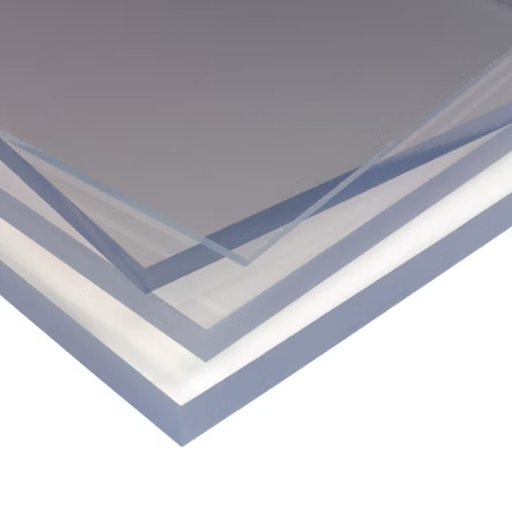
PMMA density is 1.19 g/cm³ (1,190 kg/m³) for standard unfilled grades, with a normal published range of 1.17 to 1.20 g/cm³. Impact-modified grades run about 1.11 to 1.18 g/cm³, while filled and glass-fiber grades reach 1.25 to 1.45 g/cm³. Datasheet values are measured at 23 °C.
PMMA is amorphous, so its solid density is set by chain packing and free volume rather than crystallinity. That is why standard acrylic sits in a narrow band near 1.19. Polymethyl methacrylate is the full chemical name, and Plexiglas is a brand name for the same polymer, so plexiglass density is also 1.19 g/cm³. Reference databases often round the number: MakeItFrom lists 1.2 g/cm³, or 74 lb/ft³.
PMMA Specific Gravity
Specific gravity is density relative to water, so it has no units. PMMA specific gravity is about 1.19, meaning the material is 1.19 times as dense as water at 4 °C. Datasheets often print “specific gravity 1.19” and “density 1.19 g/cm³” as if they were different properties. They are the same measurement with and without units, so use g/cm³ for calculations and specific gravity when a specification asks for it.
PMMA Density in kg/m³ and Other Units
Most of the world quotes acrylic density in g/cm³ or kg/m³. US fabricators and freight documents sometimes use lb/ft³ or lb/in³.
| Unit | Standard PMMA | Conversion |
|---|---|---|
| g/cm³ | 1.19 | Base unit |
| kg/m³ | 1,190 | 1 g/cm³ = 1,000 kg/m³ |
| lb/ft³ | 74.3 | 1 g/cm³ = 62.43 lb/ft³ |
| lb/in³ | 0.0430 | 1 g/cm³ = 0.03613 lb/in³ |
| Specific gravity | 1.19 | Dimensionless; relative to water at 4 °C |
Watch the decimal when converting. 1.19 g/cm³ becomes 1,190 kg/m³, not 1.19 kg/m³. A quote that lists the density of acrylic in kg/m³ as a single-digit figure has a unit error somewhere.
PMMA Density by Grade
Standard unfilled PMMA is the baseline, but the number moves when the formulation changes. Impact modifiers, flame retardants, mineral fillers, and glass fiber all shift density in predictable directions.
Standard Optical and General-Purpose Grades: 1.18–1.20 g/cm³
Standard optical and general-purpose grades cluster around 1.19 g/cm³. Published examples include Evonik ACRYLITE 8N at 1.19, Röhm PLEXIGLAS GS and XT at 1.19 under ISO 1183, Acrypet VH001 at 1.19, LG IF850 at 1.18, and Chi Mei CM-211 at 1.19. A 1.18 reading on a high-flow molding grade is normal. Flow modifiers change melt behavior far more than solid density.
Impact-Modified Acrylic Density: About 1.11–1.18 g/cm³
Impact modifiers are rubbery particles dispersed in the acrylic matrix. Rubber is less dense than PMMA, so adding it lowers composite density. LG HI855M, a high-impact molding grade, lists 1.17 g/cm³; some high-impact grades reach 1.14 or lower.
The overlap is the important detail. A 1.17 reading doesn’t prove a grade is impact-modified, because some standard grades list the same figure. Read density together with PMMA hardness and scratch resistance, since impact modifiers lower both.
Flame-Retardant and Mineral-Filled Grades: 1.20–1.35 g/cm³
Flame-retardant additives raise density into the 1.20 to 1.25 g/cm³ band. Mineral-filled compounds go further, to about 1.25 to 1.35 g/cm³, because the inorganic filler is denser than the polymer. A supplier quoting 1.28 for a grade described only as “PMMA” should be asked what was added.
Glass-Fiber-Reinforced PMMA: 1.30–1.45 g/cm³
Glass fiber is the largest lever. At 10 to 30% glass by weight, acrylic compounds list 1.30 to 1.45 g/cm³, averaging near 1.38. A rule-of-mixtures estimate puts a 30 wt% glass compound near 1.41 g/cm³. That is an illustration, not a specification, so use the grade datasheet.
| Grade family | Typical density (g/cm³) | Branded examples | What the number tells you |
|---|---|---|---|
| Standard optical / general purpose | 1.18–1.20 (typ. 1.19) | ACRYLITE 8N (1.19), PLEXIGLAS GS/XT (1.19), Acrypet VH001 (1.19), LG IF850 (1.18), Chi Mei CM-211 (1.19) | Baseline for design and weight calculations |
| High-flow injection molding | 1.18–1.19 | LG IF850 (1.18) | Essentially unchanged by flow modification |
| Impact-modified | 1.11–1.18 | LG HI855M (1.17); some high-impact grades around 1.14 | Lower density hints at rubber content, but overlaps standard grades |
| Flame-retardant | 1.20–1.25 | FR acrylic compounds | Additive loading raises density slightly |
| Mineral / inorganic filled | 1.25–1.35 | Filled molding compounds | Filler loading is the lever |
| Glass-fiber reinforced (10–30%) | 1.30–1.45 | GF acrylic compounds, about 1.38 average | Density rises with glass content |
| Pellets (apparent / bulk) | About 0.66 | ACRYLITE 7N/8N, ASTM D1895 | Use for hopper and container volume, not part weight |
Values are typical published ranges. Confirm the exact grade and test method against the manufacturer datasheet before you specify.
Daniel, a process engineer at an injection molder in Ohio, had a validated lens housing running on IF850 at 1.18 g/cm³. A substitute lot arrived with a COA showing 1.14. The supplier described it as “PMMA with improved toughness.” The density had already raised the right question. A Rockwell check confirmed an impact-modified compound, and the lot was rejected before it reached the press.
Cast vs Extruded vs Injection-Molding PMMA: Does Density Differ?

Not in any way you can rely on. Röhm lists 1.19 g/cm³ under ISO 1183 for both PLEXIGLAS GS (cast) and PLEXIGLAS XT (extruded). Some extruded sheet datasheets list 1.18. The ranges overlap, and the gap between forms is smaller than the tolerance on a single measurement.
The common claim that cast acrylic is denser than extruded acrylic is not supported by manufacturer data. Cast sheet is generally harder, more uniform, and better for optical work; extruded sheet is cheaper and more consistent in thickness. Those differences are real, but density does not reliably distinguish the forms.
Injection-molding pellets fall in the same band, 1.18 to 1.19 g/cm³ for standard grades. If you need to confirm product form, use process data, optical data, and documentation rather than a density reading. The PMMA material guide covers how the forms differ in production.
PMMA Density vs Glass, Polycarbonate, and Other Plastics
PMMA at 1.19 g/cm³ against glass at about 2.5 g/cm³ means acrylic weighs roughly half as much at equal thickness. The saving is about 52%, not exactly 50%. Equal thickness is the caveat: if the acrylic part must be thicker to meet a stiffness requirement, the real saving is smaller. For a broader material view, see our transparent plastics comparison.
PMMA vs Polycarbonate Density
PMMA against polycarbonate is a different story. At 1.19 versus about 1.20 g/cm³, the difference is less than 1%. Density shouldn’t drive that choice: light transmission, impact strength, heat resistance, and chemical compatibility should. Our PMMA vs polycarbonate comparison covers the decision, and the polycarbonate density article covers the PC number in depth.
| Material | Density (g/cm³) | Structure | Weight vs PMMA |
|---|---|---|---|
| PP | 0.90–0.91 | Semi-crystalline | About 0.76× |
| ABS | 1.04–1.07 | Amorphous | About 0.89× |
| PA66 | 1.14–1.15 | Semi-crystalline | About 0.96× |
| PMMA (acrylic) | 1.17–1.20 | Amorphous | 1.00× |
| PC | 1.19–1.22 | Amorphous | About 1.01× |
| PPS | 1.35 | Semi-crystalline | About 1.13× |
| POM (acetal) | 1.41–1.42 | Semi-crystalline | About 1.19× |
| PTFE | 2.14–2.20 | Semi-crystalline | About 1.82× |
| Aluminum | 2.70 | Metal | About 2.27× |
| Soda-lime glass | 2.4–2.6 | Amorphous | About 2.10× |
| Steel | 7.85 | Metal | About 6.60× |
Use density to decide when weight, freight, or part cost is the binding constraint. Don’t use it when the candidates sit within a few percent of each other. A 1% gap between PMMA and PC is noise next to the difference in impact strength.
How to Calculate Acrylic Sheet Weight and Part Weight
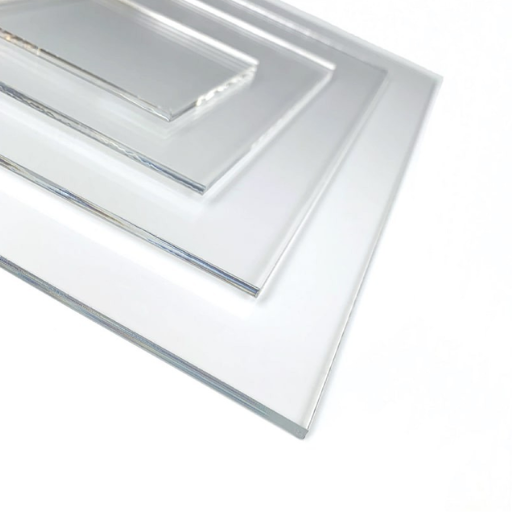
For sheet, the working formula for acrylic weight per square meter is simple: kg/m² = thickness in millimeters × density in g/cm³. At 1.19 g/cm³, a 1 mm sheet weighs 1.19 kg/m². Multiply by the area in square meters to get the sheet weight.
The units explain why it works: 1 m² at 1 mm thick is 1,000 cm³, and 1,000 × 1.19 = 1,190 g, or 1.19 kg. No conversion factor is needed.
| Thickness | Weight at 1.19 g/cm³ (kg/m²) | Reference sheet weight |
|---|---|---|
| 1 mm | 1.19 | |
| 2 mm | 2.38 | |
| 3 mm | 3.57 | 1220 × 2440 mm sheet ≈ 10.6 kg |
| 4 mm | 4.76 | |
| 5 mm | 5.95 | 1220 × 2440 mm sheet ≈ 17.7 kg |
| 6 mm | 7.14 | |
| 8 mm | 9.52 | |
| 10 mm | 11.90 | |
| 12 mm | 14.28 | |
| 15 mm | 17.85 | |
| 20 mm | 23.80 |
Worked Example: 1220 × 2440 × 5 mm Sheet
A standard 1220 × 2440 mm sheet has an area of 1.22 × 2.44 = 2.9768 m². At 5 mm and 1.19 g/cm³, it weighs 2.9768 × 5.95 = 17.71 kg. At 3 mm, the same sheet weighs 10.63 kg.
If a quote assumes 1.2 g/cm³ instead of 1.19, the 5 mm sheet comes out at 17.86 kg, about 150 g heavier. On one sheet that is nothing. On a container load it becomes a line item in the freight calculation.
Part Weight and Cost per Part
For molded parts, weight = volume × density. A 100 cm³ part in standard PMMA weighs 100 × 1.19 = 119 g. The same part in PC at 1.20 weighs 120 g, in POM at 1.41 weighs 141 g, and in glass at 2.5 weighs 250 g.
Cost per part follows directly: kilograms per part × price per kilogram. At 2.50/kg,the119gpartcosts0.119×2.50=2.50/kg,the119gpartcosts0.119×2.50=0.2975, while using the rounded 1.2 gives 0.30,an0.80.30,an0.82,500 to the material estimate. Use the datasheet value in cost models.
At container scale, the density you use sets the payload estimate. Bagged resin is weight-limited, so a 1% density error becomes a 1% freight planning error. At goods-in, invoice weight and sheet count planned on different densities won’t reconcile.
Hannah, a procurement manager at a sign fabricator in Manchester, compared two quotes for the same 5 mm sheet. One supplier calculated weight at 1.2 g/cm³ and the other at 1.19. The gap was 150 g per sheet, or 500 kg across her annual volume of 10,000 m². She standardized on 1.19 and made both suppliers quote against it, which ended the drift between orders.
Working through a container or a cost model? Send us the grade and volume and we’ll check the density assumption against the datasheet. Our PMMA resin supplier page lists the grades we stock.
Bulk Density vs Solid Density: What Pellet Buyers Need to Know
The 1.19 g/cm³ figure describes solid, void-free polymer. Pellets in a bag are not void-free. The space between pellets means a given volume of resin holds far less mass than the solid number suggests.
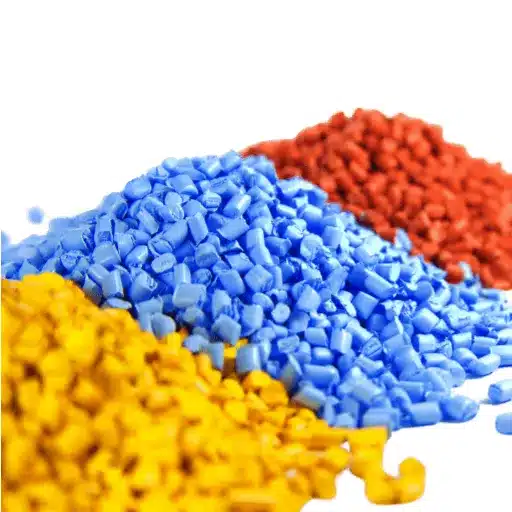
That’s bulk density, also called apparent density. Evonik lists 0.66 g/cm³ under ASTM D1895 for ACRYLITE 7N and 8N. The figure varies with pellet shape, size distribution, and how the material settled, so treat it as a handling property rather than a material constant.
Use bulk density when you size a hopper, a dryer, or a pneumatic conveying line. A dryer rated for 500 kg of PMMA at 0.66 g/cm³ holds about 0.76 m³ of pellets. If you assume 1.19, you’ll undersize the volume by nearly half. Processing calculations use solid density; material handling uses bulk density.
Bagged resin is weight-limited, not volume-limited: a 20-foot container reaches its payload limit before it runs out of space. Bulk density still sets how many bags fit on a pallet and how much void the load carries.
Don’t use bulk density to calculate part weight or judge grade quality. Two lots with the same solid density can differ in bulk density because of pellet geometry.
What Changes a PMMA Density Reading
Five factors explain most of the differences between two density reports on the same polymer.
- Grade and additives. The largest lever by far, moving the value from about 1.11 to 1.45 g/cm³. Identify the grade family before comparing numbers.
- Temperature. Datasheet values are measured at 23 °C. Density falls as temperature rises. Use the coefficient of linear expansion, about 7 × 10⁻⁵/°C, for dimensional change, and do not apply room-temperature density to melt-state calculations without PVT data.
- Moisture. PMMA absorbs only a few tenths of a percent of water, far less than nylon, so humidity barely moves density. The material still needs drying before molding.
- Test method. ASTM D792 measures density by displacement. ISO 1183 covers immersion, pyknometer, titration, and gradient-column methods. The same grade can differ slightly between procedures, so compare only values produced the same way.
- Measurement and rounding. 1.18, 1.19, 1.20, and 1.2 can all describe the same grade. Rounding is fine in a slide deck and wrong in a cost model. The PMMA properties reference lists the full property set and test conditions behind these figures.
Verifying PMMA Density on a Certificate of Analysis
A Certificate of Analysis ties a density figure to a specific lot. For PMMA, it should show the grade designation, the lot number, the density result, the test method (ASTM D792 or ISO 1183), and the condition (23 °C). A number without a method or a lot is a datasheet value, not a lot result.
Reading the Tolerance
Expect a tolerance of about ±0.01 to ±0.02 g/cm³ for unfilled grades. Filled and glass-fiber grades typically carry ±0.02 to ±0.03 because filler loading varies more. A standard grade reporting 1.17 to 1.21 is in band. The same grade reporting 1.25 is not.
What Density Can and Cannot Prove
Density catches large substitutions: a glass-filled compound in place of an unfilled grade, a heavily mineral-filled lot, or a flame-retardant grade where standard was ordered. It is weak at separating impact-modified from standard when ranges overlap, and it can’t prove cast versus extruded. Pair it with Rockwell hardness, melt flow index, and optical data.
Red Flags on a PMMA Quote
Four readings should stop a purchase order. A “standard” quote at 1.25 g/cm³ or above suggests filler. An “optical” quote at 1.14 suggests impact modifier. A COA without a method or lot isn’t lot-specific, and a density that matches while the MFI is far off means the document and the resin may not be the same material.
Tomas, a procurement lead at a lighting components maker in Mexico, received three quotes for “PMMA, density 1.2,” none of which named a grade. He asked each supplier for the grade designation, the test method, and a lot-specific COA.
One quote came back as a mineral-filled compound at 1.32 g/cm³, which would have failed the optical requirement. The other two were unfilled grades within 0.01 of each other, and the documented quote won the order. Density had done most of the screening.
We supply branded PMMA with manufacturer-issued COAs and lot traceability, including ACRYLITE, PLEXIGLAS, Acrypet, LG MMA, and Chi Mei grades. Minimum order is 25 kg, terms are FOB Shanghai, and standard lead time is 7 to 14 days. Send us your grade and the density band on your specification, and we’ll confirm the lot and the documentation before you order.
Frequently Asked Questions
What is the density of PMMA?
PMMA density is 1.19 g/cm³ (1,190 kg/m³) for standard unfilled grades, within a normal range of 1.17 to 1.20 g/cm³. Across all grades, values run from about 1.11 to 1.45 g/cm³.
What is plexiglass density?
Plexiglas is a brand name for PMMA, so plexiglass density is the same 1.19 g/cm³, with standard unfilled grades from 1.17 to 1.20 g/cm³.
What is the density of acrylic in kg/m³?
Standard acrylic density is about 1,190 kg/m³, with unfilled grades from 1,170 to 1,200 kg/m³. Convert from g/cm³ by multiplying by 1,000.
Is PMMA density 1.19 or 1.2?
Both describe the same material. 1.2 is a rounded reference value; 1.19 is the datasheet figure. Use 1.19 for weight and cost calculations, because the rounding introduces about 0.8% error.
What is the specific gravity of PMMA?
About 1.19. Specific gravity is density relative to water, so it is dimensionless. A specific gravity of 1.19 means the material is 1.19 times as dense as water.
Is acrylic denser than water?
Yes. At 1.19 g/cm³, acrylic is about 19% denser than water, and a solid piece sinks.
Is acrylic heavier than glass?
No. Acrylic at 1.19 g/cm³ is about half the weight of soda-lime glass at 2.4 to 2.6 g/cm³, at equal thickness. A PMMA part designed thicker for stiffness will save less than 52%.
Is PMMA heavier than polycarbonate?
No. PMMA at 1.19 and PC at about 1.20 g/cm³ are within 1% of each other. Choose between them on impact strength, heat resistance, and optical performance, not density.
How much does a 5 mm acrylic sheet weigh?
A 5 mm sheet at 1.19 g/cm³ weighs 5.95 kg/m². A standard 1220 × 2440 mm sheet weighs about 17.7 kg.
Do cast and extruded acrylic have different densities?
No reliable difference. Röhm lists 1.19 g/cm³ under ISO 1183 for both PLEXIGLAS GS and XT, and some extruded datasheets list 1.18. The ranges overlap.
Does impact-modified acrylic have a lower density?
Usually, yes. Impact-modified grades typically run about 1.11 to 1.18 g/cm³ because the rubber modifier is less dense than PMMA. The range overlaps standard grades, so confirm with hardness and melt flow data.
How is PMMA density tested?
The common methods are ASTM D792 (displacement) and ISO 1183 (immersion, pyknometer, titration, or gradient column), both at 23 °C. The method should be stated with every reported value.
Can density verify my PMMA grade?
Partly. Density catches filled, reinforced, and flame-retardant substitutions and gross grade errors. It can’t separate overlapping impact-modified and standard grades, and it can’t prove cast versus extruded. Pair it with hardness, MFI, and optical data.
Conclusion
PMMA density has one working number and a wide legitimate range. Use 1.19 g/cm³ for standard unfilled grades, expect 1.17 to 1.20 across them, and move to the grade datasheet when the material is impact-modified (about 1.11 to 1.18), flame-retardant (1.20 to 1.25), mineral-filled (1.25 to 1.35), or glass-fiber reinforced (1.30 to 1.45).
For sheet, weight in kg/m² is thickness in millimeters × 1.19. For parts, weight is volume × density, and cost per part is weight × price per kilogram. For pellets, use bulk density (about 0.66 g/cm³) for hoppers, dryers, and containers, never for part weight.
Density is a useful fingerprint, not a certificate of authenticity. It catches filled and reinforced substitutions, misses some grade overlaps, and cannot tell cast from extruded. Read it with the method, the tolerance, and the lot number attached.
Tell us the grade, the application, and the density band you need, and we will confirm availability and documentation from our stocked PMMA range. Request a quote for certified PMMA resin and we’ll include the datasheet and lot COA with the reply.