



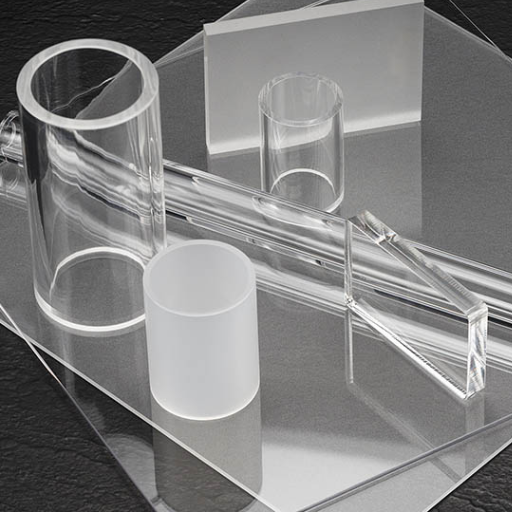



A polycarbonate visor stops a hammer. The same visor picks up a permanent scratch from a fingernail.
That contradiction is the whole story of polycarbonate hardness. PC shrugs off impact that would shatter glass, yet hazes at the surface under a car wash brush. Both facts come from the same material, measured by different tests.
A datasheet says M70, a generic chart online says R120, and a supplier email quotes “80 to 90 Shore D.” Those are three measurement systems, not three materials. This guide gives you polycarbonate hardness on every scale with the test method attached, explains why a hard plastic still scratches, and shows how glass fiber, blending, and lot consistency move it. Our complete guide to plastics hardness covers the other polymers; here we stay on PC.
What Is Polycarbonate Hardness?

Polycarbonate hardness is its resistance to indentation under a defined load. The number on almost every PC datasheet is Rockwell M70, with grades spanning M70 to M80. The same material converts to roughly Rockwell R118 to R122, about Shore D 80 to 85, and 95 to 128 MPa by ball indentation.
On a finished part you’ll more often see the shorter PC hardness figure, a Shore D reading from a handheld durometer. That is the short answer; the rest is what you need when the value goes onto a drawing, or when a part passes inspection and then scratches in the field.
Hardness measures resistance to indentation, not strength or impact
Hardness is an empirical test of how far a defined indenter presses into a surface. It says nothing about tensile strength or impact energy, and PC proves the point better than any other engineering plastic: it carries outstanding notched Izod impact, typically 600 to 850 J/m, while sitting at the low end of the Rockwell M scale. Our polycarbonate properties guide covers the rest of the property set.
Why PC is quoted on the Rockwell M scale
Polycarbonate is a rigid, high-modulus plastic, so labs test it on the Rockwell M scale: a 1/4-inch (6.35 mm) steel ball under a 100 kgf major load. ABS, which is softer, is tested on the R scale with a 1/2-inch ball under 60 kgf.
Same principle, different geometry, and the results aren’t interchangeable. A PC value of M70 and an ABS value of R105 describe two different tests. Our Rockwell hardness of plastics article walks through every scale letter and the full procedure.
The test methods behind the numbers
Three indentation standards cover the values you will meet:
- Rockwell M and R: ASTM D785 or ISO 2039-2, reported as the scale letter plus a number. MatWeb’s Rockwell hardness reference documents the ball diameters, loads, and dwell times.
- Ball indentation: ISO 2039-1, reported in MPa or N/mm², which is why some PC datasheets carry a value like 116 rather than a letter.
- Shore D: ASTM D2240 or ISO 868, measured with a handheld durometer on finished parts.
All are sensitive to specimen thickness, dwell time, and temperature, so quote a range, not a single figure. Pencil and Taber measure something different and appear below.
Need a hardness value you can defend on a drawing? Request a quote for branded prime polycarbonate with datasheets on the correct scale and full COA documentation.
Polycarbonate Hardness by Scale: M70, R118, and Shore D 80 to 85
Here is the consolidated polycarbonate hardness chart. No single datasheet gives you this view, because each one reports only the scale its customers ask for.
| Scale | Typical value | Test method | Where you will see it |
|---|---|---|---|
| Rockwell M | M70 (M70–M80 by grade) | ASTM D785 / ISO 2039-2 | Resin datasheets, drawing specs |
| Rockwell R | R118–R122 | ASTM D785 / ISO 2039-2 | Generic online property charts |
| Shore D | 80–85 (approximate) | ASTM D2240 / ISO 868 | Supplier listings, field checks |
| Ball indentation | 95–128 MPa | ISO 2039-1 | European and Asian datasheets |
| Pencil hardness | 2B–HB bare; 4H–5H coated | ASTM D3363 | Optical and glazing specs |
| Taber abrasion | 10–15 mg/1000 cycles | ASTM D1044 | Transparent-grade datasheets |
Confirm any of these against the datasheet for the grade you are buying, because filler content and test conditions move the value.
Polycarbonate Rockwell hardness: M70 and R118
Across unfilled grades, PC reads M70 to M80. Covestro’s Makrolon® datasheets cluster in that band, with grades such as Makrolon 3103 listed at M75.
Run the same polymer against the R-scale geometry and you get R118 to R122. Some generic property summaries, such as the AZoM polycarbonate data page, quote the R figure as a separate property.
It is not; it is the same material, measured with a bigger ball and a lower load. That causes real problems: if a drawing says “hardness 120” and the datasheet says M70, the two numbers aren’t in conflict. The drawing is simply incomplete.
Polycarbonate Shore D hardness and ball indentation
Shore D works on finished parts with almost no sample prep, so it’s the practical check when you can’t cut a specimen. PC reads roughly Shore D 80 to 85. Treat it as a field approximation, not a specification: PC sits high enough on the D scale that readings lose resolution, which is why datasheets quote Rockwell M instead. Our Shore hardness scale explained covers the test in detail.
European and Asian datasheets often report hardness as a pressure instead. Covestro lists Makrolon® 2407, a general-purpose UV-stabilized injection grade, at 116 N/mm² under ISO 2039-1, while Ensinger’s unfilled TECANAT® shape stock reads 128 MPa and SABIC’s LEXAN™ OQ4320 optical grade reads 95 MPa. The spread reflects the grade and specimen rather than the polymer.
Polycarbonate Scratch Resistance: Hard by Rockwell, Soft at the Surface

Devin spent two years chasing a hazing complaint on an automotive lighting program. The lenses passed every impact test in the validation plan, including a 500 g steel ball drop that would have destroyed glass. Then the field reports arrived: clouded lenses after a few hundred automated car washes.
Nothing was wrong with the material: the lenses were bare polycarbonate, and the surface was wearing. A switch to a hard-coated grade cut the failures to almost nothing.
Bulk hardness and surface hardness are different properties
Rockwell measures how the bulk resists a ball pressed into it; scratch resistance measures how the surface deforms when something drags across it. A material can be stiff in the first and soft in the second, and polycarbonate sits in exactly that position.
PC versus PMMA, and what pencil hardness shows
Acrylic inverts everything. PMMA reads Rockwell M80 to M100, higher than PC’s M70 to M80, and resists scratching better, while PC is far tougher, with impact strength roughly ten times higher. For a display cover that gets handled and cleaned, PMMA or coated PC wins; for safety glazing or machine guarding, PC wins and the surface gets a coating.
The pencil test is the fastest way to compare surfaces. Bare polycarbonate reads about 2B to HB, bare acrylic reads B to F, and a human fingernail sits at roughly 2H, which is why bare PC marks so easily. Add a hard coat and the ranking flips: coated PC reaches 4H to 5H, and Teijin’s scratch-resistant Panlite® grades reach 3H to 4H without a separate coating step.
How polycarbonate scratch and abrasion are actually tested
Surface performance gets specified with two tests, both of which appear next to the Rockwell value on optical PC datasheets.
Pencil hardness (ASTM D3363) draws a graded pencil across the surface at a fixed angle and load, and reports the hardest grade that does not cut the film. It is fast and semi-quantitative, but it is not a wear test.
Taber abrasion (ASTM D1044) presses two CS-10F rubber wheels against a rotating specimen at 500 g per wheel and measures the haze change after 100, 500, or 1000 cycles. Uncoated polycarbonate loses 10 to 15 mg per 1000 cycles and reaches a 25 to 35 percent haze change after 1000 cycles, while a properly applied hard coat stays under 1 percent.
Hard-coated sheet such as LEXAN™ MR10 records 1 to 4 percent, against 35 percent for uncoated PC and 0.5 percent for glass. That’s what “mar resistance approaching glass” means on a datasheet.
Among coating families, silicone hard coats give the highest scratch resistance and longest outdoor life, nanocomposite coats trade performance for clarity and cost, and acrylic coats are the cheapest and shortest-lived. None are scratch-proof; the goal is surviving the cleaning a part actually sees.
Choosing between coated and uncoated PC? Browse our polycarbonate grades to match a resin and coating combination to your service environment.
What Changes Polycarbonate Hardness
Polycarbonate hardness is not a fixed number, and most of the levers that move it are set before the resin reaches a molding machine.
| Lever | Direction | Typical move |
|---|---|---|
| Glass fiber (GF10 to GF40) | Rises sharply | M70 → M85 to M93 |
| PC/ABS blending | Falls toward ABS | Lands at R110–R123 |
| Flow grade (lower molecular weight) | Small shift | A few M points |
| Temperature | Falls | Progressive as Tg is approached |
| Hard coat | Surface only | 2B–HB → 4H–5H |
Glass filled polycarbonate hardness rises fast
Glass-filled grades are the biggest single jump. Rockwell M climbs from roughly M70 unfilled to M85 at 10 percent glass, M91 at 20 percent, M92 at 30 percent, and M93 at 40 percent, with ball indentation rising from about 116 MPa unfilled to 190 MPa at 30 percent glass.
Kenji found this out at a fixture-components plant in Osaka. His team validated an unfilled PC part against an acceptance window of M70 plus or minus five. A cost-down move to 20 percent glass-filled resin pushed incoming readings to M91 and tripped every inspection for a week. The material was correct for the new requirement; the specification had never been updated to match it.
PC/ABS blending lands in the middle
PC/ABS alloys combine PC’s toughness with ABS’s processing and cost. Published grades read Rockwell R110 to R123, and a comparative study puts plain PC near Shore D 79 with the blends at 72 to 74. If your drawing says R120 for a PC/ABS part, that’s a real R-scale value, not an M-scale value that lost its letter.
Molecular weight, temperature, and processing
Flow grade affects how the material recovers after indentation, so a high-flow grade can read a few points below an extrusion grade of the same chemistry. Temperature matters more in service: hardness falls as PC approaches its glass transition near 147 °C. Regrind and uneven cooling nudge readings too, which is why the acceptance window matters more than the single number.
Polycarbonate Hardness vs Other Plastics

Polycarbonate material hardness only compares to another polymer when the scale letters match, so read them before you line up any two rows. PC and POM are quoted on the M scale; ABS and PA66 are quoted on R.
| Material | Rockwell | Shore D | Note |
|---|---|---|---|
| HDPE | R60–R80 | 60–70 | Softer polyolefin |
| ABS | R90–R110 | 70–80 | Different scale (R) |
| PC | M70–M80 | 80–85 | Impact-tough, scratches easily |
| PMMA | M80–M100 | 85–90 | Harder surface, brittle under impact |
| POM homopolymer | M88–M94 | 84–86 | Hardest high-volume engineering plastic |
| PEEK (unfilled) | M99–M105 | Not typically quoted | Harder, far more expensive |
Polycarbonate vs ABS hardness, POM, and acrylic
PC is harder than ABS on both scales, but the Rockwell figures never line up numerically because ABS is quoted on R. Our ABS plastic hardness article puts ABS at R90 to R110 and Shore D 70 to 80; for the full material decision rather than the property, see our polycarbonate vs ABS comparison.
Against the harder polymers, PC is the softer material: POM homopolymer reads M88 to M94 and PMMA reads M80 to M100, both above PC’s M70 to M80. That’s worth saying plainly, because “polycarbonate is hard” is repeated so often it starts to sound like a hardness claim. It’s a toughness claim. For sliding wear surfaces, POM (acetal) resin is the better choice; the engineering plastic hardness comparison lays out the full field.
Branded PC Grades and Their Hardness Baselines
Prime manufacturers publish hardness on a defined scale with the test method attached, making their data the reference point for any quoted number.
| Grade family | Representative hardness |
|---|---|
| Covestro Makrolon® (general range) | M70–M80 |
| Covestro Makrolon® 3103 | M75 |
| Covestro Makrolon® 2407 | 116 N/mm² (ISO 2039-1) |
| SABIC LEXAN™ OQ4320 (optical) | 95 MPa (ISO 2039-1) |
| Ensinger TECANAT® (unfilled shape stock) | 128 MPa (ISO 2039-1) |
| Glass-filled PC (GF10 to GF40) | M85–M93 |
Two lessons sit in that table. The unfilled band is tight, so a supplier quoting M60 or M95 for a standard grade is worth questioning, while the MPa values legitimately disagree by 30 percent or more because they depend on the grade and specimen as much as the polymer.
One clarification, because it circulates in property summaries: hard coatings are a product category, not a resin feature. SABIC’s LEXAN™ OQ6DA dual-coated film reaches 4H pencil hardness, while a standard molding grade such as Makrolon 2407 is UV-stabilized resin, not a hard-coated optical grade.
Sourcing Consistency: Keeping a PC Hardness Spec Stable

Hardness is one of the fastest non-destructive checks you can run on incoming resin, and drift tells you what is in the bag.
Aisha ran incoming inspection for a display-cover molder in Penang. Over four lots, Rockwell M readings on a validated grade slid from M74 to M68. The parts still molded and passed impact, so nothing stopped the line.
The COA showed why: the MVR had drifted upward, pointing to a higher-flow grade substituted for the one on the purchase order. Catching it at goods-in cost a pallet; catching it after assembly would have cost a customer program.
Lot-to-lot Rockwell drift on PC usually points to off-spec resin, regrind blended into virgin, a grade substitution, or a flow-grade change. That’s why Rockwell works well as an incoming check once you’ve got the validated range for your grade.
Confirm the grade designation, the MVR (ISO 1133), the lot number, and the UV stabilizer package if the part sees daylight. Cross-checked against the datasheet, most substitutions surface before they reach a molding machine.
How Yifuhui supplies hardness-consistent PC
We hold branded prime polycarbonate from the Covestro Makrolon® and SABIC LEXAN™ families, with traceable lots and full COA and MSDS documentation, so the hardness range you validated is the range you reorder. Minimum order is 25 kg, terms are FOB Shanghai, and export documentation ships with the goods. Browse polycarbonate resin for datasheets on your grade.
Frequently Asked Questions

What is the hardness of polycarbonate?
Polycarbonate typically reads Rockwell M70, with grades spanning M70 to M80: roughly R118 to R122, Shore D 80 to 85, and 95 to 128 MPa by ball indentation. Always quote the scale and test method with the number.
Why does polycarbonate scratch so easily if it is hard?
Rockwell measures indentation in the bulk material, while scratching is a surface event. PC’s surface is soft relative to acrylic, so it marks easily despite its strength.
Is polycarbonate harder than ABS, acrylic, or POM?
PC is harder than ABS on both scales, though the two Rockwell values cannot be compared numerically because PC is quoted on M and ABS on R. PC is softer than PMMA (M80 to M100) and POM homopolymer (M88 to M94), but far tougher than PMMA, so POM remains the choice for sliding wear.
Does glass-filled polycarbonate have higher hardness?
Yes, substantially. Rockwell M rises from about M70 unfilled to M85 at 10 percent glass, M91 at 20 percent, M92 at 30 percent, and M93 at 40 percent, with ball indentation reaching roughly 190 MPa at 30 percent glass.
Is polycarbonate scratch resistant?
Not uncoated. Bare PC reads about 2B to HB on the pencil scale and hazes heavily under Taber abrasion. Hard-coated grades reach 4H to 5H and cut haze change from 25 to 35 percent down to under 1 percent.
Conclusion
Polycarbonate hardness comes down to two numbers and one rule. The numbers: Rockwell M70 typical, with grades spanning M70 to M80, and roughly R118 to R122. The rule: a value without its scale letter and test method is not a specification.
Once the scales are sorted, the material makes sense. PC is hard in bulk and soft at the surface, which is why it survives impact and still needs a hard coat on any part that gets handled. Glass fiber raises the number quickly, blending with ABS lands it in the middle, and temperature and flow grade move it by a few points either way.
That leaves the surface and the supply chain, where the real design decisions live. Bare PC scratches; coated PC reaches 3H to 4H and cuts abraded haze from double digits to under 1 percent. And a hardness reading that drifts lot to lot is one of the earliest signals of off-spec or substituted resin.
Specifying PC for a part with a validated hardness, clarity, or coating requirement? Request a quote for branded prime polycarbonate (Makrolon®, LEXAN™), 25 kg minimum order, full COA documentation, FOB Shanghai.


