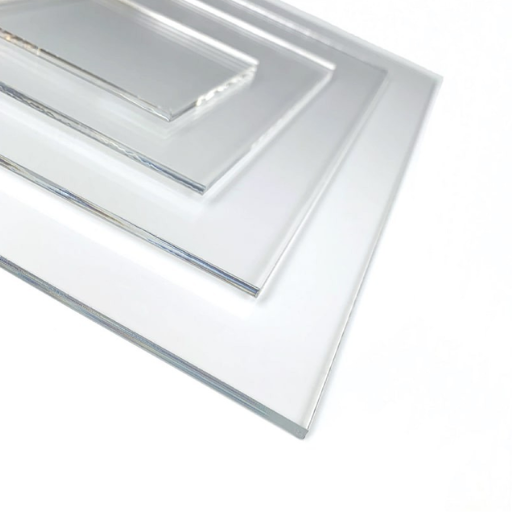

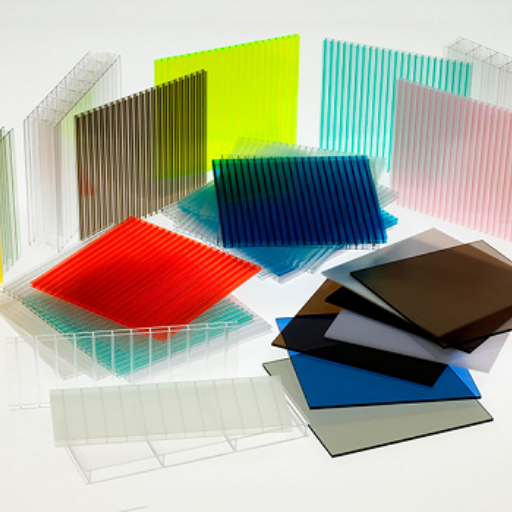
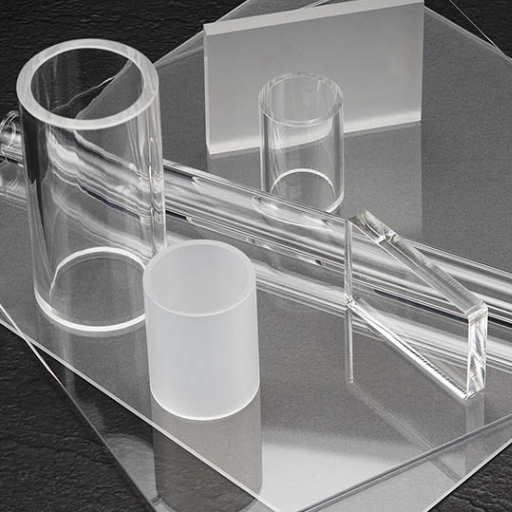



Put cast vs extruded acrylic sheet side by side and the difference is invisible. Both transmit 92% of visible light, both measure 1.19 g/cm³, and both are nominally 3 mm thick. One costs about a third more. The price gap is the least important difference between them.
If you have read that cast acrylic is stronger or that extruded acrylic is clearer, you have read half a comparison. The headline datasheet numbers are nearly identical because both products are PMMA. The real differences appear when the sheet meets a laser bed, a router, a heat gun or a solvent bottle.
This guide compares cast vs extruded acrylic by manufacturing route, measured properties, thickness tolerance, fabrication behavior, identification and cost per finished part. It is written for the person who has to specify the sheet and defend the choice.
One disclosure before we start: Yifuhui supplies PMMA resin pellets, not sheet stock. We have no reason to steer you toward the more expensive sheet. Where the evidence favors extruded, we say so.
Two Routes, Three Products: How Cast and Extruded Acrylic Are Made
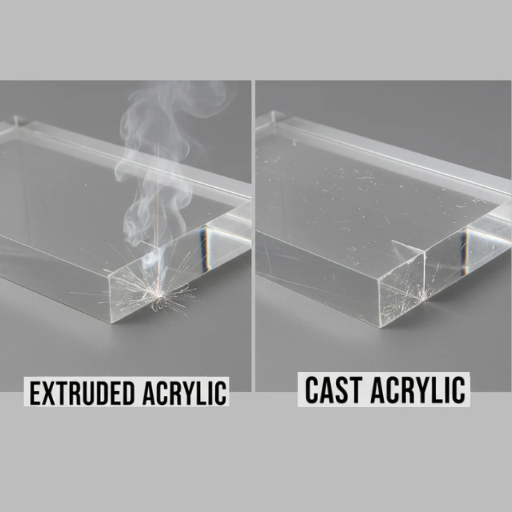
Both materials start as methyl methacrylate. The route from monomer to sheet decides the molecular weight, the internal stress and the thickness tolerance.
Cell cast
Cell casting pours a partly polymerized MMA syrup between two polished glass plates. A flexible gasket around the edge sets the nominal thickness. The filled cells go into an oven or water bath for a slow temperature ramp that commonly runs 12 to 48 hours. After demoulding, the sheet is trimmed, annealed and masked.
The slow cure produces the highest average molar mass of the three products, the lowest residual monomer and the best optical quality. It also allows thick sections and small custom color lots. The trade-off is thickness control: the gasket compresses under the weight of the stack, and the resin shrinks as it polymerizes.
Continuous cast
Continuous casting replaces the glass cell with two polished stainless-steel belts. The same syrup travels between them through heated zones: roughly 80 to 85°C water for the main polymerization, then about 120°C air for finishing. The sheet cools and is cut to length.
Continuous cast is classified as ASTM A-2 and ISO 7823-3. It holds thickness better than cell cast and can make very long sheets. It is economic mainly from about 1 to 12 mm, and its optical quality sits slightly below cell cast. Do not describe continuous-cast sheet as cell cast. They are different ASTM categories, and the distinction matters on a purchase order.
Extruded
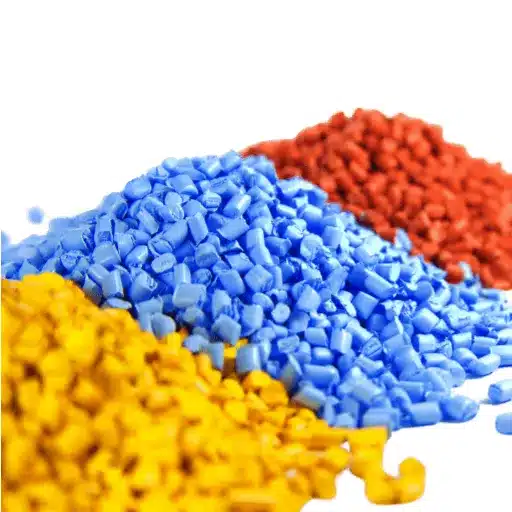
Extrusion melts PMMA pellets in a heated barrel, pushes the melt through a die with a screw, and calibrates the sheet between temperature-controlled rollers. The line runs continuously, which makes it fast and cheap per square meter.
Extruded sheet uses a lower-molar-mass extrusion grade. The melt is drawn and oriented in the machine direction, and that orientation is frozen into the sheet. This is the origin of almost every behavioral difference in the rest of this article.
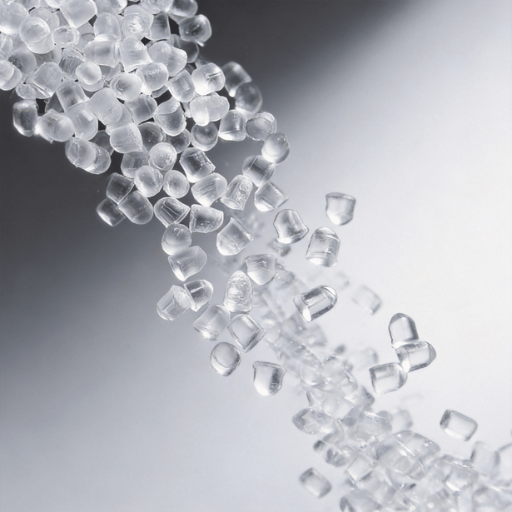
If your project is moving from a sheet prototype to an injection-molded part, the material question changes completely. Our guide to acrylic PMMA resin grade selection explains how pellet grades are specified by melt flow index, and the PMMA resin product page lists the grades we supply.
Cast vs Extruded Acrylic: What the Datasheets Actually Say
Here is the part most comparison pages skip: the standard mechanical and optical values are not meaningfully different.
| Property | Cast sheet | Extruded sheet | Does it change your decision? |
|---|---|---|---|
| Density | 1.19 g/cm³ | 1.19 g/cm³ | No |
| Light transmission, 3 mm | 92%, haze <1% | 92%, haze <1% | No |
| Tensile strength | 70–80 MPa | 72–74 MPa | No |
| Tensile modulus | 3,300 MPa | 3,300 MPa | No |
| Flexural strength | 104–130 MPa | 105–120 MPa | Marginal |
| Charpy unnotched impact | 12–15 kJ/m² | 10–15 kJ/m² | No, for standard grades |
| Rockwell M hardness | M100 | M95 | Small |
| HDT at 1.82 MPa | 105–109°C | 95–102°C | Yes, near the thermal limit |
| Vicat softening point | 115°C | 103–105°C | Yes |
| Max continuous service | 80–85°C | 70–80°C | Yes |
| Coefficient of linear expansion | 7 × 10⁻⁵ /K | 7 × 10⁻⁵ /K | No |
| Water absorption, 24 h | 0.30% | 0.30% | No |
| First-heat shrinkage | Max 2%, isotropic | 3% MD / 1% TD at ≥3 mm | Yes, for forming |
The numbers that differ are thermal and dimensional. Density is not one of them; our PMMA density guide covers the specific-gravity math.
One optical difference never shows up in a transmission figure. Cast sheet has less low-angle distortion, which you notice as image skew when you sight across a panel edge-on. Extruded sheet can carry faint die lines and a visible flow orientation. For edge-lit signs, display covers and optical parts, that uniformity decides the purchase. Both grades still quote 92%.
Cast sheet holds about 7 to 10°C more heat deflection temperature and about 10°C more Vicat softening point. Its maximum continuous service temperature is roughly 5°C higher. Those gaps matter if the part runs near 80°C or if you form at the top of the window.
The bigger difference is molecular weight. Trinseo’s sheet brochure puts average molar mass at roughly 3,000,000 for cast against roughly 150,000 for extruded, about twenty times higher. Other literature quotes 1.5 to 2.2 million for cast, and no manufacturer publishes a measured value for extruded sheet, so treat the ratio as an order of magnitude rather than a precise figure. The ranking is the part that holds up. It is why cast resists solvent crazing better and survives machining with fewer stress cracks, even though its tensile strength is not higher.
Where sources disagree
Impact strength. Several supplier pages say cast acrylic is stronger. Standard-grade datasheets show Charpy unnotched values of 12 to 15 kJ/m² for cast and 10 to 15 kJ/m² for extruded, and Izod notched values of 1.4 to 1.6 and 1.3 to 1.6 kJ/m². The difference appears in high-impact modified grades, not in standard clear sheet.
Laser cut edges. Trotec says extruded produces the true flame-polished edge. Several fabricators and other laser vendors report a glossier cast edge. Cast tolerates a wider setting window; extruded cuts faster. Test coupons from the actual lot.
Laser engraving. Boss Laser states that no setting produces the cast-style white mark on extruded stock. Some supplier pages claim otherwise. Grade and power matter. Test a patch.
Price premium. Q3 2026 Chinese domestic prices put the cast premium at about 26%. Retail cut-to-size spreads run wider. Treat any single percentage as indicative.
Cast vs Extruded Acrylic Thickness Tolerance and Sheet Formats
| Nominal 3 mm | Standard | Allowed variation |
|---|---|---|
| Cast | ISO 7823-1 | ±0.70 mm |
| Extruded | ISO 7823-2 | ±0.15 mm |
Tolerance is where the manufacturing route becomes a purchasing decision.
ISO 7823-1 specifies cast sheet at ±(0.4 + 0.1h) mm, where h is nominal thickness. At 3 mm that is ±0.70 mm. ISO 7823-2 specifies extruded sheet at ±10% for 1.5 to under 3 mm and ±5% for 3 to 20 mm. At 3 mm that is ±0.15 mm.
ASTM D4802 splits the same territory. A-1 cell cast uses an asymmetric table, A-2 continuous cast is ±10%, and B-2 extruded is ±5%.
In practical terms, an extruded 3 mm sheet stays within about 0.15 mm of nominal. A cast 3 mm sheet can legally sit 0.70 mm away from nominal. If you are machining a 3.0 mm slot or fitting a sheet into an aluminum frame, that difference decides whether you need a finishing pass.
Thickness range follows the same logic. Cast is quoted from about 2 mm to 160 mm, but standard production commonly stops near 60 mm and thicker material arrives as block. ISO 7823-1 covers 1.5 to 25 mm. Extruded runs from about 0.7 mm to 30 mm depending on supplier, with a practical ceiling near 20 mm; ISO 7823-2 covers 1.5 to 20 mm.
If you need 50 mm, cast, often supplied as block, is the only practical route. If you need 1 mm at high volume, extrusion wins.
Sheet size differs too. Cast is capped by the glass plate or cell, typically around 3,050 × 2,030 mm. Extruded can run up to about 2,050 mm wide and 6,000 mm long. Long, narrow parts nest better on extruded; wide panels often nest better on cast.
Cast vs Extruded Acrylic in Fabrication: Process by Process
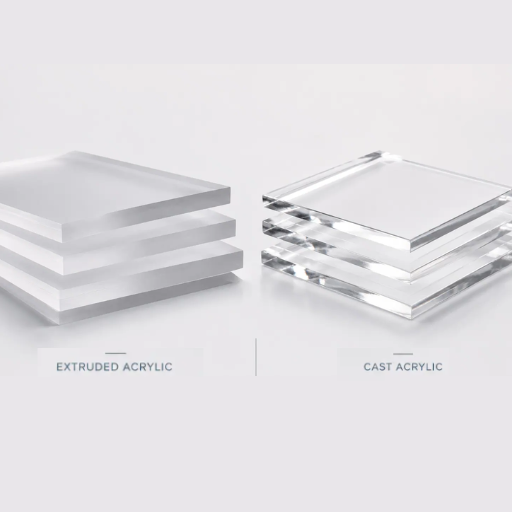
Datasheets describe the sheet at rest. Fabrication decides whether the sheet works.
Laser cutting
Cast vs extruded acrylic laser cutting is where the two grades diverge most on the shop floor. Both cut cleanly on a CO₂ laser, but they behave differently.
Cast cuts slower and needs more power for the same thickness. It also tolerates a wider setting window, so the edge quality holds when focus drifts across a sheet. Extruded cuts faster at lower power, which is why it dominates high-volume flat parts. It is more temperature-sensitive, though, and can produce a bubbly edge if the settings run hot.
Equipment makers disagree on which type gives the better cut edge. Trotec says extruded produces the true flame-polished edge; several fabricators and other laser vendors report a glossier edge on cast. What is not disputed is that cast is the safer choice for thick sections and for parts bonded or annealed after cutting. The kerf carries less stress.
Laser engraving
Engraving is the clearest process split. Cast acrylic engraves to a bright, high-contrast frosty white. Its higher molecular weight and lower stress produce a uniform, powdery removal. Extruded acrylic engraves matte gray to nearly clear.
Boss Laser states that no setting change produces the cast-style white mark on extruded stock. Some supplier pages claim otherwise.
If the engraved mark is the product, such as a control panel, trophy or retail display, specify cast or run a test patch on the exact extruded lot. Picture a sign shop in Rotterdam with a 40-sheet order: the extruded sheets cut perfectly, but the engraved logos came out clear instead of white. The rework ate the 25% saving.
CNC routing and machining
Cast vs extruded acrylic for CNC routing comes down to edge stress.
Both machine well with sharp, single-flute tools and good chip evacuation. Cast is the safer choice for thick parts and for edges that will be polished, because the lower stress means fewer hairline cracks around holes and slots. Extruded is fine for thin brackets, templates and nested panels where tolerance and cost matter more than edge finish. Heat is the enemy in both: keep the tool moving and do not dwell.
Thermoforming
Extruded sheet dominates thin-gauge, high-volume forming: signage faces, packaging trays, machine guards. It is cheaper, it holds thickness tightly, and it forms at lower cost per part. Its lower melt strength also reproduces fine mold detail and deep draws more easily, though the forming window is narrow.
The catch is directional shrinkage. Extruded sheet shrinks about 3% in the machine direction and 1% in the transverse direction at 3 mm and above. Below 3 mm the figures rise to about 6% and 2%. A mold cut for isotropic shrinkage will produce an oval part.
Cast sheet shrinks about 2% in all directions. It forms at a higher temperature, about 160 to 175°C against 150 to 160°C for extruded, and its higher melt strength brings more spring-back. That makes cast harder to draw into fine detail but more forgiving of uneven oven heating, and it remains the choice for thick, optical and large parts.
Picture a workshop in Texas that built a forming tool around an extruded sheet without allowing for machine-direction shrink. The first parts were 4 mm out of round on a 600 mm panel. The fix was a new tool, not a new sheet.
Solvent bonding
Both bond with dichloromethane or a two-part acrylic adhesive. Cast is more forgiving: its higher molecular weight and lower stress give a wider window before crazing starts at the joint.
ACRIFIX data puts cast-to-cast tensile shear at 36 to 42 MPa as bonded and 42 to 48 MPa after annealing. Extruded-to-extruded joints reach 32 to 38 MPa as bonded and 40 to 46 MPa annealed, and extruded parts should be annealed before bonding as a matter of principle. That crazing is environmental stress cracking, and the PMMA chemical resistance guide covers the solvents and stress states that trigger it.
For aquariums, chemical tanks and structural laminations, cast is the default. For display cases and low-load joints, extruded bonds adequately if the joint is well fitted and annealed.
Aquariums and structural panels
Cast vs extruded acrylic for aquariums is not a close call. Cast acrylic is the standard for aquarium viewing panels and structural glazing. Thickness availability, higher molecular weight, better crazing resistance and predictable bonding explain why. ACRYLITE’s aquarium calculation tool assumes cast for a reason.
Extruded sheet can serve low-stress decorative panels. It is a poor place to save money on a structural tank: a failed bond in a 1,000-liter aquarium is not a warranty conversation.
| Process | Better default | Why | Watch out |
|---|---|---|---|
| Laser cutting, thin gauge | Extruded | Cost and tight tolerance | Edge stress at high power |
| Laser cutting, thick or optical edge | Cast | Lower stress, less crazing | Higher sheet cost |
| Laser engraving | Cast | Consistent frosted white | Test extruded lots |
| CNC routing, thick parts | Cast | Fewer cracks at holes and slots | Heat buildup |
| CNC routing, thin nested parts | Extruded | Tolerance and yield | Tool dwell |
| Thermoforming, thin high-volume | Extruded | Cost and thickness control | Machine-direction shrink |
| Thermoforming, heavy-gauge or deep draw | Cast | Isotropic 2% shrink | Slower cycle |
| Solvent bonding, structural | Cast | Crazing resistance | Joint fit |
| Aquarium or structural panel | Cast | Molecular weight and thickness | Annealing schedule |
Tell us the process, the thickness and the chemical or thermal load, and we will tell you whether the application is sheet territory or resin territory. Send your application details and we will respond within 24 hours.
How to Tell Cast From Extruded Acrylic
To tell cast from extruded acrylic, start with micrometer readings at six to eight points. Then run a heat-shrink test on a marked strip, engrave a test patch at production settings, and check the masking. Field tests only narrow the possibilities; the technical datasheet is the only definitive answer.
The tests below are the workshop version.
- Scan the thickness. Take six to eight micrometer readings across the sheet. Extruded stays within about ±5%; cast varies more and often runs thick.
- Run a heat-shrink test. Cut a 100 × 25 mm strip, mark 100 mm, heat it at about 160 to 170°C until it softens, then cool and measure. Extruded shrinks more along the extrusion direction.
- Engrave a test patch. Use production settings. Frosted white points to cast; clear or patchy points to extruded, though not conclusively.
- Try a solvent test. Apply solvent to a stressed edge in a ventilated area. Extruded crazes sooner.
- Check the masking and print. Cast is often paper-masked; extruded often carries PE film. Neither is definitive.
- Ask for the TDS. The datasheet states cast, continuous cast or extruded. This is the only test that settles it.
Perspex and Optix are brand names, not material categories. A given product line may be cast, continuous cast or extruded, so confirm the form on the TDS.
Use the field tests to decide whether to ask harder questions, not to win an argument with a supplier.
When the answer matters, put the form and the tolerance class on the purchase order instead of buying “3 mm acrylic”:
3 mm clear cast acrylic sheet, ASTM D4802 A-1 or ISO 7823-1, thickness ±0.70 mm, paper masking both faces, UV-stabilized, annealed, trimmed square.
A line that names only the thickness is how a shop ends up machining a sheet that arrived 0.7 mm heavy.
Cast vs Extruded Acrylic Cost: Why the Cheaper Sheet Is Not Always the Cheaper Part
Most buyers frame the cost question as extruded vs cast acrylic. Cast acrylic sheet usually carries a premium. Chinese domestic prices in Q3 2026 put general-purpose cast sheet at about 4,082pertonneagainst4,082pertonneagainst3,246 for extruded, roughly 26% . That is a single commercial index, so treat the level as indicative as well as the spread.
Channel moves the number more than grade does. US list prices for a 48 × 96 in clear sheet run 313.85forcastagainst313.85forcastagainst170.64 for extruded at 0.236 in, an 84% gap, but 259.01against259.01against249.55 at 0.250 in, a 4% gap. Stock position, masking and cut-to-size service swing that spread more than the polymer does.
The number that matters is cost per finished part.
Four factors move it:
- Thickness tolerance. A cast 3 mm sheet may arrive at 3.5 mm. You paid for 3.5 mm of material, and you may have to machine it down.
- Scrap and yield. Tight tolerance and long sheet formats improve nesting on extruded. Cast’s wider formats can reduce offcuts on large panels.
- Finishing. Cast edges polish more easily and engrave more consistently. Extruded may need more test pieces and more rework on engraved work.
- Annealing. Both types benefit from annealing before or after machining. Extruded is usually held at about 80°C for one hour per millimetre of thickness, with a minimum of two hours, then cooled slowly. Cast typically runs two to four hours at 70 to 80°C. Extruded is more sensitive to uneven heating because differential shrinkage adds stress, so the schedule has less room for error.
Cast pays when the part is thick, structural, chemically exposed, engraved, or expected to last outdoors for decades. Extruded pays when the part is thin, flat, high-volume, mechanically simple and dimensionally demanding.
For the underlying thermal behavior, our guide to PMMA glass transition temperature explains annealing windows. If impact is the real requirement, neither form may be right; PMMA vs polycarbonate explains where the crossover sits.
The Third Option: PMMA Resin Pellets
If the part is going to be injection molded, no sheet will do. Sheet stock is already polymerized. You cannot feed it into a molding machine and get a consistent optical part. You need PMMA resin pellets, which are a different product with a different specification: melt flow index, pellet size, additive package and molding window.
That is the boundary of this article. Sheet buyers should use the comparison above. Buyers moving to molded parts should start with our guide to how to specify a PMMA molding grade, which covers MFI bands and grade families. Or go straight to the PMMA resin grades we stock.
Yifuhui supplies PMMA resin pellets, not sheet. We hold high-clarity grades for optical, lighting and display applications, with manufacturer COA and MSDS on every lot and a 25 kg minimum order. If you are prototyping in sheet and planning to mold, tell us the application and we will help you translate the sheet requirement into a resin specification.
Frequently Asked Questions
Is cast acrylic stronger than extruded acrylic?
For standard clear sheet, the difference is small. Tensile strength and Charpy impact values overlap, and cast is not automatically stronger. Cast does resist crazing and solvent attack better because of its much higher molecular weight. High-impact modified grades are a separate comparison.
Is cast or extruded acrylic cheaper?
Extruded is usually cheaper per sheet. Q3 2026 Chinese domestic prices put cast about 26% above extruded, and retail spreads run wider. The gap can close or reverse on a finished-part basis once you count thickness overage, machining, scrap and rework.
Can you laser cut both types?
Yes. Both cut cleanly on a CO₂ laser. Cast is the safer choice for thick sections and visible edges; extruded is fine for thin, high-volume flat parts. Settings must be adjusted for thickness and grade.
Can you thermoform extruded acrylic?
Yes, and it is the standard choice for thin-gauge, high-volume forming. Allow for directional shrinkage of about 3% machine direction and 1% transverse at 3 mm and above, rising to about 6% and 2% below 3 mm.
How can you tell cast acrylic from extruded acrylic?
Measure thickness variation, run a heat-shrink test, engrave a test patch, or check the masking and TDS. Documentation is the only definitive answer; field tests only narrow the possibilities.
Which acrylic is better for an aquarium?
Cast. Higher molecular weight, better crazing resistance, thicker sections and more predictable solvent bonding make it the default for structural viewing panels.
Is cast acrylic worth the extra cost?
When the part is thick, structural, engraved, chemically exposed or expected to last outdoors, yes. For thin, flat, high-volume panels where tolerance and price dominate, extruded usually delivers the lower cost per finished part.
What is the best acrylic for laser engraving?
Cast. It engraves to a bright, high-contrast frosted white, while extruded stock engraves matte gray to nearly clear. Test the exact lot before a production order.
Which acrylic sheet has better thickness tolerance?
Extruded. At 3 mm nominal, ISO 7823-2 holds it to about ±0.15 mm, while ISO 7823-1 allows cast about ±0.70 mm. Cast’s wider band is a manufacturing consequence, not a defect.
The Short Version
Cast vs extruded acrylic is the same polymer made two different ways. The optical and mechanical headline numbers are close enough that the category alone should not decide your specification.
What decides it is tolerance, thermal headroom, shrinkage, molecular weight and the fabrication process. At 3 mm, extruded holds ±0.15 mm and cast can sit ±0.70 mm from nominal. Cast shrinks evenly at about 2%; extruded shrinks directionally and more below 3 mm. Cast engraves and bonds with more margin; extruded cuts, forms and nests at lower cost.
If you are specifying sheet, start with the process and work backward to the sheet. If you are moving to a molded part, stop comparing sheet and specify a resin grade.
We supply PMMA resin pellets, not sheet, so we will not pretend a cast vs extruded acrylic comparison is a product pitch. If your project is crossing that boundary, send us the application, thickness and expected volume. We will recommend a grade with the datasheet and COA documentation to support it. Trial quantities start at 25 kg.