
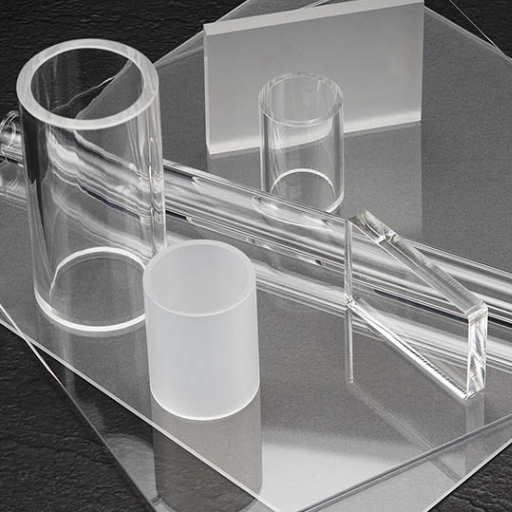



Two suppliers send you a datasheet. Both promise 92% light transmission. One number was measured at 3 mm to ISO 13468-2 on a light-guide grade; the other was typed into a brochure with no thickness, no method, and no grade behind it. Only one survives your optical validation.
If you specify optical grade PMMA, you already know the material works. The hard part is proving which grade you are buying, and that the lot in front of you matches the sample you approved. “Optical grade” is not an ISO, ASTM, or EN designation. It is a manufacturer’s label, and every supplier defines it a little differently.
This guide shows what the designation promises, how to read each optical number with its standard and thickness attached, which grade families fit light guides, lenses, and automotive lighting, and how to verify a lot on a COA.
What “Optical Grade PMMA” Actually Means
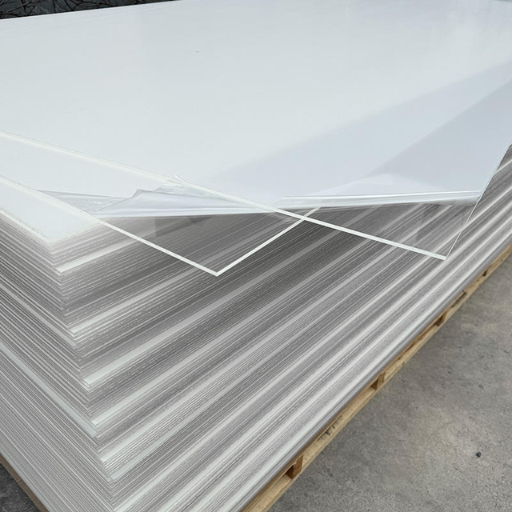
Optical-grade PMMA is a molding or extrusion grade held to tighter limits than general-purpose acrylic: roughly 92% luminous transmittance at 3 mm, haze below 1%, low yellowness index, low foreign-particle content, controlled residual monomer and birefringence, and a UV package selected for the application.
Because no standards body defines the term, two suppliers can sell optical grade PMMA, or optical grade acrylic sheet, and mean different things. Comparing measurable limits is the only way to tell them apart.
Manufacturers describe it in their own language. Röhm specifies that ACRYLITE Optical is free of visible dust, fines, and contaminants. Kuraray positions PARAPET GH-S and GH-K on optics plus flowability for thin microstructures.
The clearest evidence is long-path transmission. PLEXIGLAS Optical 0Z024 reaches 91% at a 150 mm light path, about 5% higher than typical extruded acrylic. At 3 mm the grade difference is small. At 150 mm it decides whether the far end of a light guide still looks lit.
What optical grade does not buy you: impact strength, since PMMA stays brittle; scratch immunity; or outdoor suitability, since POQ grades are LED-only. Nor does it guarantee one UV cutoff: UV transmission is adjustable from high transmitting to high absorbing.
If you need the datasheet behind these numbers, request the grade TDS and a sample COA. At Yifuhui we answer within 24 hours.
The Optical Numbers Behind Every Datasheet
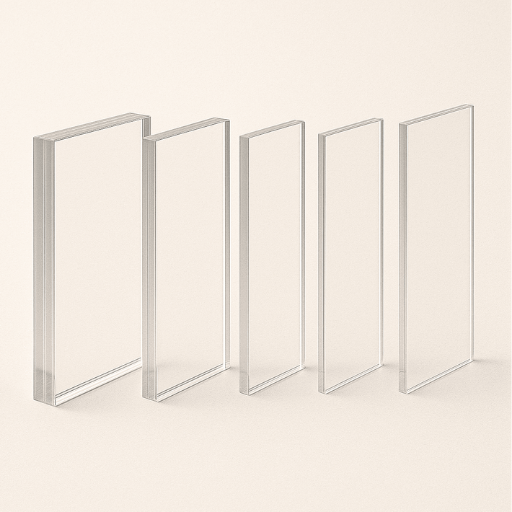
Read every figure as a package: value, standard, thickness, grade.
PMMA Light Transmission: Why 92% Is Not 92%
Total luminous transmittance for optical grade PMMA sits at 92% at 3 mm: to ISO 13468-2 under D65 on ACRYLITE POQ64 and POQ66, to DIN 5036-3 on PLEXIGLAS 0Z024, and to ASTM D1003 under C/2° on general-purpose Plaskolite OPTIX, which states no gauge. ACRYPET VH5 reports 93% at 3 mm to ISO 13468-1. That spread reflects method and grade variance, not a quality gap.
The missing 8% is mostly reflection. Röhm puts surface loss at about 4% per interface, so 8% total. No grade change recovers that; anti-reflective coating does. If a supplier claims their grade “absorbs less,” ask for internal transmittance.
A common qualification failure: two grades both read 92% at 3 mm, so the cheaper one gets approved. At the 150 mm path the part actually uses, the long-path grade holds 91% while the standard one trails by about 5 points. Same headline, different optical path.
Specify transmission at your actual path length. For a 2 mm lens cap, 3 mm data is conservative. For a 500 mm light pipe, it tells you almost nothing.
PMMA Haze: The Number That Predicts Light-Guide Yield
Haze is the share of transmitted light scattered beyond 2.5 degrees. It separates a light guide from a frosted panel.
Clear optical grades cluster tight: 0.3% to ISO 14782 on ACRYPET VH5, below 1% to ASTM D1003 on PLEXIGLAS 0Z024. General-purpose clear sheet typically runs 1% to 2%, rising to 2% to 2.7% on some thick-gauge stock, and those figures arrive without a gauge. Datasheets in this class often omit the thickness, one more reason to demand it. All are “clear” products; the gap is grade, thickness, and surface finish.
If impact strength matters more than clarity, compare PMMA vs polycarbonate.
Thickness and mold polish move haze more than resin choice. Vendor clarity guides show haze climbing several-fold between a 3 mm and a 12 mm specimen on the same grade, and a worn cavity raises haze on identical pellets. Published light-guide targets: transmittance above 90% at the working path, haze below 1%, retardation below 10 nm, and color shift under ΔYI 2 after aging. Treat those as design targets, not certification thresholds.
PMMA Yellowness Index: Tracking Color Drift
Yellowness index quantifies the shift toward yellow in a near-colorless material. A lens that starts neutral and drifts yellow in service is a warranty claim, not a cosmetic issue.
Reference values from Röhm’s ACRYLITE data put YI below 1 to ASTM D1925 on the standard optical line and on the LED grades. ASTM D1925 was withdrawn in 1995, and ASTM E313 at C/2° is its designated replacement: same illuminant and observer, comparable values, a small offset from D1925’s rounded coefficients. E313 at D65/10° is a different number. A supplier quoting 0.4 without naming the standard has given you a number you cannot audit.
An engineer on a machining forum described an exterior cast acrylic lens that yellowed within a year; the sheet carried no UV package. UV-stabilized grades resist this; unverified acrylic does not. “Acrylic does not yellow” is marketing.
PMMA Refractive Index and Abbe Number: Design Constants
Refractive index is 1.490 at the sodium D line, 589.3 nm, to ISO 489. Datasheets showing 1.489 to 1.491 are within normal variation. ASTM D542 corresponds to ISO 489 Method A, so a D542 figure is the same nD value. Reported to four figures, 1.490 should carry its wavelength; in practice, state the temperature and apparatus.
One mismatch matters. A spectral study of PMMA reports an average refractive index near 1.47 across the visible and near-infrared. That is a thin-film average, not the datum a lens designer enters into a raytrace. Use 1.490 nD.
The Abbe number describes chromatic dispersion. PMMA’s is commonly quoted as 57.2, in a working range of 55 to 58. Only one source we reviewed publishes it, with no standard and no basis. Treat 57 as a convention unless your supplier states the measurement basis.
| Property | Optical grade | General purpose | Method | Conditions |
|---|---|---|---|---|
| Luminous transmittance | 92% | 90 to 92% | ISO 13468-2 / DIN 5036-3 / ASTM D1003 | optical at 3 mm; sheet gauge not stated |
| Transmittance, long path | 91% | about 5 points lower | works method, no published standard | 150 mm rod, sheet |
| Haze | 0.3% to <1% | 1 to 2% sheet; under 2% molding | ISO 14782 / ASTM D1003 | optical at 3 mm; sheet gauge not stated |
| Yellowness index | below 1 | 1 to 3 | ASTM D1925 (withdrawn) / ASTM E313 C/2° | thickness per TDS; state illuminant |
| Refractive index | 1.490 | 1.49 | ISO 489 nD / ASTM D542 | 589.3 nm; state temperature |
| Abbe number | ~57, convention | ~57 | rarely reported | visible band |
Every method travels with an illuminant: D1003 is C/2°, ISO 13468 is D65, and DIN 5036-3 reports vary. The 150 mm value is a works measurement with no published standard. Mechanical and thermal values sit in the PMMA properties reference.
ASTM vs ISO: Why Optical Data Doesn’t Compare Across Suppliers
Most optical disputes are two correct measurements of the same material, taken different ways.
| Measurement | Standards in play | Why results diverge | What to demand |
|---|---|---|---|
| Luminous transmittance | ASTM D1003, ISO 13468-1/-2, DIN 5036-3 | Instrument geometry, illuminant (D65 versus C/2°), specimen prep | Value, standard, thickness, illuminant, D1003 procedure |
| Haze | ASTM D1003, ISO 14782 | Aperture and geometry, plus thickness dependence | Value, standard, thickness, procedure |
| Yellowness index | ASTM E313, ASTM D1925 (withdrawn) | E313 at D65/10° is a different number from D1925 | Value, standard, illuminant/observer |
| Refractive index | ISO 489, ASTM D542 | Technically equivalent nD methods; temperature and apparatus carry the variance | nD plus temperature and apparatus |
| Melt flow | ISO 1133, ASTM D1238 | Same plastometer and 230 °C/3.8 kg condition; ISO 1133 defines both MFR and MVR, D1238 reports MFR, and preheat and piston travel differ | Value, unit, method, condition |
A supplier quotes haze at 1.2% to ASTM D1003 on a 1.5 mm plaque; your drawing calls for below 1% at 3 mm. Both can be true of the same resin, and the part still fails.
Several designations have been revised since, so check the edition behind a number that must hold. The rule is blunt: a number without its standard is a claim, not a specification. Write the standard, thickness, and illuminant into the drawing, then require the COA to report against those conditions.
Optical Grade PMMA Families and What Each One Is For
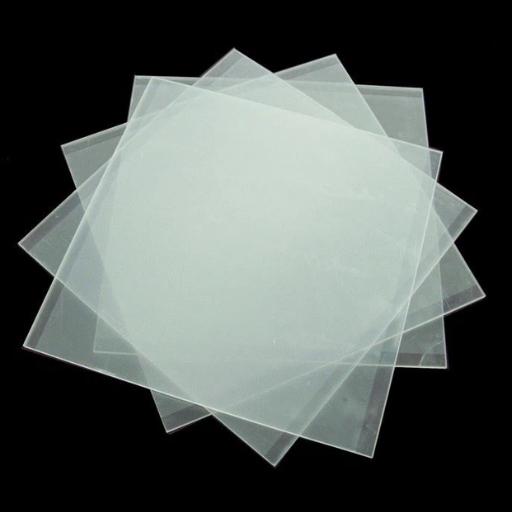
Families exist because optical jobs conflict: a long-path grade has low melt flow, wrong for a 0.4 mm microstructure. Pick by job, not by the highest transmission number. Melt-flow figures are MVR or MFR, both run at 230 °C/3.8 kg for PMMA; convert through melt density before comparing.
| Family | Optical job | Verified examples | Watch-out |
|---|---|---|---|
| General optical molding | Lenses, covers, light pipes | ACRYLITE POQ64 (injection, MVR 9.0), PLEXIGLAS 8N | Check path-length data; not all are long-path grades |
| Light-guide / LED | Long paths, low absorption; thin sections | PLEXIGLAS 0Z024 (extruded sheet, 91% at 150 mm), ACRYLITE POQ66 (extrusion, MVR 2.3), POQ62 (high flow, MVR 21), ACRYPET VH5 (thick light-guide plate, MFR 5.5), LX MMA HP05B and HP202 (extrusion) | POQ is LED-only and not for outdoor use; 0Z024 is sheet, not pellets |
| High-purity lens | Lowest inclusions, stable RI | ACRYLITE Optical SuPure 8N, PARAPET GH-S and GH-K | Premium price; verify lot documentation |
| Heat-resistant optical | High-power LED, automotive | PLEXIGLAS Optical HT | MVR comparable to standard; confirm cycle for the grade |
| Diffusion | Even, glare-free light | ACRYLITE Satinice, PLEXIGLAS Softlight | Not a clarity grade; never compare its haze to optical clear |
| UV-block / UV-transmit | Outdoor protection, UV curing | Plaskolite UV Block (from 380 nm), Röhm adjustable-UV compounds | Cutoff set by additive package, not by polymer |
Brand ownership matters, and it splits by region. Röhm makes PLEXIGLAS molding compounds outside the Americas and sells the same compounds as ACRYLITE inside them. Trinseo, which bought Arkema’s PMMA business in 2021, sells PLEXIGLAS in the Americas and ALTUGLAS everywhere else. The PLEXIGLAS and ACRYLITE sheet and film business, including 0Z024, has sat in Polyvantis since May 2024.
Among the others, Mitsubishi Chemical makes ACRYPET, Kuraray makes PARAPET, LX MMA’s CRYSTALUX covers the HP extrusion and IH injection series, Chi Mei makes ACRYREX, and Plaskolite makes OPTIX.
Application sets the shortlist:
- LED light guides: transmission at path length, low haze, low YI, low birefringence. Long-path grades are the default; high-flow grades suit thin microstructures.
- Display light guide plates: add a retardation limit to the specification. Injection-compression suppresses the birefringence a standard shot leaves behind.
- Lenses: refractive index consistency, dispersion, freedom from inclusions. Anti-reflective coating is usually assumed.
- Automotive lighting: heat and weathering. Optical HT buys a +15 °C service margin over standard PMMA and a 105 °C UL relative thermal index.
For the polymer itself, see the PMMA material overview.
Processing PMMA Without Losing the Optics
You can buy a 0.3% haze grade and mold 2% haze parts. Processing is where optical grade is most often lost.
Drying is non-negotiable: PMMA absorbs about 0.3% moisture in 24 hours to ASTM D570 and up to roughly 2% at equilibrium. ACRYLITE POQ64 calls for below 90 °C for 2 to 3 hours; LX MMA HP05B specifies a maximum of 90 °C for 3 to 4 hours. General optical guidance runs 80 to 90 °C for 4 to 6 hours, extended to 8 hours for demanding optics. Skip it and you get silver streaks: visible and unfixable.
Melt and mold windows are grade-specific. POQ64 runs 220 to 240 °C melt and 60 to 90 °C mold. HP05B runs 230 to 260 °C melt. No universal PMMA melt temperature exists; quoting one produces unmelted pellets or thermal yellowing.
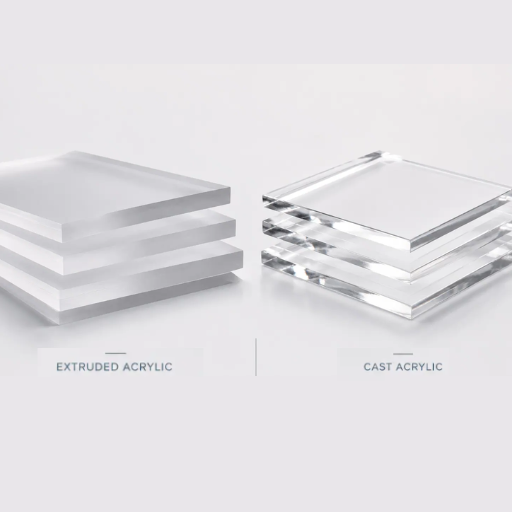
Birefringence is mostly a processing problem, not purely a resin property. Orientation from fill and packing leaves stress that shows under crossed polarizers, and sheet stock arrives with residual stress of its own, so cast versus extruded acrylic comes first. Injection-compression, lower packing pressure, balanced cooling, and annealing at 70 to 80 °C for 2 to 4 hours all reduce it.
Defect points to cause:
- Silver streaks: moisture in the pellet. Dry longer.
- Flow and weld lines on an optical face: gate position or melt temperature.
- Yellowing: thermal history or a missing UV package.
Regrind caps are a house decision: some optical molders allow 20 to 30%, some none. Ask the supplier, then write your own cap into the process sheet.
How to Verify Optical Grade on a COA
A COA is the only document tying a specific lot to specific measured values. Read it like an auditor.
| COA field | What good looks like | Red flag |
|---|---|---|
| Issuer | Manufacturer-issued, tied to a production lot | Trader-generated certificate, no manufacturer |
| Grade | Exact code, for example POQ64 or 0Z024 | “PMMA optical” with no grade |
| Lot | Unique number and date, traceable to the carton | No lot, reused lot, or lot absent from packaging |
| Transmission | 92.0%, ISO 13468-2, 3 mm | 92% with no thickness or standard |
| Haze | under 1%, ASTM D1003 Procedure A, 3 mm | Haze figure with no thickness or standard |
| Yellowness index | under 1, ASTM E313 C/2° (or D1925), 3 mm | Value with no standard or illuminant |
| Melt flow (MVR) | 9.0 cm³/10 min, ISO 1133, 230 °C/3.8 kg | MFR value quoted as MVR, or condition omitted |
Three traps account for most failures. The number without a thickness: 92% at 3 mm and 92% at 50 mm are different claims. The number without a standard: D1003 and ISO 13468 are not interchangeable methods, and E313 matches D1925 only at C/2°. The COA without a manufacturer: a certificate a trader generated from a spreadsheet is a datasheet, not a lot record.
A common incoming-inspection failure: a COA reading “haze 0.8%” arrives with no thickness and is accepted. Incoming inspection at 3 mm then measures 1.6% on the same resin. Both are correct, because the certificate described a thinner plaque than the drawing. The resin met its datasheet; the lot still failed the drawing, and the missing thickness is what hid it.
Sourcing Optical Grade PMMA: What the Premium Buys
Branded optical grades cost more than general-purpose acrylic, and the premium buys a published specification with methods attached, lot-level consistency, and a manufacturer-issued COA you can defend in an audit.
House grades work only if you validate every lot yourself. For a light guide or lens, testing cost usually exceeds the savings.
Published Chinese asks for branded optical grade PMMA sit near CNY 17 to 18 per kg in 25 kg bags, undated and small-lot, so treat them as order-of-magnitude only. New optical-grade capacity is coming online in China, which widens grade availability, not documentation quality.
At Yifuhui we supply PMMA in optical and general-purpose grades with manufacturer COA per lot, 25 kg minimum order, FOB Shanghai. The branded grades above are reference specifications for how each property is measured, not a claim that we stock every brand listed. Tell us the path length, the process, and the acceptance limits, and we will match a grade rather than quote whatever is on the shelf. Our acrylic PMMA resin guide covers MOQ, packing, and lot documents.
Request an optical-grade PMMA quote with TDS and sample COA
Frequently Asked Questions
Is optical grade PMMA a certified standard?
No. No ISO, ASTM, or EN standard defines optical grade; it is a manufacturer’s designation for tighter optical limits, so specify measurable values with their methods.
What is the light transmission of PMMA?
About 92% total luminous transmittance at 3 mm, to ISO 13468-2 under D65 or ASTM D1003 under C/2°. Long-path grades hold 91% at 150 mm; the rest is mostly 4% reflection per surface.
What haze should optical grade PMMA have?
Below 1% to ASTM D1003 Procedure A at 3 mm is the usual target, and a good light-guide grade can measure 0.3% to ISO 14782 at the same gauge. Haze rises with thickness, so compare at equal thickness.
What is a good yellowness index for acrylic?
Below 1 to ASTM D1925 on standard optical and LED grades. Because D1925 was withdrawn in favor of E313, insist on the standard and the illuminant before comparing figures.
What is the refractive index of PMMA?
1.490 at the sodium D line, 589.3 nm, to ISO 489. Values from 1.489 to 1.491 are normal variation. The 1.47 figure circulating online is a thin-film average, not a design datum.
Which PMMA grade is best for light guides?
Long-path grades such as PLEXIGLAS 0Z024 sheet, ACRYLITE POQ66, ACRYPET VH5, or LX MMA HP05B. High-flow grades like POQ62 suit thin microstructures. POQ is specified for LED sources and not for outdoor use.
How do I verify optical grade PMMA on a COA?
Check four things: the issuer is the manufacturer, the grade code is exact, every optical value carries its standard and thickness, and the lot matches the packaging.
Optical grade PMMA is a useful shorthand and a poor specification. The material does its job well: about 92% transmission at 3 mm, haze below 1% at the same gauge, refractive index stable at 1.490, and enough grade variety to fit a 0.4 mm microstructure or a 500 mm pipe.
Four rules separate a working specification from a failed one:
- Define optical grade by measurable limits, not by the label.
- Write the standard, thickness, and illuminant on every optical number.
- Choose the grade family by optical job, not by headline transmission.
- Audit the COA for issuer, grade, lot, and method.
If you are specifying a new optical part, send us the drawing and the acceptance limits. We will name the optical grade PMMA that fits, quote the datasheet behind it, and tell you what the COA will show when the lot ships. To gain a deeper understanding of PMMA Hardness: Rockwell M Values, Scratch Resistance, and Why Grades Differ and Applications of PMMA: What Each Industry Uses, and Which Grade Fits, please refer to our accompanying guide.