



PMMA is in your tail lights, your sign faces, your dentures and the display you are reading this on. It is not in your headlamp cover lens, and it is not in your refrigerator’s crisper drawer, whatever the application lists say.
The acronym also belongs to a cosmetic filler and to an unrelated controlled substance. This page is about the rigid, transparent thermoplastic, polymethyl methacrylate.
This guide covers the applications of PMMA industry by industry, then the jobs the material is credited with and cannot do. It starts with the four questions that decide whether a part ships: which form it is made from, which grade family fits, which standard it has to pass, and how it fails when the grade is wrong. For the polymer itself, the PMMA material guide covers structure and processing.
What is PMMA used for? Applications by industry
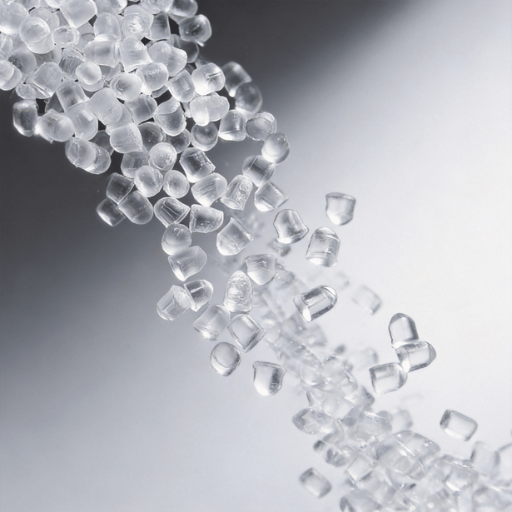
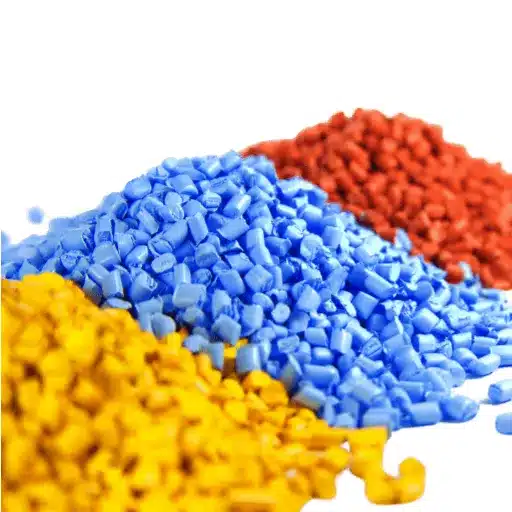
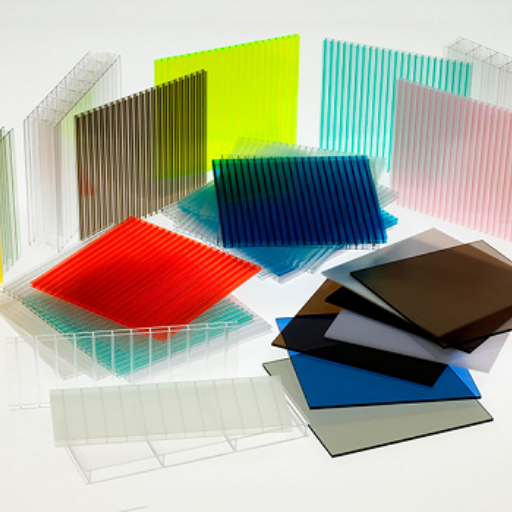
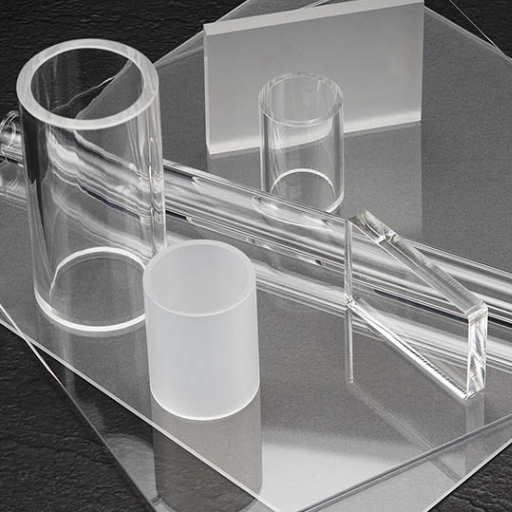
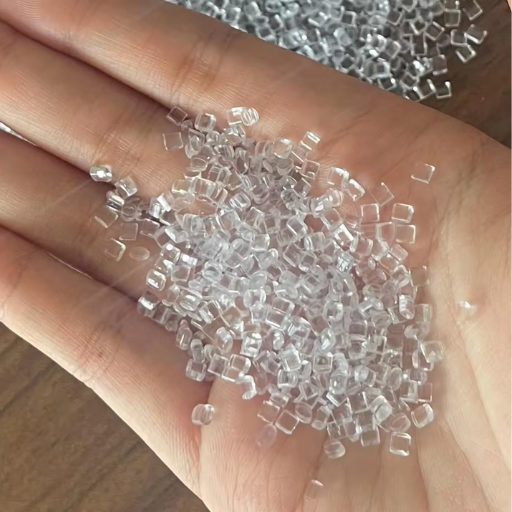
PMMA is used wherever a part has to stay clear for years: automotive rear and signal lenses, LED diffusers and light guides, illuminated signage, architectural glazing, aquariums, cosmetic packaging, drinkware, food display, bone cement, dentures, cuvettes and machine guards. The form changes with the job. Moulded parts use pellets, signage and glazing use sheet, and bone cement is a powder and liquid system rather than a resin grade.
| Industry | Typical parts | Form and grade family |
|---|---|---|
| Automotive and transport | Rear and signal lenses, reflectors, light guides | Pellet, heat-stable optical |
| Lighting and displays | Diffusers, light boxes, light-guide plates | Sheet or pellet, optical diffusion grades |
| Signage and architecture | Channel letters, glazing, canopies | Cast or extruded sheet |
| Medical and dental | Bone cement, intraocular lenses, dentures, cuvettes | Powder and liquid, or optical moulding |
| Consumer and food contact | Cosmetic jars, drinkware, sneeze guards | Pellet, or food-contact sheet |
| Industrial | Machine guards, aircraft windows, portlights | Sheet, including stretched acrylic |
Each of these is expanded below, with the standard to verify and the failure mode to expect.
Three product forms, three different buyers
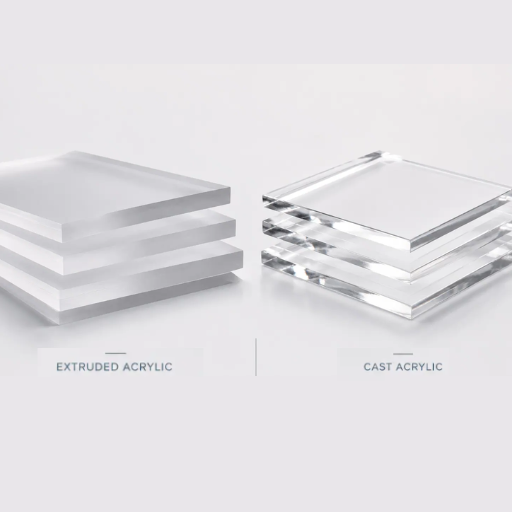
PMMA reaches the market as three products. They aren’t interchangeable, and the choice is made before anyone discusses grade. If you are choosing between the two sheet forms, how cast and extruded acrylic differ is the deeper comparison.
Cast sheet
Liquid monomer is poured between glass plates and polymerised in place. Cast sheet has the highest molecular weight of the three, which shows up as the best resistance to solvents and to environmental stress cracking. It runs from about 2 mm to 160 mm.
Extruded sheet
Pelletised polymer is melted and pushed through a die. Tolerance is tighter and cost is lower, but molecular weight is lower too, so aggressive cleaners craze it faster. Thin flat signage is its home.
Moulding compound
Pellets for injection moulding and extrusion. This is the only form that carries a melt flow rate, and the only one where grade codes mean anything. If the part comes out of a tool, this is your form.
A purchase order that names only “PLEXIGLAS” is ambiguous. Röhm sells PLEXIGLAS moulding compounds; Polyvantis sells PLEXIGLAS sheet. State the form, the grade and the supplying legal entity.
We supply PMMA as moulding compound: pellets for injection moulding and extrusion, from established producers, with lot documentation. This guide also covers sheet and cast applications, because you’ll meet them in specifications and competing quotes. When a job needs sheet, we’ll say so rather than quote you a pellet. What we stock is listed under PMMA resin supplier.
PMMA plastic uses: the application and grade matrix
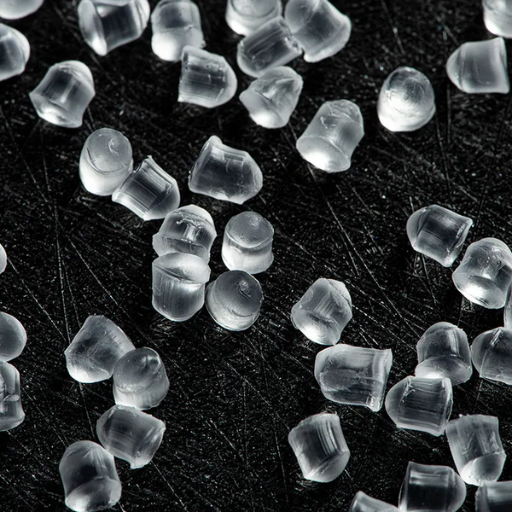
Most lists of the applications of PMMA stop at the industry name. This one keeps going: the form, the grade family, the property that earns PMMA the job, the standard to pass, and the failure mode.
Find your application, note the form and grade family, then check the standard in the last column. Where more than one grade is named, the split is heat resistance, flow or chemical resistance.
| Application | Form | Grade family | Governing property | Verify against | Failure mode |
|---|---|---|---|---|---|
| Rear, signal and indicator lamp lenses | Pellet | Heat-stable optical | 92% transmission, haze under 1% | SAE J576; FMVSS 108 | Cleaner crazing; stone-chip cracking |
| DRL light guides and light pipes | Pellet | Long-path optical | Low haze; attenuation in dB/m at the LED wavelength | OEM optical specification | Weld-line scatter; yellowing |
| LED diffusers, light boxes, luminaires | Sheet | Diffusion grades | Transmission traded against haze, deliberately | UL 879; ASTM D4802 or ISO 7823 | Transmission drops steeply with gauge |
| Edge-lit signs and channel letters | Cast sheet | Cast optical | Engraves to bright frosted white | ASTM D4802-16(2024); ISO 7823-1 | Extruded sheet engraves dull grey |
| Architectural glazing, canopies, rooflights | Cast or extruded sheet | Glazing grades | Half the weight of glass; impact; thermoformability | EN 13501-1; IBC 2606 | Combustible; creep; thermal bowing |
| Aquariums, pool windows, viewports | Thick cast sheet | Cast block | Clarity at depth plus impact resistance | ISO 7823-1 plus project engineering | Creep rupture, not short-term strength |
| Cosmetic packaging, closures, compacts | Pellet | Chemical-resistant | Gloss; Rockwell M99-M102 scuff resistance | 21 CFR 177.1010; EU 10/2011 | Ethanol stress cracking |
| Tableware, drinkware, tumblers | Pellet or sheet | General-purpose moulding | Clarity and impact against glass | 21 CFR 177.1010; EU 10/2011 | Irreversible crazing in a dishwasher |
| Food display, sneeze guards, bakery cases | Cast sheet, 5 mm | Food-contact sheet | Shatter resistance in a service area | 177.1010 plus a signed DoC | Scratches trap bacteria |
| Medical bone cement, beads, spacers | Powder plus liquid monomer | Cement system, not a pellet | Exotherm control and set time | ISO 5833; ASTM F451 | Thermal necrosis; residual monomer |
| Machine guards, CNC windows, inspection ports | Sheet, 3-10 mm | Impact-modified sheet | Stiffness and scratch resistance | OSHA 29 CFR 1910.212 | Notch sensitivity at drilled holes |
| Aircraft cabin windows and canopies | Stretched acrylic, 2-12 mm | Biaxially oriented | Craze and crack-growth resistance | MIL-PRF-25690B; 14 CFR 25.775 | Standard cast sheet fails the burn test |
How to choose a PMMA grade
Selection isn’t a menu. The constraints run in order, and each choice forecloses later ones.
1. Process route fixes the form. Injection moulding takes compound pellets. Extrusion and thermoforming take higher-molecular-weight extrusion grades. Cast sheet is a different polymerisation route and can’t be replaced by pellets in thick glazing.
2. Melt flow rate picks the band. These figures are at 230 °C/3.8 kg per ISO 1133, the PMMA convention:
- 0.5-2.5 g/10 min: extrusion, thick walls, best stress-crack resistance
- 2-4: general-purpose moulding and standard optical parts
- 5-8: medium flow, lenses and covers with moderate wall
- 10-15: high flow for walls under about 1.5 mm
- above 20: thin-wall parts and light-guide plates
A figure measured at 230 °C/10 kg isn’t comparable and reads roughly three times higher. Many datasheets quote MVR in cm³/10 min rather than MFR in g/10 min, so check which one you have.
3. Heat. Standard PMMA holds a heat deflection temperature of 85-95 °C at 1.8 MPa, or 100-105 °C at 0.45 MPa. Always carry the load: the two readings differ by 8-12 °C for the same grade. Continuous service above about 80 °C, or radiant load from an LED board, needs a heat-resistant grade.
4. Optical. Transmission, haze and yellowness compare only when the thickness is stated. 92% at 3.2 mm is the norm.
5. Impact. Standard PMMA is notch-sensitive. Impact-modified grades roughly double or triple notched impact for a loss of 1-8 points of transmission. If the part sits in a stone-chip or airbag zone, the answer is usually polycarbonate.
6. Compliance. Automotive takes SAE J576 plus FMVSS 108, electrical takes UL 746C, food takes 21 CFR 177.1010 plus EU 10/2011 with a signed declaration, and medical takes ISO 10993 alongside the device file.
7. Verify the lot. Ask for a certificate of analysis carrying MFR, transmission and yellowness for the production lot, with density at 1.18-1.19 g/cm³ as a fast identity check. Then buy a 25 kg trial from that lot before a container.
The acrylic PMMA resin grade selection guide maps applications onto these bands and the branded grades that sit in them.
Automotive and transport: PMMA wins the optics and loses the lens
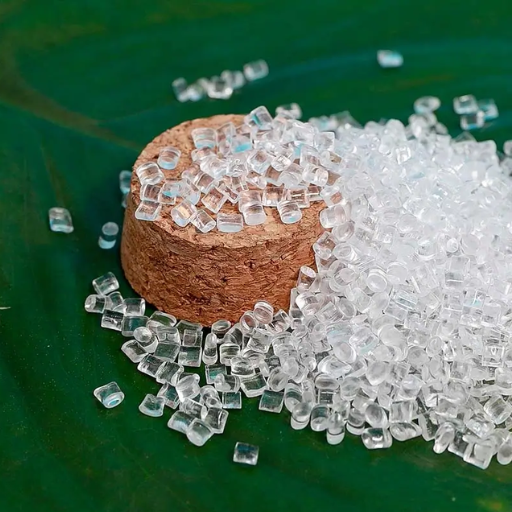
The applications of PMMA in vehicle lighting are narrower than the industry lists suggest. Rear, signal and indicator lenses are PMMA, as are reflex reflectors, bezels, and the light guides that carry one LED across a tail lamp. The property that wins the job is optical: 92% transmission at 3.2 mm, haze below 1%, and weathering that passes SAE J576 without a coating.
Uncoated polycarbonate hazes by 25-35% on the same exposure. FMVSS 108 caps haze at 30% for lamp lenses and 7% for reflex reflectors, which is why the reflector surface matters as much as the resin. The EU equivalent sits in UNECE R148, R149 and R150, published through WP.29.
Why the front headlamp lens is polycarbonate
The front cover lens is polycarbonate, and has been since the 1990s. PMMA is brittle under stone impact and softens above roughly 80 °C continuous, and a headlamp sits behind a hot light source in a stone-chip zone. Any page listing “PMMA headlamp lenses” without that split is describing a plastic that stopped being used there a generation ago. The same logic runs the PMMA vs polycarbonate decision across the rest of the vehicle.
Solvent cleaners are the usual failure. A fabricator on eng-tips described a machined acrylic tube that passed inspection, shipped, and cracked three weeks later. The load wasn’t the cause. An alcohol-based cleaner was, and the shop had no idea it was a stress-cracking agent.
Optics, displays and lighting
Refractive index is 1.491-1.492 at 589 nm, with an Abbe number around 55-60. That gives a critical angle near 42° against air, which is why a light pipe carries an LED across a panel on total internal reflection with almost no coating.
The transmission-haze trade-off
The real engineering problem isn’t clarity. It’s the transmission-haze trade-off in diffusers. A diffusion grade is specified twice: total transmission, and the half-angle over which it spreads light.
A tight diffuser, around 20°, keeps more light moving forward. A wide one, around 50°, evens out the panel but throws transmission away. Manufacturers publish both, and the numbers only compare at the same gauge.
Transmission also falls as sheet gets thicker, so the same grade behaves differently at 2 mm and at 8 mm. That is the most common specification error in light-box work.
Light guides and lens arrays
Light-guide plates depend on edge quality more than resin: a sawn or badly polished edge won’t couple light. Lenses and Fresnel arrays use optical grades with haze below 1%, limited by weld-line scatter where a gate sits in the optical path.
Attenuation for light pipes is quoted in dB/m at the actual LED wavelength. PMMA is usable to about 780 nm and not beyond, because carbon-hydrogen bonds absorb in the near infrared. The PMMA properties reference carries the method-by-method table behind these numbers.
Signage, retail and architecture
Signage splits on form, not fashion. Cast sheet engraves to a bright frosted white and holds an edge. Extruded sheet engraves dull grey and can’t be rescued. If the sign is edge-lit or engraved, the form is cast.
Architectural glazing and canopies
Architectural glazing is where PMMA’s honesty problem lives. Standard acrylic is combustible: Euroclass E under EN 13501-1, UL 94 HB, limiting oxygen index around 17%. It ignites, it burns, and it adds fuel.
It is not fire-resistant, and a D-s2, d0 rating is not available for plain acrylic. IBC 2606 restricts light-transmitting plastic in exterior walls, and egress routes need glass or a tested system.
Thermal movement is the second architectural issue. With a coefficient of linear expansion near 76 µm/m·K, a 3 m panel grows about 3 mm across a 40 °C swing. One fabricator’s fix for panels oil-canning at around 70 °C was to specify thicker sheet. It made no difference. The panels were expanding against a frame that held them rigid in-plane, and thickness only changed how they buckled.
Slotted holes and clearance solved it.
Illuminated signs and ADA wayfinding
UL 879 governs illuminated signage and asks for at least UL 94 HB with a relative thermal index near 50 °C in non-enclosure use. ADA wayfinding adds geometry: tactile characters raised 1/32 in, 5/8 in minimum height, and a sign top mounted 48-60 in above finished floor.
Medical, dental and laboratory
The applications of PMMA in medicine mostly bypass the pellet. Bone cement is PMMA, and it ships as a powder of pre-polymerised beads plus a liquid monomer, mixed at the point of use. ISO 5833 sets the minima: compressive strength of at least 70 MPa, flexural strength of at least 50 MPa, flexural modulus of at least 1,800 MPa, peak exotherm no higher than 90 °C, and setting time of 3-15 minutes. ASTM F451 defines a different window, 5-15 minutes, so the standard changes the number you can print.
The failure mode is thermal. Polymerisation is exothermic, and in a thin bone mantle the peak temperature can damage tissue. Residual monomer is a sensitiser, and the polymer doesn’t degrade.
Intraocular and contact lenses
Intraocular and hard contact lenses use proprietary copolymers, not commodity PMMA. They borrow the chemistry for optical precision and add UV absorbers. Oxygen permeability is effectively zero, so they’re a legacy category.
Dentures and prosthetics
Denture bases and teeth use powder-liquid systems or milled discs, governed by ISO 20795-1 and tested to ISO 10993.
Cuvettes and microfluidics
Laboratory uses are cuvettes and microfluidic chips: a mouldable optical path in a disposable part, usable from about 300 to 900 nm. Water absorption of 0.3-0.4% drifts a channel over months, and autofluorescence is higher than in COC or COP.
One boundary belongs here. ISO 10993 is a test framework, not a certificate. “Medical grade” has no legal definition. FDA clears and approves devices, never resins.
Consumer goods, appliances and food contact
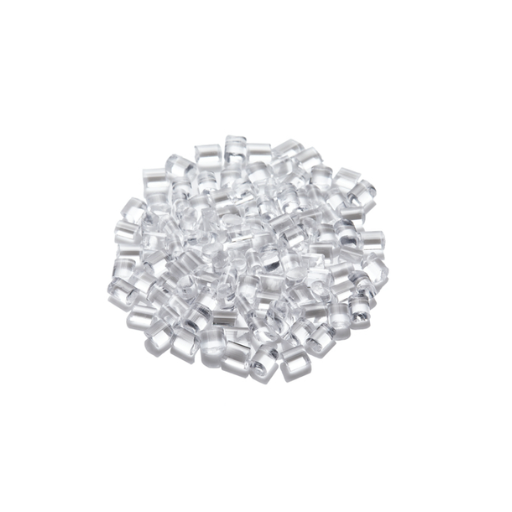
The applications of PMMA in consumer goods run on appearance, and cosmetic packaging is the strongest niche. Clarity, gloss and Rockwell M99-M102 scuff resistance make it the natural choice for jars, compacts and perfume closures.
Cosmetic packaging and the PP cup
Chemistry is the limit. In published compatibility ratings ethanol stress-cracks the polymer, rating D for severe effect even at 20 °C, and essential oils move from C at 20 °C to D at 50 °C.
That’s why there’s a polypropylene cup inside the acrylic jar. The acrylic is the visible surface; the PP does the containment.
Drinkware and dishwashers
Tableware has the same problem with heat. Standard PMMA is not dishwasher safe. Residential cycles reach 60-71 °C plus a hot dry phase, and commercial rinse stages run near 82 °C.
Heat, alkaline detergent and moulded-in stress together produce crazing that cannot be polished out. Suppliers of finished drinkware rate their articles at 70-80 °C, and at least one European maker restricts resin-handled cutlery to a 50 °C eco cycle.
Food display and sneeze guards
Food display is a genuine application, in cast sheet around 5 mm: sneeze guards, bakery cases, display shelving. The requirement is a food-contact grade with a signed declaration. 21 CFR 177.1010 limits non-volatile extractives to 0.3 mg/in² on the finished article, and EU 10/2011 sets an overall migration limit of 10 mg/dm². UV-printed and mirrored acrylic are not food contact.
Appliance panels and washing-machine lids use impact-modified grades that survive detergent and a slammed lid. Detergent and fabric softener are stress-cracking agents, and unmodified PMMA is too brittle for that duty. For surface performance, see PMMA hardness and scratch resistance.
Industrial, aerospace, marine and water
Machine guards and CNC windows are sold as impact protection and usually are not. OSHA 29 CFR 1910.212 and ANSI B11.19 govern the guard and its risk assessment; neither names a polymer.
An acrylic guard is a splash and chip shield. Where impact is real, the material is polycarbonate or a PC/PMMA laminate. Acrylic’s notch sensitivity means a crack starts at a drilled hole long before the panel sees a design load.
Aircraft windows and canopies
Aircraft cabin windows are stretched acrylic, 2-12 mm, made to MIL-PRF-25690B. Biaxial orientation buys craze and crack-growth resistance that cast sheet doesn’t have. 14 CFR 25.775 covers the structure and 25.853 with Appendix F covers flammability; standard cast PMMA doesn’t pass it. Cockpit windshields are laminated glass, not acrylic.
Marine portlights and boat windows
Marine portlights and boat windows use cast sheet, where PMMA’s UV stability beats every other clear plastic and corrosion is a non-issue. ISO 12216:2020 sets the structural requirements. What fails is wave-slam impact, brittle fracture, and crazing from solvent-based sealants.
Aquariums are the clearest case of a load path whose limit isn’t strength. Builders of a 200-plus gallon tank reported crazing that looked like a panel failure; it was seam separation. The panel hadn’t reached its short-term strength. It had crept under years of hydrostatic load.
Tanks are sized by allowable stress over a 10-20 year life, and nothing goes below the waterline without engineering.
Where PMMA is the wrong material
Half the applications PMMA gets credited with online are wrong. The sections above cover the half that is right. This is what to use instead.
| Requirement | Use instead |
|---|---|
| Gears, bearings, cams, wear parts | POM, PA66, PBT, PEEK, PPS |
| Front headlamp lens, stone-chip zone | Coated polycarbonate |
| Impact-rated eye and face protection (Z87+) | Polycarbonate |
| Flameproof equipment window (Ex d) | Tempered glass, or PC per the certificate |
| Pressure sight glass (DIN 7080/7081) | Borosilicate or soda-lime glass |
| Fire-rated or egress glazing | Glass or a tested system; plain acrylic is Euroclass E |
| Refrigerator crisper drawers | SAN or GPPS |
| Dishwasher-cycle drinkware | PP, or a copolyester |
| High-alcohol cosmetic contact | PP or PETG inner |
| High-end camera optics, microfluidics | COC or COP |
| Structural glazing, balustrade load path | Laminated glass |
The pattern is consistent. PMMA loses wherever a mechanism must deform under load, wherever impact is a design case, and wherever a pressure boundary or fire rating has to hold. It wins on clarity, weathering, weight, and cost per square metre of light. Where impact or heat rules the decision, the polycarbonate resin grades page covers the alternative.
Sustainability and end of life
PMMA is one of the few high-volume addition polymers that unzips back to its monomer: thermal depolymerisation splits it into methyl methacrylate, and commercial recycled-MMA optical grades exist. Mechanical regrind is capped near 20-30% in optical parts, because haze and yellowness accumulate.
“Bio-based PMMA” usually means a mass-balance allocation, not a bio-derived molecule, so ask for the certificate.
How to specify and verify
Six items decide whether the material you ordered is the material that arrives:
- A grade-specific technical datasheet, not a family brochure.
- A certificate of analysis per lot, carrying MFR, transmission, yellowness and density.
- The standard and its edition year: ASTM D4802-16(2024), not ASTM D4802.
- A declaration of conformity naming the exact grade and colour.
- A written change-notification agreement.
- A 25 kg trial drawn from the production lot before a volume order.
The largest mislabelling risk in this supply chain is a house certificate with no manufacturer lot number on it. If it can’t be traced to a production batch, treat the grade as unverified. Then request the datasheet for the grade you’re considering, with its lot documentation.
Frequently asked questions
What is PMMA used for?
Automotive rear and signal lenses, LED diffusers, signage, glazing, aquariums, cosmetic packaging, drinkware, food display, bone cement, dentures and machine windows. It wins on clarity and weathering, and loses above about 80 °C.
Why is PMMA used in car lights?
92% transmission at 3.2 mm, haze under 1%, and weathering that passes SAE J576 where uncoated polycarbonate hazes by 25-35%. FMVSS 108 caps haze at 30% for lamp lenses and 7% for reflex reflectors. The front cover lens, though, is polycarbonate.
Is PMMA food safe?
Only if it is a food-contact grade with a signed declaration. 21 CFR 177.1010 limits non-volatile extractives to 0.3 mg/in² on the finished article, and EU 10/2011 sets a migration limit of 10 mg/dm².
Is PMMA used in medical devices?
Yes: bone cement, intraocular lenses, dentures, cuvettes and microfluidics. ISO 10993 supports a device file but never substitutes for it, and “medical grade” has no legal definition.
Is PMMA the same as acrylic?
Yes. PMMA is the polymer; acrylic is the family and trade name. Sheet sold as acrylic is at least 80% methyl methacrylate under ASTM D4802.
Is PMMA brittle?
Yes. Notched Izod runs 15-74 J/m and elongation at break is 4-5%, so a notch becomes a crack. Impact-modified grades double or triple that. For real impact duty, use polycarbonate.
Is PMMA recyclable?
Yes, unusually well. Thermal depolymerisation recovers methyl methacrylate, and commercial recycled-MMA optical grades exist. Mechanical regrind is limited to about 20-30% in optical parts.
Is PMMA a thermoplastic or thermoset?
A thermoplastic. It melts, can be remoulded, and can be depolymerised, which is exactly why the recycling route works.
Is clear 3D-printer resin PMMA?
No. Clear resins for SLA and DLP are methacrylate photopolymers, not polymerised PMMA. PMMA filament exists but is rare and warps.
The applications of PMMA, sorted
The applications of PMMA sort along a short path. Form first, because it forecloses the rest. Then grade family, by heat, flow or chemical resistance.
Then the property that earns the job. Then the standard you’ll be asked to prove. Then the failure mode you’re accepting.
Follow that path and the list of industries stops being trivia and becomes a specification. Keep the other half in view too. Knowing that a dishwasher will craze your drinkware, that a headlamp lens is polycarbonate, and that a tank fails by creep rather than by breaking is worth more than another list of products.
Request a PMMA datasheet. Tell us the application, the process and the standard, and we’ll name the grade.