

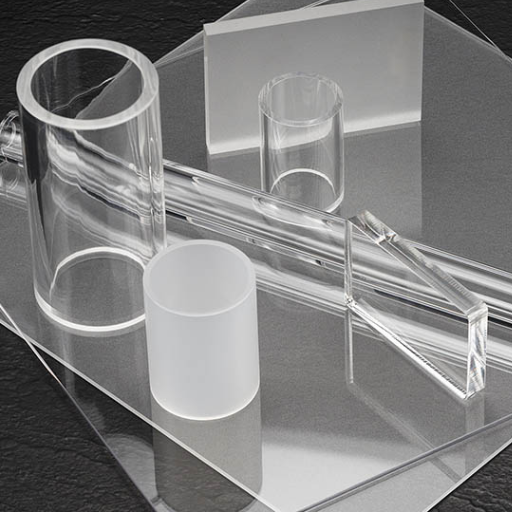



Search “polycarbonate melting point” and you get two answers that cannot both be right. Half the internet says 220 to 230 °C. The other half says polycarbonate has no melting point at all.
Both answers describe something real, and the gap between them is the most important thing to understand before you design, mold, or buy a PC part. The number on the datasheet isn’t a melting point, and it isn’t a service limit either. It’s a softening landmark. Treating it as anything more is how engineers end up with warped lenses, cracked enclosures, and brittle parts that “melted” exactly as specified.
Here is the honest picture. Polycarbonate is an amorphous thermoplastic, so it has no true melting point. It softens above its glass transition temperature of about 147 °C (297 °F), flows as a thick liquid from roughly 215 to 230 °C, and is actually molded at 280 to 320 °C. The design numbers you spec against are Tg, heat deflection temperature (HDT), and continuous service temperature, none of which appear in the melting point column.
This guide gives you every temperature that matters for polycarbonate, explains where the misleading 220 to 230 °C figure comes from, breaks PC down by grade, and shows what to verify when you source the resin. We supply branded prime polycarbonate grades from Suzhou, China, with a Certificate of Analysis on every batch. If you already know which grade you need, request a PC resin quote and our technical team responds within 24 hours.
Does Polycarbonate Have a Melting Point?

No. Polycarbonate has no true melting point. It is an amorphous thermoplastic with no crystalline regions to melt, so it softens gradually above its glass transition temperature of about 147 °C (297 °F) and flows as a viscous liquid from roughly 215 to 230 °C. Commercial molding runs at 280 to 320 °C.
That’s the direct answer behind searches for “does polycarbonate melt,” “does polycarbonate have a melting point,” and “pc melting point.” It’s a real distinction, not a technicality.
A semi-crystalline plastic like nylon or acetal holds its molecular chains in ordered crystals, and those crystals break down at one sharp temperature. Melt the crystals and the material is liquid. Polycarbonate’s bulky, stiff chains never pack into crystals in the first place, so there’s nothing to break down all at once. It has no sharp transition from solid to liquid, only a gradual loss of stiffness as it heats.
Why Polycarbonate Has No Melting Point
Polycarbonate is built from bisphenol A units joined by carbonate linkages, which gives its backbone an aromatic, rigid, and irregular shape. Those chains entangle randomly in the melt and stay entangled when the part cools, because the cooling happens far too fast for them to organize into crystals. The result is a transparent, glassy solid with no ordered structure at all.
That structure is exactly why PC is transparent. Crystalline regions scatter light, and amorphous ones don’t. The same physics that makes polycarbonate clear is the same physics that leaves it without a melting point.
For the polymer-classification background, Wikipedia’s entry on polycarbonate is a reliable technical starting point. It confirms the ~147 °C Tg value, notes the flow point above 155 °C, and documents the absence of a sharp melting transition in commercial PC.
One honest footnote for completeness. Crystalline polycarbonate can be produced in a laboratory through solvent-induced crystallization or extended annealing. When researchers do this, the crystalline regions show a very broad melt somewhere in the 200 to 250 °C region, and extrapolated equilibrium melting values run as high as 317 to 335 °C for ideal chains.
That research is academic. No commercial PC resin pellet you can buy behaves this way, and you shouldn’t let a materials handbook convince you otherwise.
Where the “220 to 230 °C Melting Point” Comes From
The 220 to 230 °C (428 to 446 °F) figure appears on datasheets and material safety data sheets everywhere. It isn’t wrong so much as mislabeled. That’s the temperature at which amorphous PC becomes a free-flowing viscous fluid under its own weight, the point where the tangled chains slide past each other readily enough to pour.
So if you came here looking for the polycarbonate melting temperature, this is very likely the number you already saw. It is a flow landmark, not a phase change.
It sits just above PC’s softening point of about 150 to 160 °C and well below the 280 to 320 °C a molder actually sets on the barrel. That’s precisely why the number confuses people. A reader sees “melting point 220 °C” and “processing temperature 300 °C” on the same datasheet and assumes something is inconsistent.
It isn’t. Those are two different measurements of two different behaviors.
Older references circulate other values too, including 250 °C and 267 °C. Those numbers trace back to historical literature and to crystalline samples, not to the amorphous resin in your hopper. Treat 220 to 230 °C as a softening and flow landmark, never as a thermodynamic melting point, and never as a service or processing setpoint.
The Polycarbonate Melting Point Numbers That Actually Matter
Five temperatures define how PC behaves in a mold and in service. Each one answers a different question, and mixing them up is the source of nearly every PC thermal mistake.
- Glass transition temperature (Tg): about 147 °C, the real design ceiling.
- Softening and Vicat range: about 150 to 160 °C, when the part starts to give under load.
- Datasheet “melting point”: 220 to 230 °C, the flow landmark that is not a melting point.
- Processing melt temperature: 280 to 320 °C, what the machine is actually set to.
- Decomposition onset: above 310 to 360 °C, where the polymer starts to break down.
Glass Transition Temperature (Tg): About 147 °C
Standard bisphenol A polycarbonate has a glass transition temperature of approximately 147 °C, which is 297 °F or 420 K. Reported values range from about 140 to 155 °C depending on grade, molecular weight, moisture content, and test method.
Tg is the temperature at which the amorphous polymer shifts from a rigid glass to a soft, rubbery state. Above it, the modulus drops sharply, creep accelerates, and dimensional and optical stability degrade. This is the number that actually limits a PC part in hot service, and it’s why engineers should be searching for PC’s glass transition temperature rather than its melting point.
Designers typically hold continuous service about 40 to 50 °C below Tg, which puts the practical ceiling near 100 to 110 °C. We cover the full picture in our dedicated guide to polycarbonate glass transition temperature, including how Tg varies by grade and how to design against it.
Softening Point and Vicat Softening Temperature
The softening point sits around 150 to 160 °C. The formal measurement is the Vicat softening temperature, tested to ISO 306 or ASTM D1525, which tracks how deep a loaded needle penetrates the surface as the material heats. Standard PC grades land near 145 to 150 °C, while high-heat copolycarbonate grades run considerably higher.
Vicat is a practical proxy for “when does this part start to give,” not a melting temperature and not a design limit. If you need the difference between softening, melting, and deflection explained cleanly, our heat deflection temperature versus melting point hub walks through which number to specify for which load case.
Heat Deflection Temperature (HDT)
HDT is the temperature at which a loaded test bar deflects by a set amount, measured per ISO 75 or ASTM D648. Unfilled polycarbonate reaches about 125 to 135 °C at 1.82 MPa, with some sources quoting a wider 107 to 130 °C band by grade. Glass-filled and high-heat grades push past 140 to 150 °C at the same load.
HDT is the number to put in a specification whenever a part carries a load at temperature. Melting point tells you nothing about that. Our polycarbonate heat deflection temperature article breaks the values down grade by grade.
Continuous Service Temperature: About 115 to 125 °C
Applications for PC are commonly rated from -60 °C to +120 °C, with short-term excursions to about 135 °C. The message is simple and worth repeating: the 220 to 230 °C figure people call PC’s melting point is nowhere near a usable service limit. Keep the long-term ceiling near 115 to 125 °C for standard grades and check the grade datasheet for high-heat options.
Thermal Decomposition: Above 310 to 360 °C
Degradation onset varies by grade and source. Conservative figures put visible degradation above roughly 310 °C, while some filament datasheets list decomposition above 360 °C. Yellowing and molecular weight loss begin before bulk decomposition, which is why PC needs a controlled melt temperature and short residence time. Moisture makes it worse, because PC also degrades hydrolytically.
Polycarbonate Thermal Properties at a Glance
| Property | Value | What it actually means |
|---|---|---|
| True melting point (Tm) | None (amorphous) | No crystalline phase exists to melt |
| Glass transition (Tg) | ~147 °C (297 °F) | The real design ceiling |
| Softening / Vicat (VST) | ~150 to 160 °C | Starts to give under load |
| Datasheet “melting point” | 220 to 230 °C (428 to 446 °F) | Flow landmark, not a Tm |
| HDT at 1.82 MPa | ~125 to 135 °C | Load-bearing thermal limit |
| Continuous service | ~115 to 125 °C | Hold 40 to 50 °C below Tg |
| Processing melt temp | 280 to 320 °C | What the machine is set to |
| Mold temperature | 80 to 120 °C | Controls stress and optical quality |
| Drying | 120 °C for 2 to 6 h to under 0.02% | Mandatory, hydrolysis risk |
| Decomposition onset | Above 310 to 360 °C | Degradation and yellowing |
Why Polycarbonate Is Molded at 280 to 320 °C

If Tg is 147 °C and the flow landmark is 220 to 230 °C, the obvious question is why anyone runs a PC barrel at 300 °C. The answer is melt viscosity.
Polycarbonate’s aromatic backbone is stiff and its chains are long, so the melt is thick. Heat is what thins it. Raising the melt temperature drops the viscosity enough for the polymer to fill a cavity under realistic injection pressures, and PC is also strongly shear-thinning, so injection speed matters as much as temperature. The 280 to 320 °C window is the compromise where PC flows well without degrading. The Omnexus/SpecialChem polycarbonate selection guide lists the same melt range, alongside 310 to 340 °C for high-heat grades.
High-heat grades, such as Apec copolycarbonate, need even more heat. Their melt temperature runs 310 to 340 °C, and glass-filled grades sit around 310 to 330 °C. Mold temperature is the other half of the equation: PC is usually run with a mold held at 80 to 120 °C to control molded-in stress and protect optical quality. Warm molds reduce the frozen-in stress that later causes stress cracking.
Two process rules follow directly from the chemistry. Keep residence time short, because long holds at high melt temperature degrade the polymer even inside the window. And dry the resin, because moisture turns a temperature problem into a chemical one.
Drying Is Mandatory, Not Optional
Polycarbonate is hygroscopic. It absorbs moisture from the air, and that water does two damaging things during molding. It flashes to steam at the gate, causing splay marks and bubbles, and it attacks the polymer chains by hydrolysis, cutting molecular weight and embrittling the finished part.
The fix is a drying step that isn’t negotiable. Dry PC at 120 °C for 2 to 6 hours to bring moisture below 0.02%, using a dehumidifying or desiccant dryer with a dew point of -20 °C or lower. A hot-air dryer won’t do it for PC. The PC injection molding guide from CN Mould & Plastic documents the same 120 °C and 2 to 6 hour drying schedule.
This is also why the “melting point” number alone can never tell you how to run a process. A part molded from wet resin can satisfy every temperature on the datasheet and still fail in the field.
Annealing and Stress Relief
Annealing below Tg, typically around 120 to 130 °C, relieves molded-in stress and improves dimensional stability without softening the part into the rubbery state. It is a common step for parts that will see solvents, load, or tight tolerances, and it is another reminder that PC is managed through its Tg and processing window, not through any melting temperature.
Polycarbonate Melting Point and Thermal Limits by Grade
Not every PC grade shares the same thermal profile, and the differences are what drive grade selection. None of them gains a melting point. What changes is the glass transition temperature, the HDT, and the polycarbonate processing temperature window.
| Grade family | Tg (°C) | HDT at 1.82 MPa (°C) | Process melt (°C) | Typical applications |
|---|---|---|---|---|
| Standard Makrolon 2407 / 2805 | ~145 to 147 | ~125 to 130 | 280 to 310 | Safety glazing, helmets, light covers, machine guards, enclosures |
| Flame-retardant Makrolon 6555 / 6557 | ~145 | ~125 to 130 | 280 to 310 | Electrical enclosures, power-supply housings, consumer electronics |
| High-heat Apec copolycarbonate | Up to ~180 to 200+ | ~140 to 150+ | 310 to 340 | Automotive lighting bezels, high-heat enclosures, medical devices |
| Glass-filled Makrolon 9125 | ~147 | ~145 to 150+ | 310 to 330 | Structural and load-bearing parts needing higher stiffness |
Confirm these values against the manufacturer datasheet for the exact grade before you commit to a design. Grade families vary within themselves, and even a suffix can change the thermal profile. One honest caveat on the Apec line: a high-heat grade still has no melting point. The upgrade raises Tg and HDT, and it doesn’t create a Tm.
Polycarbonate Melting Point vs. Other Plastics

The fast way to understand why PC’s melting point question is the wrong question is to compare it against materials that do have one.
| Material | Structure | Tm (°C) | Tg (°C) | HDT at 1.82 MPa (°C) | Process melt (°C) | Service (°C) |
|---|---|---|---|---|---|---|
| PC | Amorphous | None (softens ~215 to 230) | ~147 | ~125 to 135 | 280 to 320 | 115 to 125 |
| ABS | Amorphous | None | ~105 | ~85 to 100 | 200 to 250 | 60 to 80 |
| PMMA | Amorphous | None (softens ~160) | ~105 | ~80 to 100 | 210 to 240 | 65 to 80 |
| POM | Semi-crystalline | ~165 | ~-60 | ~100 to 110 | 185 to 210 | 80 to 120 |
| PA66 | Semi-crystalline | ~255 to 265 | ~50 to 65 (dry) | ~70 to 100 | 270 to 300 | 80 to 120 |
| HDPE | Semi-crystalline | ~130 to 137 | ~-120 | ~45 to 70 | 180 to 260 | 60 to 80 |
The pattern is clear. The melting point column is empty for PC, ABS, and PMMA, because all three are amorphous. They’re compared on Tg and HDT instead. Meanwhile POM, PA66, and HDPE have real melting points and are judged partly on that number. That’s the single most useful frame for anyone confused by a “polycarbonate melting point” search result.
PC vs. ABS at Elevated Temperature
Neither material has a melting point, so the melting point chart can’t separate them at all. PC’s Tg of about 147 °C against ABS’s roughly 105 °C is the entire selection decision for a warm enclosure, and it’s why PC wins there. Our ABS melting temperature guide covers the other side of that comparison.
PC vs. PA66 for High-Heat Parts
PA66 has a genuine melting point near 260 °C and, with glass reinforcement, a high short-term HDT. But PA66 is semi-crystalline, opaque, and hygroscopic, while PC keeps clarity and impact strength to higher continuous temperatures. If you need transparency and toughness at temperature, PC wins. If you need maximum stiffness and short-term heat resistance, a glass-filled PA66 is usually the better spec. Where friction and dimensional stability matter more than heat, POM is often the stronger choice.
For the full cross-material chart, including all of these materials side by side, see our plastic melting point chart.
Why Polycarbonate Thermal Consistency Matters for Buyers
Thermal data only helps if it’s true for the batch you actually mold. This is where the difference between branded prime resin and an unknown compound shows up on the shop floor.
Batch-to-Batch Variation Is a Red Flag
Branded manufacturers publish consistent Tg, HDT, and melt flow rate baselines for each grade. When a supplier’s numbers drift between shipments, it usually signals off-spec compounding, regrind contamination, or material that isn’t the branded grade it claims to be.
Marcus, a process engineer at a medical-device molder, found this the expensive way. His line had run a transparent PC housing for two years with stable cycle times. Then a new resin lot started short-shotting, and a few parts came out with a faint haze that failed optical inspection. The supplier blamed the mold.
Marcus sent a sample for thermal analysis, and the glass transition temperature came in several degrees below the grade baseline, with a broader transition than the reference. That pattern pointed to blended regrind. Switching back to a traceable branded lot restored the process within a day.
For a buyer, the lesson is direct. Because PC has no melting point, you can’t validate it by testing a melting temperature. Validate Tg, HDT, and melt flow against the published baseline instead.
What to Check on the Certificate of Analysis
The COA is your thermal verification tool. Confirm four fields: grade designation and manufacturer, so you know exactly which branded grade you are buying; the thermal baseline of Tg, HDT, Vicat, and melt flow rate; density, as a secondary identity check; and the lot and batch number, along with RoHS and REACH statements where your market requires them.
A COA is only as valuable as the brand behind it. That’s why we supply branded prime polycarbonate rather than commodity compound, and why every batch from our Suzhou warehouse ships with a manufacturer-issued Certificate of Analysis, the MSDS, the commercial invoice, and the packing list.
Sourcing Polycarbonate from China
If you source PC from China, buy branded prime resin from a supplier who can prove it. Our location in Suzhou, minutes from the Port of Shanghai, keeps export lead times at 7 to 14 days depending on destination, with FOB Shanghai as the standard term and a 25 kg minimum order.
That small minimum makes qualification practical. Order 25 kg from the same lot your production material will come from, run your own thermal and flow checks against the COA, and confirm the grade before committing to volume. Our polycarbonate supplier page lists the branded grades and documentation we provide for optical, electrical, automotive, and medical applications.
Frequently Asked Questions

Does polycarbonate have a melting point?
No. Polycarbonate is amorphous and has no true melting point. It softens above its glass transition temperature of about 147 °C and flows as a viscous liquid from roughly 215 to 230 °C.
What is the polycarbonate melting point in Celsius?
There’s no true melting point. The figure most often quoted, 220 to 230 °C, is a softening and flow range, not a thermodynamic melting transition.
What is the polycarbonate melting point in Fahrenheit?
About 428 to 446 °F, which is the same 220 to 230 °C flow range. Commercial polycarbonate has no true Tm in either scale.
What temperature does polycarbonate melt at?
There is no single melting temperature. Amorphous PC softens gradually, becoming a pourable viscous fluid around 215 to 230 °C, and it is processed at 280 to 320 °C.
Why is PC’s melting point listed as 220 to 230 °C if it has no melting point?
That number marks where amorphous PC becomes a free-flowing viscous fluid. It’s a practical flow landmark, not a melting point, and it sits well below the 280 to 320 °C a molder actually runs.
At what temperature does polycarbonate soften?
Softening begins around 150 to 160 °C. The formal Vicat softening temperature for standard grades is about 145 to 150 °C, with high-heat grades running much higher.
Is polycarbonate safe at 120 °C?
Yes for many standard grades, provided there is no significant load. Continuous service is commonly rated near 115 to 125 °C, but HDT at 1.82 MPa is only about 125 to 135 °C, so a loaded part needs closer review.
What temperature should polycarbonate be processed at?
Injection molding melt temperature is 280 to 320 °C for standard grades, 310 to 340 °C for high-heat grades, and 310 to 330 °C for filled grades. Mold temperature runs 80 to 120 °C.
Does polycarbonate need to be dried before molding?
Yes, always. Dry at 120 °C for 2 to 6 hours to below 0.02% moisture in a dehumidifying dryer. Molding wet PC causes splay, bubbles, and hydrolysis-driven embrittlement.
Is polycarbonate better than ABS for high-temperature applications?
Yes. Neither has a melting point, so the comparison comes down to Tg: about 147 °C for PC against roughly 105 °C for ABS. PC holds its dimensions and clarity to much higher temperatures.
Is polycarbonate food safe at high temperature?
Many PC grades carry food-contact approvals, but the limit is the grade’s service temperature and its HDT under load, not any melting point. Verify the specific grade’s food-contact documentation and intended-use temperature range with your supplier.
Conclusion
The polycarbonate melting point is one of the most misunderstood numbers in engineering plastics, and the truth is simpler than the SERP suggests. PC is amorphous, so it has no true melting point. It softens above a glass transition temperature of about 147 °C, flows from roughly 215 to 230 °C, and is molded at 280 to 320 °C after drying to below 0.02% moisture. The numbers that actually govern a design are Tg, HDT of about 125 to 135 °C at 1.82 MPa, and continuous service near 115 to 125 °C. High-heat grades raise Tg and HDT, never Tm.
Treat the datasheet’s 220 to 230 °C as a flow landmark, not a service limit or a setpoint. Validate your incoming resin on Tg, HDT, and melt flow rather than a melting temperature that does not exist, and buy branded prime PC with a traceable Certificate of Analysis so the batch behaves like the datasheet.
We supply branded prime polycarbonate, including standard, flame-retardant, high-heat, and glass-filled grades, from leading manufacturers with full COA documentation, a 25 kg minimum order, and FOB Shanghai pricing. Tell us your application, your service temperature, and your load case, and we will recommend the right branded grade, including an honest redirect to PPS or PA66-GF if your part runs hotter than PC should.
Request a PC resin quote and get a recommendation backed by real datasheets, not a number that was never a melting point.