




In March 2025, a packaging plant in Gujarat rejected 4,300 jerrycans after a single production shift. The bottles passed visual inspection but failed the 1.8-meter drop test. Root cause tracking took three days to isolate: the HDPE blow molding resin had a melt flow index 40% above the value on the supplier’s datasheet. The parison sagged more than the die-gap program could compensate for, and the bottom pinch-off welds ended up too thin to hold.
That line processed over two million containers annually. The supplier’s generic “blow molding grade HDPE” had no lot-specific Certificate of Analysis, no manufacturer letterhead, and no batch MFI value traceable to the original producer. The material was cheap. The scrap, downtime, and QC investigation cost fourteen times what the resin savings delivered.
This guide covers HDPE blow molding process parameters, grade selection by MFI and container type, temperature profiling across barrel zones, defect troubleshooting, multi-layer co-extrusion, and the COA verification that prevents the Gujarat scenario from repeating on your line.
What Is HDPE Blow Molding?
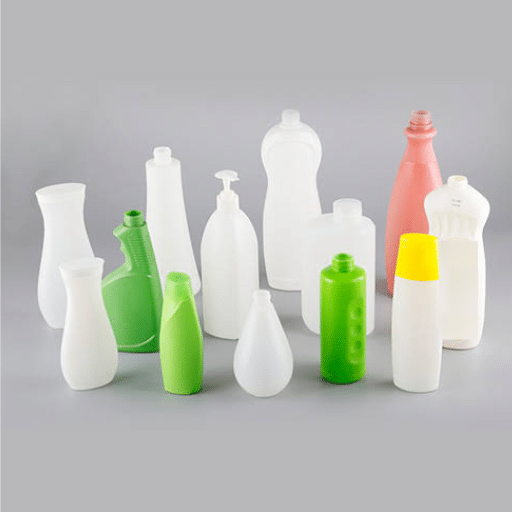
HDPE blow molding produces hollow plastic parts by extruding a molten HDPE tube, called a parison, and inflating it with compressed air against a cooled mold cavity. It is the manufacturing backbone behind roughly 70% of the world’s rigid plastic packaging, from 50 ml pharmaceutical dropper bottles to 1,200-liter intermediate bulk containers. HDPE bottle blow molding specifically dominates the packaging sector, producing an estimated 60 billion units annually for food, chemical, pharmaceutical, and personal care markets.
How HDPE Extrusion Blow Molding Works
The process runs in five sequential steps:
- Extrusion: HDPE pellets melt inside a heated barrel and are pushed through a die head to form a vertical parison.
- Mold close: Two mold halves clamp around the parison, pinching it shut at the top and bottom.
- Blow: A blow pin or needle injects compressed air, expanding the parison against the chilled mold walls.
- Cooling: The plastic solidifies against the mold, typically at 60 to 75 percent of total cycle time.
- Ejection: The mold opens, the finished container is removed, and flash is trimmed.
This is extrusion blow molding (EBM), the dominant variant for HDPE. Injection blow molding (IBM) and injection stretch blow molding (ISBM) exist for specific applications but EBM accounts for nearly all HDPE production from bottles to drums.
Why HDPE Dominates Blow Molding
HDPE became the standard blow molding material for four practical reasons. First, its melt strength keeps the parison from sagging too quickly during extrusion, something LDPE and PP struggle to match at comparable processing temperatures. Second, HDPE’s chemical resistance handles the detergents, bleach, agrochemicals, and industrial fluids that fill blow-molded containers. Third, the broad processing window (180 to 230 degrees Celsius melt temperature) gives operators more margin for error than narrow-window materials like PET. Fourth, HDPE is significantly cheaper than engineering thermoplastics, and it recycles under resin code 2 with an established post-consumer recycling infrastructure.
HDPE blow molding also has real limitations. Wall thickness uniformity is difficult, parison sag and anisotropic shrinkage create variation that mold design can manage but never eliminate. The material’s heat deflection temperature tops out at 70 to 100 degrees Celsius at 0.45 MPa, meaning hot-fill applications need a different resin.
Environmental stress cracking resistance varies dramatically by grade. Choosing the wrong ESCR rating for a detergent or solvent application will produce field failures. UV exposure degrades unstabilized HDPE within months of outdoor storage. For small, solid, high-precision parts, blow molding is the wrong process entirely — that workload belongs to injection molding.
Related reading: For the fundamentals of HDPE’s molecular structure, density, and property ranges, see our complete high density polyethylene material guide.
HDPE Blow Molding Process Parameters
Extrusion blow molding demands control over six interdependent variables. Small deviations in one parameter cascade through wall thickness distribution, cooling rate, and weld integrity.
Barrel Temperature Profile
The extruder barrel is divided into zones, each requiring a specific setpoint for HDPE:
| Zone | Temperature | Purpose |
|---|---|---|
| Feed zone | 160–180°C | Begin melting without premature softening at the hopper throat |
| Compression/middle zones | 180–200°C | Complete melting under progressively decreasing channel depth |
| Metering zone | 200–220°C | Homogenize melt temperature and build head pressure |
| Die head | 175–200°C | Shape the parison; slightly cooler than metering to preserve melt strength |
Target melt temperature: 190–210 degrees Celsius. Keep it within plus or minus 3 degrees for process stability. Running hotter (210 to 220 degrees) improves surface gloss but increases parison sag and degradation risk. Running cooler (180 to 190 degrees) reduces sag but risks surface roughness, incomplete fills, and poor weld strength.
Key Parameter Reference
| Parameter | Recommended Range | What Happens Outside Range |
|---|---|---|
| Melt temperature | 190–210°C (range 180–220°C) | Below: rough surface, poor welds. Above: sagging, black specks, degradation |
| Mold temperature | 10–30°C | Warmer: better surface, longer cycle. Colder: faster cycle, higher residual stress |
| Blow pressure | 0.2–0.7 MPa (30–100 psi) | Too low: incomplete forming at corners and deep draws. Too high: flash, excessive clamp force needed |
| Screw speed | Under 70 RPM | Above 70 RPM: melt fracture risk increases; sharkskin appears on parison surface |
| Back pressure | 0.3–1.5 MPa | Excessive back pressure increases residence time and degradation risk |
| Cooling time | 60–75% of total cycle | Insufficient cooling is the number one cause of rocker bottoms and warped necks |
| Shrinkage | 1.5–3.0% | Higher than injection-molding-grade HDPE; mold dimensions must account for this from design |
HDPE Blow Molding Temperature and Degradation
HDPE blow molding temperature control is the single most influential parameter for consistent container quality. HDPE begins degrading above 250 degrees Celsius with extended residence time. The warning signs are black specks (carbonized resin particles) appearing in the parison, a sharp or acrid odor at the die head, and reduced melt strength that causes the parison to elongate unpredictably. The safety ceiling for most commercial grades is 280 degrees, approaching this risks catastrophic degradation that requires a full barrel and die head purge.
Do not leave the machine idling at full processing temperature without material flow. Resin sitting static in the barrel consumes its antioxidant package faster than resin moving through the screw. During pauses exceeding 15 minutes, purge enough material to refresh the barrel contents and drop temperatures 25 to 40 degrees.
Parison Programming
Servo-driven parison programming dynamically adjusts the die gap during extrusion to vary wall thickness along the parison’s length. The goal is uniform bottle wall thickness after inflation.
The parison needs extra material at three stress points: the bottom pinch-off weld, the handle attachment area, and the shoulder where the bottle transitions from body to neck. It can be thinner in the bottle body’s cylindrical mid-section, this is the primary weight-saving opportunity.
Gravity stretches the parison as it hangs. The upper section thins out before the lower section even forms. A properly programmed die-gap curve compensates by starting wide and narrowing as the parison lengthens. Typical weight savings from effective parison programming run 5 to 15 percent per container. On a line producing ten million bottles a year, that difference alone can recover the cost of upgrading from a basic to a servo-controlled die head within twelve months.
Need help matching resin to your specific container design? Contact our technical team with your application details, we’ll recommend the right branded grade, not just the one in stock.
HDPE Grade Selection for Blow Molding

Blow molding grade selection starts with one number: the melt flow index. Everything else, parison stability, weld strength, cycle time, flows from it.
HDPE Blow Molding MFI: Grade-to-Application Mapping
Blow molding HDPE uses low-MFI grades because melt strength matters more than flowability. The resin must support its own weight as the parison hangs from the die head. Higher MFI means lower molecular weight, which means faster sag and thinner walls where you need them thickest.
| Container Type | Target MFI (g/10min at 190°C/2.16 kg) | Why This Range |
|---|---|---|
| IBCs, large drums (120–220L), heating oil tanks | 0.15–0.35 | Maximum melt strength required; accumulator head machines; the parison weighs kilograms, not grams |
| Industrial jerrycans (10–30L), chemical containers | 0.2–0.5 | Still needs high melt strength but faster cycle times than drum production |
| General-purpose bottles (1–5L), detergent, household chemicals | 0.5–1.0 | Balanced processability; short enough cycle time for multi-cavity production |
| Small bottles (50–1000 ml), pharmaceutical, thin-wall cosmetic | 1.0–2.5 | High flow needed to fill thin walls quickly; parison weight is low so sag is less of a concern |
A fractional-melt HDPE grade (MFI below 0.35) sounds ideal for everything, maximum strength, maximum ESCR. But running fractional-melt resin on a line designed for MFI 0.8 will crater throughput, spike melt pressure, and produce incomplete fills. For every container, the right MFI is the lowest value that still fills the mold within your target cycle time.
Density Selection
HDPE material properties — particularly density — directly determine blow molding performance. HDPE density ranges from 0.945 to 0.965 grams per cubic centimeter, and the tenth of a gram difference between 0.950 and 0.960 changes stiffness by 15 to 20 percent:
- 0.955–0.965 g/cm³: Stiffness-critical parts, industrial drums, IBCs, pallets. Maximum top-load strength, lower impact.
- 0.950–0.955 g/cm³: General-purpose bottles and jerrycans. The sweet spot for most applications.
- 0.945–0.950 g/cm³: Impact-critical, enhanced ESCR. Softer but tougher. Choose this when the container will be dropped repeatedly or exposed to aggressive chemicals.
Branded Grade Examples
| Grade | Supplier | Application Window | Key Differentiator |
|---|---|---|---|
| SABIC ICP4907S | SABIC | IBCs, heating oil tanks (1000L+) | UV-stabilized, UN-certified for dangerous goods transport |
| SABIC ICP5602 | SABIC | Tight-head drums (25–220L) | Food approved, UN-certified |
| SABIC B4520 | SABIC | Jerrycans, detergent bottles (5–30L) | Industry-standard ESCR, broad molecular weight distribution for wide processing window |
| SABIC B5411 | SABIC | Industrial chemical containers | High ESCR, thermal stabilized for elevated-temperature filling |
| Lupolen 5121A | LyondellBasell | Jerrycans, dangerous goods packaging | High molecular weight HDPE; high rigidity combined with good ESCR |
| Hostalen ACP 5831 D | LyondellBasell | Large chemical containers, agrochemical | Bimodal HDPE; exceptional ESCR for aggressive chemical exposure |
A critical detail for procurement: many blow-molding HDPE grades report MFI at the 21.6 kilogram load (Condition F, ASTM D1238) rather than the standard 2.16 kilogram load, because the fractional-melt nature of these grades makes 2.16 kilogram readings too low to distinguish between grades. For food and pharmaceutical applications, confirm the grade is FDA-compliant before specifying. Always verify which test condition applies when comparing datasheets.
ESCR: The Grade Selection Factor Most Missed
Environmental stress cracking resistance decides whether a container survives six months in a warehouse or cracks on the third delivery truck. Detergents, surfactants, bleach, fuels, and alcohols all attack HDPE through stress cracking. The mechanism is slow — micro-cracks initiate at stress concentrations, propagate over weeks to months, and suddenly produce a catastrophic leak.
Patel, a packaging engineer at a Pune agrochemical company, learned this the hard way in 2024. He specified a standard blow-molding HDPE for 20-liter pesticide containers. The datasheet listed good impact resistance and adequate stiffness. No one checked the ESCR rating.
Within four months of field use, 7 percent of containers developed pinhole leaks at the bottom radius where residual molding stress concentrated. The recall and reformulation cost exceeded the two-year resin budget difference between the standard grade and the bimodal high-ESCR grade he should’ve used.
ESCR is reported as hours to failure under ASTM D1693 Condition B. For detergent and surfactant packaging, spec grades with ESCR above 100 hours. For aggressive agrochemicals and industrial solvents, target bimodal HMW-HDPE with ESCR above 300 hours. For food-contact applications with benign contents, standard grades are normally sufficient.
Not sure which ESCR rating your application requires? Request grade guidance from our technical team, tell us what you’re packaging and we’ll identify the right branded HDPE.
HDPE Blow Molding vs Injection Molding
HDPE containers and their closures sit on the same shelf and ship on the same pallet, but they come from entirely different processes.
Choose blow molding when the part is hollow, needs a handle, requires co-extrusion barrier layers, or can tolerate wall thickness tolerance of plus or minus 0.1 to 0.5 millimeters. Bottles, drums, jerrycans, and tanks all fall in this category.
Choose injection molding when the part is solid, requires tight dimensional tolerances, needs a glossy cosmetic surface, or demands complex geometry. Caps, closures, fittings, and threaded components belong here.
| Factor | HDPE Blow Molding | HDPE Injection Molding |
|---|---|---|
| Product type | Hollow containers | Solid precision parts |
| Typical MFI range | 0.15–2.5 (low) | 8–50 (high) |
| The property that matters most | Melt strength, ESCR | Flowability |
| Tooling investment | 15K–15K–50K | 50K–50K–200K |
| Trim waste | 5–8% (recyclable) | Near zero |
A full container packaging program typically requires both: blow-molded bottles from one set of molds, injection-molded caps from another, and a supplier who can provide the right HDPE grade for each. For injection-molding-grade HDPE processing parameters, see our companion HDPE injection molding guide.
Multi-Layer Co-Extrusion Blow Molding
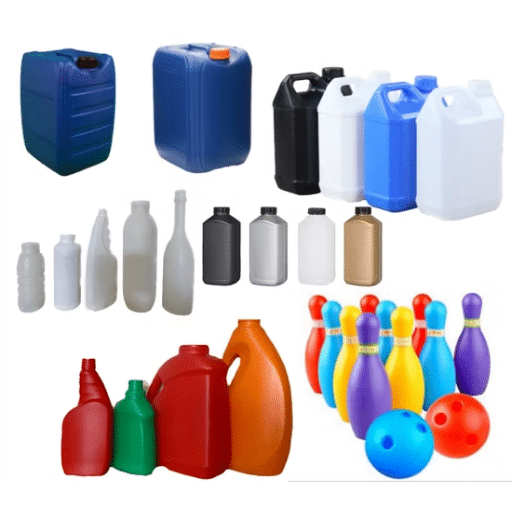
A single-layer HDPE bottle handles about 80 percent of packaging applications. For the remaining 20 percent, oxygen-sensitive agrochemicals, extended-shelf-life foods, products where you want recycled content but can’t put it in product contact, co-extrusion adds layers that solve problems single-layer cannot.
The 6-Layer Structure
A typical multi-layer HDPE container for an aggressive chemical looks like this:
- Outer layer (virgin HDPE): Brand color, UV stabilization, printing surface.
- Regrind layer: Recycled flash and trim from in-house production, cuts virgin resin consumption by 20 to 35 percent.
- Adhesive (tie) layer: Maleic anhydride-grafted polyethylene that bonds HDPE to EVOH.
- Barrier layer (EVOH): Ethylene vinyl alcohol copolymer. Blocks oxygen permeation to 0.01 to 0.05 cc-millimeters per square meter per day, roughly three orders of magnitude better than HDPE alone.
- Adhesive (tie) layer: Symmetrical bond to the inner layer.
- Inner layer (virgin HDPE): Product-contact surface. Food-safe or chemical-resistant grade depending on the application.
When Co-Extrusion Makes Sense
Co-extrusion requires 3 to 6 extruders feeding one die head. Capital cost is substantially higher than single-layer. It is worth the investment when:
- The product is oxygen-sensitive (agrochemicals, some foods, certain pharmaceuticals)
- European PPWR regulations or brand-owner mandates require post-consumer recycled content in the container, and PCR cannot contact the product
- Shelf-life extension through barrier layers justifies the per-unit cost premium
- Regrind layer economics save enough virgin resin to recover the extra equipment cost within 18 to 36 months
One operational note: EVOH is moisture-sensitive. It must always be sandwiched between HDPE layers. An exposed EVOH layer absorbs humidity from ambient air or the product, loses its barrier properties, and delaminates.
Common HDPE Blow Molding Defects
Most defects in HDPE blow molding trace back to three root causes: temperature outside the processing window, parison programming that does not match the mold, or resin that does not match the grade specification.
Defect Troubleshooting Matrix
Black spots and streaking lines
Degraded resin carbonized in the die head or die bushing. Purge and clean the die head thoroughly. Inspect incoming resin for oxidized particles, a single lot of overheated regrind can contaminate an entire production run. Never regrind bottles that already show burn marks; the degraded material will re-deposit in the die head and create more black spots in the next batch.
Rocker bottoms (wobbly base)
Insufficient cooling before demolding. The bottle base is still soft when the mold opens, and it deforms as it drops onto the conveyor. Increase cooling water flow and verify that cooling channels are not blocked. Check that the blow pin retracts and exhausts residual pressure before the mold opens, trapped air pushes the warm base outward, and it sets in that warped position.
Leakage and poor weld integrity
Weak pinch-off welds at the bottom, side, or handle area. Slow down the mold close speed so material has time to push inward and fuse at the pinch-off. Increase parison thickness at the handle and bottom weld zones in your die-gap program. Verify the blow pin nozzle and mold are a matched set, a gap that is too wide leaves an unfilled channel at the neck that leaks under the cap torque.
Uneven radial wall thickness
A misaligned die mandrel makes the parison hang crooked. The thick side hits the mold first, the thin side stretches to fill the gap. Align the die mandrel and die until the parison hangs perfectly vertical. If this keeps drifting, check for die centering wear or an off-center thermocouple producing uneven melt temperature around the die circumference.
Orange peel surface texture
The parison made intermittent contact with the cold mold surface before full inflation. This happens when the die mouth diameter is too narrow for the container’s oval dimensions and pre-blow pressure is set too high. Switch to a larger die mouth diameter so the parison has a smaller blow-up ratio and does not touch the mold wall until final inflation.
Sharkskin (alternating thick and thin bands on the parison)
In continuous extrusion machines, this means extruder RPM is too high, the HDPE melt enters its flow instability region. Reduce RPM. In reciprocating screw machines, the cause is the opposite, extruding too slowly with insufficient shot pressure. Increase shot pressure to push through the pressure plateau region where sharkskin occurs.
Sudden brittleness and environmental stress cracking in service
This is almost always a grade selection problem, not a processing problem. The ESCR rating of the resin is inadequate for the chemical it contacts. Switch to a higher-ESCR grade with documented performance against the specific chemical in your product. Also check for sharp internal corners in the container design, radii below 0.5 times wall thickness concentrate stress and accelerate cracking regardless of grade.
Process Stability Habits That Prevent Defects
The operators who produce the fewest rejects follow three disciplines.
First, they follow a shutdown protocol: drop temperatures 25 to 40 degrees and purge at low RPM, maintaining a semi-fluid state about 55 degrees below the operating setpoint. They don’t go completely cold unless the line is down for days.
Second, on startup, they heat in two steps — barrel first to within 100 degrees of operating temperature, then die head — rather than heating everything simultaneously. Simultaneous heating in the die head and barrel produces a cold slug at the adapter that shears off later in the run.
Third, during any idle period over 15 minutes, they purge. Static resin degrades; moving resin does not.
Running Recycled HDPE in Blow Molding
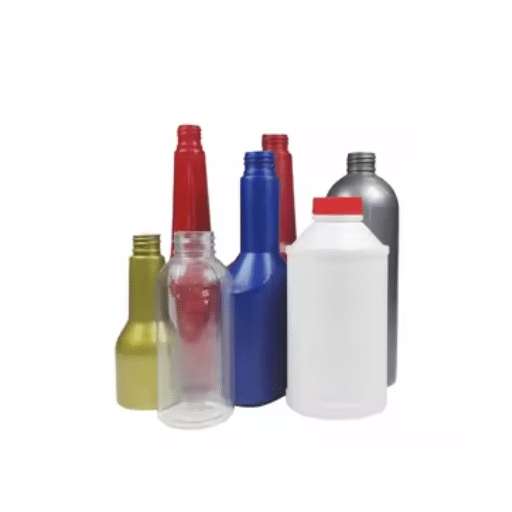
Post-consumer recycled HDPE is the fastest-growing segment of the blow molding resin market, expanding at 5.6 percent annually. Incorporating it comes with trade-offs.
PCR melt viscosity varies more than virgin material across batches. Parison melt strength decreases, especially with higher PCR percentages. Surface gels and small contaminants appear that virgin grades filter out at the manufacturer level.
For non-food applications like household chemical bottles and industrial containers, 30 to 40 percent regrind typically runs without significant quality impact. For critical applications, keep virgin HDPE in the product-contact and outer layers, and confine PCR to the regrind and middle layers in a co-extrusion structure.
When running PCR, three adjustments help maintain consistency:
- Add 5 to 15 percent virgin high-molecular-weight HDPE to compensate for melt strength loss
- Use 80 to 100 mesh screen packs to catch contaminants that would cause pinhole leaks
- Inspect incoming PCR batches for bulk density, MFI, and visible contamination before loading into the material handling system
European PPWR regulations are pushing minimum PCR content toward 25 to 30 percent by 2030. Brand-owner sustainability pledges are accelerating this timeline. But PCR HDPE currently sells at a 25 to 35 percent premium over virgin in most regional markets, so validate the ROI per application rather than adopting PCR as a blanket policy.
HDPE Blow Molding in 2026: Market Context
The global HDPE blow molding market was valued at 8.4 billion USD in 2024 and projects to 12.2 billion by 2031 at a 5.6 percent compound annual growth rate. Asia-Pacific is the fastest region, growing at 5.2 percent, with China’s container segment expanding at 10.2 percent. Jerrycans are the fastest-growing container type at 7.7 percent, driven by chemical and agrochemical distribution expansion in developing markets.
August 2026 indicative pricing places China-origin blow-molding-grade HDPE at approximately 950 to 1,100 USD per metric ton. Middle Eastern and Asian branded grades (SABIC B4520, LyondellBasell Lupolen 5121A) range from 1,200 to 1,350 per metric ton FOB Shanghai. The branded premium of 150 to 250 dollars per ton buys lot-to-lot MFI consistency within plus or minus 5 percent, manufacturer-issued COA, and full batch traceability.
Sourcing branded prime HDPE blow-molding resin with traceable COA documentation? Request a quote from Yifuhui, 25 kg minimum order, from 500 ml bottle grades to 220L drum-grade HMW-HDPE, FOB Shanghai.
Sourcing Blow-Molding-Grade HDPE
Choosing the right blow molding HDPE resin supplier means more than comparing price per metric ton. It means verifying lot-to-lot MFI consistency, confirming ESCR ratings against your chemical exposure, and receiving manufacturer-issued COA documentation for every shipment. A factory in eastern Thailand started experiencing bottle weight drift in early 2026. Their 1-liter detergent bottles were coming off the line 4 grams heavier than target — 42 grams instead of 38. Weekly resin consumption crept up, and nobody flagged it for six weeks because the bottles still passed QC drop tests and neck finish checks.
When the production manager finally ran the numbers, the excess 4 grams per bottle across 800,000 bottles per month meant 3,200 kilograms of extra resin consumed every month. The cause: the supplier had substituted a higher-density HDPE grade with a 15 percent lower MFI without notification. The COA listed “HDPE blow molding grade” with no brand name, no grade number, and no manufacturer test data.
This is the cost of sourcing HDPE without verified documentation.
How to Verify HDPE Blow Molding Resin via COA
A genuine Certificate of Analysis issued by the resin manufacturer contains specific, verifiable fields:
- Grade designation, must state the brand name and grade number (SABIC B4520, not “HDPE blow molding grade”)
- Melt flow index, with the exact test condition (190 degrees Celsius, 2.16 kilograms, or 190 degrees Celsius, 21.6 kilograms)
- Density, per ASTM D792, with the specific value for that lot
- Tensile yield strength, per ASTM D638; cross-reference against the manufacturer’s published datasheet
- ESCR, where applicable, reported as hours to failure under ASTM D1693, Condition B
- Compliance statements, FDA, RoHS, REACH, UN dangerous goods certification where the application requires them
- Lot number and date of manufacture, traceable to the original producer’s batch record
Cross-reference every field against the manufacturer’s published datasheet. Acceptable deviation is within the datasheet’s stated tolerance. Reject any COA that is supplier-generated rather than manufacturer-issued — an internal document from a trading company does not verify anything about the resin’s origin. For a full guide to qualifying HDPE suppliers from China, see our supplier verification checklist.
Red Flags in HDPE Supply
Five warning signs should stop a procurement decision immediately:
- Generic grade designation, “HDPE blow molding” or “HDPE blow grade” without brand and grade number
- Supplier-generated COA without manufacturer letterhead or lot-specific test values
- MFI reported at the wrong test condition, insist on the condition specified in the manufacturer’s datasheet
- Lot-to-lot MFI swings beyond plus or minus 15 percent, indicates blending of multiple unknown sources rather than a consistent branded resin stream
- Price significantly below the regional market benchmark without a documented reason (confirmed seasonal surplus from a named manufacturer, a canceled export order with verifiable paperwork)
The branded premium of 150 to 250 dollars per metric ton over generic China-origin HDPE buys something specific: the confidence that the resin in Lot B runs identically to the resin you qualified in Lot A. For a high-volume blow molding line, the scrap, downtime, and QC cost from a single lot of off-spec material typically exceeds the branded premium for an entire year of resin purchases.
Conclusion
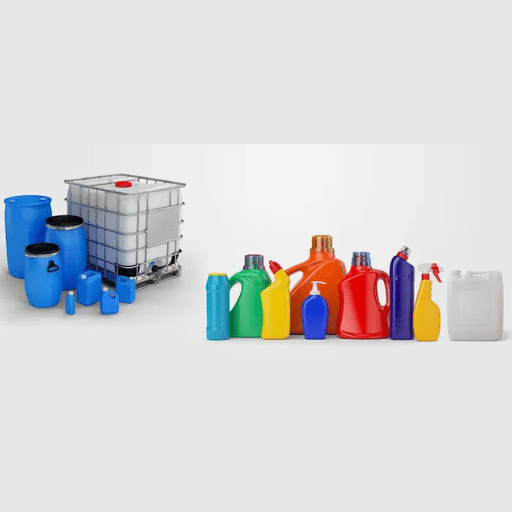
HDPE blow molding succeeds or fails on six factors: matching grade MFI to container geometry, maintaining barrel and die head temperatures within 3 degrees of target, programming the parison for uniform wall thickness, cooling thoroughly before demolding, verifying that the ESCR rating handles the product’s chemical exposure, and confirming resin consistency via manufacturer-issued COA for every lot received.
Every variable interacts. Run the mold too cold and gain cycle speed but risk rocker bottoms. Push melt temperature for better surface finish and lose parison melt strength. Save 150 dollars per ton on generic resin and pay 2,000 dollars in scrap, downtime, and investigation the first time a bad lot hits the hopper.
For process engineers, the parameter table and defect matrix in this guide are actionable reference tools. For procurement teams, the branded grade examples and COA verification checklist provide a framework for qualifying resin suppliers and rejecting undocumented material before it reaches the extruder. For both, the principle is the same: the right HDPE blow molding grade, verified by the right documentation, running at the right parameters, produces containers that pass QC on the first shift and every shift after that.
Request a quote for branded prime HDPE blow-molding-grade resin with full manufacturer-issued COA documentation. Available from 25 kg trial quantities to full container loads. FOB Shanghai with complete export documentation, including commercial invoice, packing list, COA, and MSDS. Contact our technical team for grade selection support and pricing.
Frequently Asked Questions
What is HDPE blow molding?
HDPE blow molding is a manufacturing process that creates hollow plastic containers by extruding a molten HDPE tube (a parison) and inflating it with compressed air against a cooled mold cavity. Extrusion blow molding is the standard method for producing HDPE bottles, containers, jerrycans, and drums ranging from 50 milliliters to over 1,200 liters.
What is the typical melt temperature for HDPE blow molding?
Recommended melt temperature is 190 to 210 degrees Celsius, within the broader workable range of 180 to 220 degrees. Barrel zones should be profiled from 160 to 180 degrees in the feed zone up to 200 to 220 degrees in the metering zone. The die head should run at 175 to 200 degrees. Maintain all zones within plus or minus 3 degrees for process stability.
What MFI should HDPE be for blow molding?
Blow-molding-grade HDPE uses low MFI resins (0.15 to 2.5 grams per 10 minutes at 190 degrees Celsius, 2.16 kilogram load). Large containers (20 to 220 liter drums, IBCs) use fractional-melt grades of MFI 0.15 to 0.35. Medium containers (5 to 20 liter jerrycans) use MFI 0.2 to 0.5. General-purpose bottles use MFI 0.5 to 1.0. Small thin-wall bottles use MFI 1.0 to 2.5.
What are the most common defects in HDPE blow molding?
The most frequent defects are rocker bottoms (insufficient cooling), black spots (degraded resin in the die head), leakage or weld-line failure (poor pinch-off), uneven wall thickness (misaligned die mandrel), surface bubbles (moisture in resin), orange peel surface (excessive pre-blow with a narrow die mouth), and sharkskin (incorrect screw RPM or shot pressure).
How is HDPE blow molding different from injection molding?
Blow molding produces hollow containers using low-MFI HDPE and compressed air inflation. Injection molding produces solid precision parts like caps and closures using high-MFI HDPE injected under high pressure. Blow mold tooling costs 15,000 to 50,000 dollars versus 50,000 to 200,000 dollars for injection molds.
What is parison programming?
Parison programming dynamically adjusts the die gap during parison extrusion to vary wall thickness along the parison length. It compensates for gravitational sag, places extra material at stress points such as handles and bottom pinch-off, and reduces material in non-critical zones. Effective programming typically saves 5 to 15 percent in container weight.
Can recycled HDPE be used in blow molding?
Yes. Post-consumer recycled HDPE can be incorporated at 30 to 40 percent for non-food applications such as household chemical bottles. For food-contact applications, confine PCR to non-contact middle layers behind virgin HDPE barrier layers. Compensate for reduced melt strength by adding 5 to 15 percent virgin HMW-HDPE or increasing back pressure.
How do I verify that HDPE resin matches the blow molding grade I specified?
Request a Certificate of Analysis issued on the manufacturer’s letterhead for each resin lot. Verify that the grade designation, MFI at the correct test condition, density, and ESCR values match the manufacturer’s published datasheet within stated tolerances. Reject any supplier-generated internal COA that cannot be cross-referenced to the original manufacturer’s documentation.