




Ask ten people whether plastic has a melting point and you will get ten confident answers, most of them wrong. One says plastic melts at 200 °C. Another swears it melts at 105 °C. A chart on a supplier’s website lists 260 °C for the same material. And a few engineers will tell you flatly that the plastic they work with never melts at all.
They are all describing plastic. They cannot all be right.
The confusion comes from treating “plastic” as a single material. It is not. Plastic is a family that spans three very different behaviors under heat, and whether a given plastic has a melting point depends entirely on which of the three you are holding. So the honest answer to does plastic have a melting point is: some do, some do not, and some never will.
This guide gives you the rule in one line, a decision table that maps the common plastics, and the reason behind each answer. It also covers the mistake that costs engineering teams real money, which is treating a melting point like a service temperature. We supply branded prime engineering resins from Suzhou with a manufacturer Certificate of Analysis on every batch, so if you already know the family you need, request a quote and our team responds within 24 hours. If you want the full reference numbers first, our plastic melting point chart holds the master table.
Does Plastic Have a Melting Point?

It depends on the plastic. Semi-crystalline thermoplastics such as POM, PA66, HDPE, PET, and PTFE have a true melting point (Tm). Amorphous thermoplastics such as ABS, PC, PMMA, and PVC have no true melting point and only soften above their glass transition temperature (Tg). Thermosets such as epoxy and phenolic never melt at all. They decompose.
That is the direct answer behind searches for “does plastic have a melting point,” “do all plastics have a melting point,” and “which plastics have no melting point.” It is a real materials distinction, not a technicality, and it decides how you select a material, how you process it, and what you can check on a datasheet.
The Three Kinds of Plastic, and How Each Responds to Heat
Every plastic you will meet falls into one of three groups. The group, not the brand name, tells you what happens when it gets hot.
- Semi-crystalline thermoplastics. Their chains fold into ordered crystal regions. Those crystals hold the material together until a specific temperature breaks them down, and that temperature is a true melting point. The change is reversible, so the material can be remelted and remolded.
- Amorphous thermoplastics. Their chains are tangled and random. There is no crystal structure to break down, so there is no melting point. Instead the material goes from hard and glassy to soft and rubbery above its glass transition temperature (Tg), then flows or degrades.
- Thermosets. Their chains are chemically cross-linked into a rigid three-dimensional network. Heat cannot separate that network, because the bonds are covalent and permanent. A thermoset softens slightly, then chars and decomposes. It never melts, and it can never be remelted.
There is a fourth group, thermoplastic elastomers, that sits outside this trio. Their behavior still follows the same rule. A TPE has a melting point if it has a crystalline phase. A cross-linked rubber does not.
Which Plastics Have a Melting Point? The Decision Table
This table answers the question for the plastics you are most likely to specify. The melting point column is deliberately empty for the amorphous materials, because writing a number there is the single most common error in published plastic charts.
| Plastic | Family | True melting point? | Tg (°C) | Representative Tm (°C) |
|---|---|---|---|---|
| POM (acetal) | Semi-crystalline | Yes | about -60 | 165 to 175 |
| PA66 (nylon 66) | Semi-crystalline | Yes | 50 to 65 | 255 to 265 |
| PA6 (nylon 6) | Semi-crystalline | Yes | about 54 | 215 to 225 |
| HDPE | Semi-crystalline | Yes | about -110 | 125 to 137 |
| PP | Semi-crystalline | Yes | -18 to -10 | 160 to 170 |
| PET | Semi-crystalline | Yes | 69 to 79 | 245 to 260 |
| PBT | Semi-crystalline | Yes | about 45 | 220 to 230 |
| PPS | Semi-crystalline | Yes | about 85 | 275 to 290 |
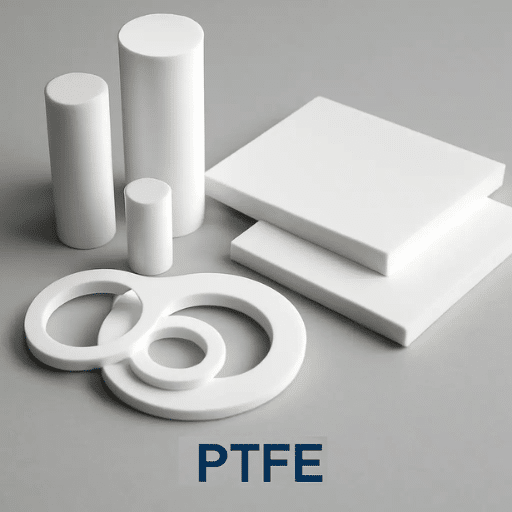
| PTFE | Semi-crystalline | Yes | about -97 | 327 |
| PEEK | Semi-crystalline | Yes | about 143 | about 343 |
| ABS | Amorphous | No, softens above Tg | about 105 | none |
| PC (polycarbonate) | Amorphous | No, softens above Tg | about 147 | none |
| PMMA (acrylic) | Amorphous | No, softens above Tg | about 105 | none |
| PS (polystyrene) | Amorphous | No, softens above Tg | about 100 | none |
| PVC (rigid) | Amorphous | No, softens above Tg | about 80 | none |
| Epoxy / phenolic | Thermoset | No, decomposes | varies | none |
Values are typical for unmodified grades and shift with comonomer, filler, and moisture. Melting points are measured by differential scanning calorimetry (DSC) to ASTM D3418 or ISO 11357. Always verify against the specific grade datasheet.
Read the amorphous rows again. That is where the confusion lives. When a chart prints “ABS: 105 °C” in a melting point column, it is reporting a Tg, not a melting point. The material does not melt at 105 °C. It begins to soften, and it will creep and distort under load long before 105 °C.
A Story of One Wrong Number
Daniel is a product engineer at a consumer electronics company. In early 2026 he was specifying a bracket that had to sit next to a warm power supply, and he pulled a melting point chart from a materials website to sanity-check his choice.
The chart listed ABS at 105 °C under “melting point.” Daniel did the math, decided a bracket seeing 70 °C had plenty of margin, and moved on.
Six months later the brackets came back from field testing warped and loose at their screw bosses. The chart had not lied about the number. It had mislabeled it. Daniel had designed against a glass transition temperature he believed was a melting point, and 35 °C of apparent margin evaporated once the true service limit near 70 to 80 °C was applied.
The lesson is not that charts are useless. It is that a “melting point” number for an amorphous plastic is almost never what it claims to be.
Why Some Plastics Have No Melting Point

To see why amorphous plastics have no melting point, you have to look at how their chains are arranged when the material solidifies.
Semi-Crystalline Plastics Have a True Melting Point
A semi-crystalline polymer, like POM or nylon, folds part of its chains into ordered crystalline regions. Depending on the grade, somewhere between 30% and 70% of the material is crystalline, with the rest amorphous. Those crystallites are held together by secondary bonds that take real energy to break.
Raise the temperature far enough and the crystallites come apart at once. The material transitions from a solid to a viscous melt, and that transition is the melting point. Because the crystalline fraction has a real structure to break, the melting point is a genuine, measurable property. On a DSC curve it shows up as a distinct melting peak, called a melting endotherm.
Amorphous Plastics Have No Melting Point, Only a Tg
An amorphous polymer never gets the chance to order itself. Its chains are bulky or irregular, and the material cools too fast for them to pack into crystals. The result is a tangle of random, entangled chains with no crystal lattice anywhere.
There is nothing to break down all at once, so there is no melting point. What you get instead is a glass transition. Below its Tg the material is hard and glassy. Above it, the chain segments start to move, the material turns rubbery, and stiffness drops by orders of magnitude. Heat it further and it flows as a highly viscous liquid. That gradual softening, rather than a clean melt, is why a datasheet often quotes a softening point for an amorphous plastic. It is a temperature landmark, not a true melting transition, and the distinction between a softening point and a melting point trips up a lot of material selection.
That is the whole answer. A melting point requires a crystal lattice to melt. An amorphous plastic does not have one, so it softens instead. ScienceDirect’s overview of amorphous polymers makes the point directly: amorphous polymers have no crystal lattice to break, so they show a Tg and no discrete Tm.
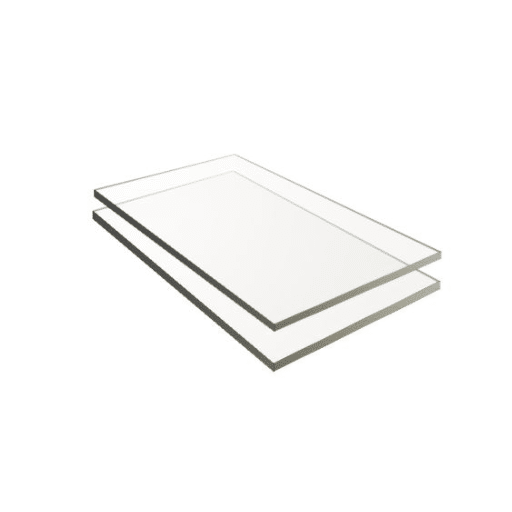
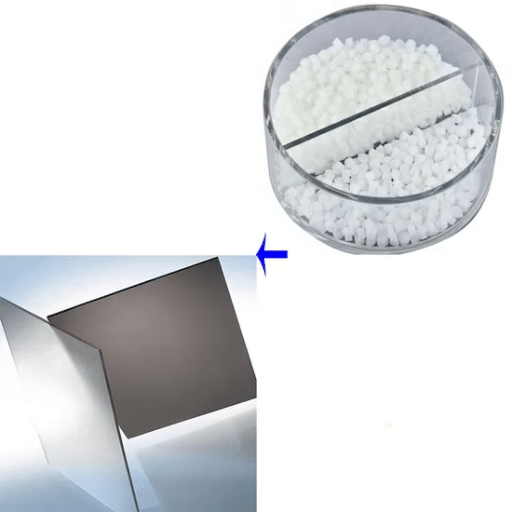
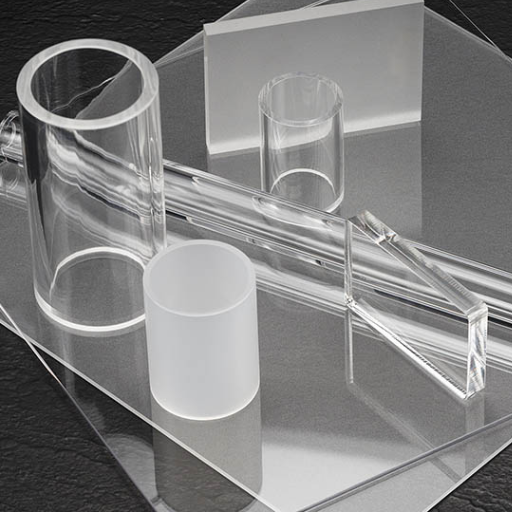
This is also why so many amorphous plastics are transparent. Crystalline regions scatter light, and amorphous ones do not. The same disorder that makes PC, PMMA, and clear polystyrene see-through is the disorder that leaves them without a melting point. Our polycarbonate melting point and PMMA melting point guides walk through the two most common transparent thermoplastics in detail.
Thermosets Never Melt, They Decompose
Thermosets break the pattern entirely. During curing, their chains react to form covalent cross-links, building a three-dimensional network that behaves like one giant molecule.
Heat can wiggle that network, and it does soften very slightly, but it cannot separate the cross-links. There is no temperature at which the material becomes a melt you can pour or remold. Push hard enough and the network itself starts to come apart chemically. The material chars and decomposes.
This is why materials tables list the melting temperature of a thermoset as “not applicable” rather than a number. It is also why a thermoset part cannot be recycled by melting, while a thermoplastic bottle or bucket can. Wikipedia’s entry on thermosetting polymers and its companion page on thermoplastics draw the reversible-versus-irreversible line clearly. Epoxy, phenolic, melamine, silicone, and cured polyester are all thermosets. None of them have a melting point.
Why Polymers Melt Over a Range, Not at One Sharp Point
Here is a wrinkle that even the semi-crystalline plastics share. Ice melts at exactly 0 °C. Table salt melts at 801 °C. Those are sharp, single points, accurate to about 0.1 °C.
Plastics do not behave that way. Even POM and nylon, which have true melting points, melt over a range. A datasheet value is the peak of that range, not a knife-edge transition. Ask why polymers do not have a sharp melting point, and you get two answers.
Reason One: Chains Come in Many Lengths
A polymer sample is a mixture of chains with different molecular weights. Short chains melt first, because they need less thermal energy to break free. Long chains melt later. Over the whole sample, the individual melting events smear into a broad band rather than a single point.
Reason Two: Crystals Come in Many Qualities
Crystalline regions are never perfect. Some are well ordered and melt high. Others contain defects, chain ends, and branches, so they melt lower. Cooling rate matters too. Quench a part fast and you trap smaller, less perfect crystals that melt lower and over a wider range than a slowly cooled part.
Add comonomers, plasticizers, and moisture and the range widens further. The practical takeaway is simple. Two datasheets for the same polymer family can quote different melting points and both be honest. The number depends on the grade, the molecular weight, and the test method. That is one more reason a melting point is a starting point, never the whole thermal story.
Melting Point Is Not a Service Temperature
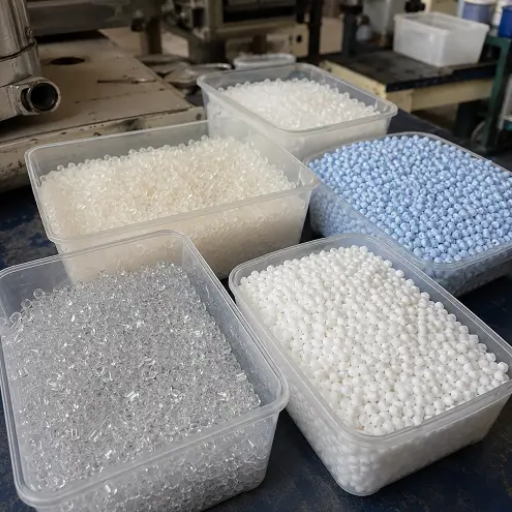
The most expensive misunderstanding in this whole topic is using a melting point as a service limit. It is not one. It is not even close.
A plastic that melts at 165 °C cannot be used at 165 °C. Strength, stiffness, and dimensional stability fall away well before the melt. The numbers that actually govern a design are the heat deflection temperature (HDT) under load and the continuous service temperature, and both sit far below the melting point. Our engineering plastic temperature guide covers how Tg, HDT, and service temperature work together across the common families.
POM makes the gap concrete. Its melting point is roughly 165 °C. Its HDT at 1.8 MPa is closer to 100 to 110 °C, and its continuous service ceiling lands around 80 to 120 °C depending on the grade and load. The melt number is a processing target, not a design margin.
For amorphous plastics the rule is even stricter. Their ceiling is the Tg, and creep begins below it. PC softens near 147 °C, yet its practical continuous service is roughly 115 to 125 °C. ABS softens near 105 °C and serves comfortably to about 60 to 80 °C.
A Hot Car and Two Plastics
Consider a part that sits in a parked car on a summer afternoon. An interior trim clip in ABS, an amorphous plastic, can see cabin temperatures near 80 °C. That is close to the material’s service ceiling, so the clip may relax and lose its grip over time.
The same clip in glass-filled PA66, a semi-crystalline plastic, holds its shape. Its PA66 melting point is above 255 °C, and more importantly its HDT under load is high enough that 80 °C is nowhere near its limit. Same shape, same function, different thermal family, different outcome. The decision was never about which plastic “melts,” it was about which number limits the part. For the full rule on that, see our guide to heat deflection temperature versus melting point.
What This Means for Sourcing and Quality Checking
If you buy resin, the amorphous-versus-semi-crystalline distinction becomes a practical tool the moment a delivery arrives.
A semi-crystalline resin has a melting point you can measure. That gives you a fingerprint. The material should show a melt endotherm at the temperature the manufacturer’s datasheet specifies. An amorphous resin has no such peak, so its identity is confirmed through other values.
This turns the melting point into a quality check. If a supplier ships resin claimed to be a named semi-crystalline grade and the incoming DSC shows no melting peak at all, something is wrong. The lot may be mislabeled, contaminated with regrind, or a different material entirely. A melting point that has drifted outside the datasheet window is a smaller red flag but still worth a question, because it can shift your process and your cycle times.
A Buyer Catches a Wrong Lot
Priya runs incoming inspection for a molder in Southeast Asia. In April she received a shipment of acetal pellets sold as a specific branded POM grade, with paperwork that looked complete.
Her first check was the melt behavior. The branded grade was supposed to show a clean melting point near 165 °C. The sample showed a broad, shifted endotherm, and the melt flow rate ran high against the datasheet.
She flagged the lot before it reached the press. A follow-up confirmed the material had been blended with a lower-grade stream. Had she trusted the paperwork alone, the mistake would have surfaced later as short shots, warped parts, and a scrap rate that nobody could explain. The melting point caught what the invoice hid.
For both amorphous and semi-crystalline resin, the Certificate of Analysis is the document to read closely. Check the grade designation and manufacturer, the melt flow index, the density, and where reported, the thermal values such as HDT and Vicat. Then match them against the manufacturer’s published datasheet for that exact grade.
We supply branded prime engineering resins rather than commodity compound, so every batch from our Suzhou warehouse ships with a manufacturer-issued COA, the MSDS, the commercial invoice, and the packing list. Our location near the Port of Shanghai keeps export lead times at 7 to 14 days depending on destination, with FOB Shanghai as the standard term and a 25 kg minimum order. That small minimum makes qualification practical. Order 25 kg from the same lot your production material will come from, run your own checks against the COA, and confirm the grade before committing to volume. If your part needs a semi-crystalline workhorse, browse our POM resin grades and see the POM melting point guide, or turn to the ABS melting temperature article for the amorphous side of the same decision.
Frequently Asked Questions
Does plastic have a melting point?
It depends on the plastic. Semi-crystalline thermoplastics such as POM, PA66, HDPE, and PET have a true melting point. Amorphous thermoplastics such as ABS, PC, and PMMA have no true melting point and only soften above their glass transition temperature. Thermosets never melt.
Do all plastics have a melting point?
No. Most thermoplastics do, but the amorphous ones do not, and no thermoset does. Roughly, semi-crystalline thermoplastics melt, amorphous thermoplastics soften, and thermosets decompose.
Which plastics have no melting point?
The amorphous thermoplastics, including ABS, polycarbonate, PMMA (acrylic), polystyrene, and rigid PVC, plus every thermoset such as epoxy, phenolic, and melamine.
Do thermosets melt?
No. Once cured, a thermoset is a cross-linked network that cannot be remelted or remolded. Heating it drives the material to decompose and char before any melting point is reached. Materials tables list its melting temperature as not applicable.
Do thermoplastics have a melting point?
Semi-crystalline thermoplastics do. Amorphous thermoplastics do not. The dividing line is whether the polymer has an ordered crystalline phase to melt.
Why do polymers not have a sharp melting point?
Two reasons. Chains come in a range of molecular weights, so short chains melt before long ones. And crystalline regions vary in perfection, so imperfect crystals melt lower than better-ordered ones. The result is a melting range rather than a single point.
Is melting point the same as glass transition temperature?
No. A melting point is where a crystalline phase breaks down. The glass transition is where an amorphous phase changes from hard and glassy to soft and rubbery. Semi-crystalline plastics have both. Amorphous plastics have only a Tg.
Does ABS have a melting point?
No. ABS is amorphous, so it has no true melting point. It softens above a glass transition temperature of about 105 °C, and its practical service limit is well below that.
Does polycarbonate have a melting point?
No. PC is amorphous, with a glass transition temperature near 147 °C and no true Tm. It is often mislabeled in charts that list 147 °C as a melting point.
Does PVC have a melting point?
Commercial rigid PVC is largely amorphous, with a glass transition around 80 °C and no true melting point. The 212 °C figure that appears in some tables refers to a crystalline form that commercial PVC does not match.
Can thermoset plastic be melted and remolded?
No. The cross-links are permanent covalent bonds. A cured thermoset cannot be melted, remolded, or recycled by melting. That permanence is why thermosets are strong and heat-resistant, and why thermoplastic scrap is easier to recycle.
Is melting point the same as heat resistance?
No, and confusing the two causes real design errors. Heat resistance is governed by the heat deflection temperature and continuous service temperature, which sit well below the melting point. Never use a melting point as a service ceiling.
Conclusion
The question of whether plastic has a melting point has three correct answers, and now you can tell them apart. So does plastic have a melting point? It depends on the family. Semi-crystalline thermoplastics such as POM, PA66, and HDPE have a true melting point, though even they melt over a range rather than at a single sharp degree. Amorphous thermoplastics such as ABS, PC, and PMMA have no melting point at all. They soften above their glass transition temperature. Thermosets such as epoxy and phenolic never melt, because their cross-linked network decomposes first.
The practical rule that follows is simple. A melting point is a processing landmark, never a service limit. Design against the heat deflection temperature and the continuous service temperature. Confirm a delivered lot against the melting behavior and the thermal values on its Certificate of Analysis, not against the invoice.
We supply branded prime resin across both families, from semi-crystalline POM, PA66, and HDPE to amorphous PC and ABS, all with full COA documentation, a 25 kg minimum order, and FOB Shanghai pricing. Tell us your operating temperature, your load, and your application, and we will point you to the right family and the right grade, including an honest redirect if the material you came in asking for is not the one your part actually needs. To gain a deeper understanding of ABS Melting Point in Fahrenheit, POM Melting Point, and Polycarbonate Melting Point, please refer to our accompanying guide.
Request a resin quote and get a recommendation backed by real datasheets and a traceable Certificate of Analysis.