




When a water tank manufacturer in the Middle East switched to cheaper “rotomolding grade” HDPE powder last spring, the first 5,000-liter tank came off the line looking flawless on the outside. Then the QC team cut open the wall at the fill fitting and found a layer of internal bubbles. Porosity.
Sixty tanks were scrapped before the team traced the root cause. It wasn’t the oven. It wasn’t the rotation ratio. It was the powder.
HDPE rotomolding is one of the simplest processes in plastics. Load pulverized powder into a mold, rotate it on two axes inside a heated oven, and let heat and gravity fuse the material against the walls. No pressure, no weld lines, and some of the largest hollow plastic parts in the world. But the process punishes inconsistent powder, and that’s exactly where most problems begin.
This guide covers HDPE rotomolding end to end: process parameters, powder grade selection by MFI and density, HDPE vs. LLDPE for rotational molding, common defects and their fixes, market context, and how to verify that the powder you order will consolidate into void-free walls lot after lot. If you’re new to the process, start with our HDPE material guide for the fundamentals, then come back here for the rotomolding specifics.
What Is HDPE Rotomolding?

Rotational molding, or rotomolding, is a low-pressure process for producing seamless, hollow parts. Unlike injection molding, which forces molten polymer into a cavity under high pressure, rotomolding relies on heat and biaxial rotation. Powder melts, coats the mold interior, and fuses into a single-piece wall.
How Rotational Molding Works
The cycle runs in four steps:
- Charge: A measured weight of HDPE powder, typically 150 to 500 microns, is loaded into a hollow mold.
- Heat and rotate: The mold rotates biaxially inside an oven at 220 to 240 degrees Celsius while powder tumbles, melts, and coats the walls uniformly.
- Cool: The mold moves to a cooling station while rotation continues, letting the part solidify evenly.
- Eject: The part is removed, and the mold is recharged for the next cycle.
The result is a one-piece hollow part with no weld lines, no gate marks, and low residual stress. Wall thickness is set by charge weight and oven profile, not by mold cavity geometry.
Why HDPE Is the Dominant Rotomolding Material
Polyethylene accounts for roughly 73 percent of all rotomolding material use, and HDPE is its stiffest, most chemical-resistant member. For tanks, bins, playground structures, and marine hardware, HDPE delivers four advantages that matter:
- Stiffness: The highest rigidity of the polyethylene family, which keeps large tanks and structural parts from flexing under load.
- Chemical and permeation resistance: HDPE withstands acids, bases, hydrocarbons, and saltwater, which is why it dominates chemical storage and marine applications. For a deeper look, our HDPE chemical resistance guide covers exposure limits by chemical class.
- Outdoor durability: UV-stabilized grades hold up 10 to 15 years outdoors, from desert water tanks to boat docks.
- Food contact: FDA-compliant grades are available under 21 CFR 177.1520 for potable water and food service. Our guide to food-safe HDPE grades explains which applications need certified material.
HDPE Rotomolding Limitations
Honest material selection requires naming the trade-offs. HDPE rotomolding has five real limitations:
- Long cycle times: Heating and cooling dominate, running 20 to 50 minutes for large tanks versus seconds for injection molding.
- Surface finish: Interior and exterior surfaces are rougher than injection-molded parts.
- Warpage risk: High crystallinity and non-uniform cooling can distort parts, especially large flat panels.
- Inner-wall oxidation: Excessive oven time degrades the inner surface, causing roughness and reduced impact strength.
- Not for pressure parts: Rotomolded walls are not suited to high internal pressure or tight dimensional tolerances.
If your product needs tight tolerances, high surface finish, or very high volumes, injection molding is likely the better route. If it needs uniform thin walls at scale, blow molding. Rotomolding earns its place when parts are large, hollow, seamless, and low-tooling-cost.
HDPE Rotomolding Process Parameters
The process window determines whether powder consolidates into dense, void-free walls or a porous, rough shell. Five parameters matter most.
Powder Form and Particle Size
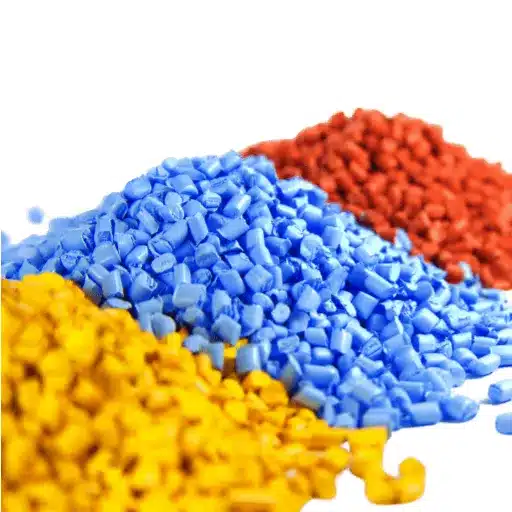
Rotomolding uses powder, not pellets. Pellets are pulverized to roughly 150 to 500 microns, about 35 mesh. Particle size distribution matters as much as the average size:
- Too fine: Powder oxidizes faster, dusts during charging, and creates handling losses.
- Too coarse: Particles do not sinter fully, leaving incomplete fusion and a rough inner surface.
- Narrow distribution: Promotes uniform melting and consolidation. Wide distributions produce variable wall density.
Oven Temperature and Heating Time
For HDPE, oven temperature typically runs 220 to 240 degrees Celsius. Large tanks with thick walls may use higher oven profiles for 20 to 50 minutes, while thin-wall parts need only 5 to 15 minutes. Two cautions: a higher internal air temperature improves tensile and impact strength, but excessive oven time degrades the inner wall. The goal is a peak internal air temperature that fully fuses the powder without oxidizing it.
Mold Rotation
The mold rotates on two perpendicular axes. The standard rotation ratio is 4:1 outer to inner, with speeds of 4 to 10 rpm during heating. Keep rotation slow. High speeds add centrifugal force that throws powder off the walls and creates uneven thickness. During cooling, drop to 1 to 2 rpm so shrinkage stays uniform.
Cooling and Demolding
Cool with air, forced-air fans, or water mist down to 50 to 80 degrees Celsius before ejection. Continue slow rotation during cooling. Non-uniform cooling is the leading cause of warpage in HDPE rotomolded parts, so a controlled cooling profile is not optional.
Key Parameter Snapshot
| Parameter | Recommended Range | Notes |
|---|---|---|
| Oven temperature (HDPE) | 220 to 240 degrees Celsius | Higher for thick walls and large parts |
| Heating time | 5 to 15 min (thin wall); 20 to 50 min (large tanks) | Sets wall thickness and density |
| Rotation ratio (outer: inner) | 4:1 typical | Lower ratios (2:1) for asymmetric parts |
| Rotation speed (heating) | 4 to 10 rpm | Keep slow; avoid centrifugal effects |
| Rotation speed (cooling) | 1 to 2 rpm | Prevents uneven cooling and warpage |
| Cooling method | Air, forced air, or water mist | Uniform cooling is critical |
| Demold temperature | 50 to 80 degrees Celsius | Below the melting range before ejection |
| Powder particle size | 150 to 500 microns | Narrow distribution preferred |
| Powder bulk density | About 0.32 to 0.36 g/cm3 (HDPE) | Affects charging and consolidation |
| Wall thickness control | About +/-10% | Tuned by rotation ratio and oven profile |
| Shrinkage | 1.5 to 3.5% (HDPE) | Higher than LLDPE; design the mold accordingly |
HDPE Rotomolding Powder Grade Selection
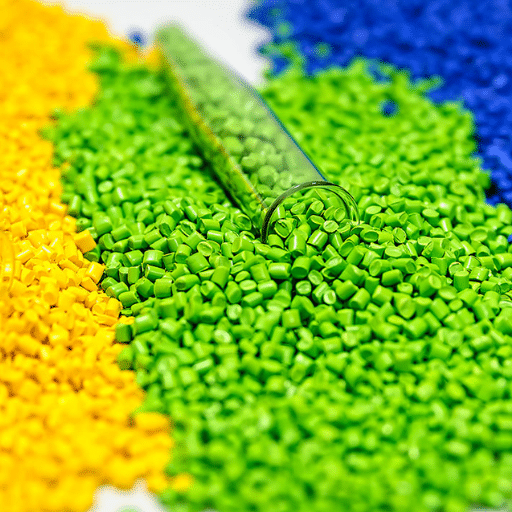
This is where most molders and procurement teams get into trouble. Generic “rotomolding powder” without a defined grade is a gamble, because MFI and density drive how the powder sinters and how the part performs.
MFI-to-Application Mapping
Rotomolding resins are specified by melt flow index at 190 degrees Celsius and 2.16 kg load (ASTM D1238). Note that this is not the 21.6 kg load used for fractional-melt blow molding grades. The mapping:
- MFI 2 to 4 g/10 min: The HDPE rotomolding sweet spot for tanks, bins, material handling, and general industrial parts. It balances uniform sintering against mechanical properties.
- MFI 4 to 6 g/10 min: Thin-wall parts, complex geometries, and shorter cycles. Higher flow fills details faster but reduces toughness.
- MFI below 2 g/10 min: High-molecular-weight grades for large tanks and heavy walls where maximum toughness and ESCR are required. Slower to sinter, but the toughest walls.
The rule: use the lowest MFI that still consolidates uniformly. Higher MFI flows better but lowers strength and environmental stress crack resistance.
Density Selection
Density controls stiffness and impact:
- 0.945 to 0.950 g/cm3: General-purpose rotomolding HDPE, the balanced default.
- 0.950 to 0.959 g/cm3: Stiffness-critical parts such as structural tanks and stackable bins. Higher rigidity, slightly lower impact.
- 0.941 to 0.945 g/cm3: Impact-critical and enhanced-ESCR grades for tougher service.
Very high density resins above 0.960 g/cm3 are not used in rotomolding. Crystallization behavior causes excessive warpage.
Branded HDPE Rotomolding Grades
Branded prime grades carry published, lot-traceable values you can verify. These are examples of HDPE rotomolding grades in common use:
| Grade | Supplier | Type | Key Feature | Target Application |
|---|---|---|---|---|
| Lupolen GX 5002 | LyondellBasell | HDPE | Cold-temperature impact, high ESCR | Tanks, large containers |
| Lupolen GX 5003 | LyondellBasell | HDPE | Higher MFI for complex parts | Crates, marine, outdoor furniture |
| Lupolen 3621 M RM Black | LyondellBasell | HDPE compound | Impact and stiffness balance to -30 degrees Celsius | Industrial fuel tanks, technical parts |
| Lupolen 4021 K RM Black | LyondellBasell | HDPE compound | ESCR and low-temperature impact | Underground waste and sewage systems |
| R35A042 | GAIL (India) | HDPE | Good processability and strength | Chemical and water storage tanks, pallets |
| KM U-542sMR | KMI Group | Octene sHDPE | Low-temperature impact, ESCR above 1,000 hr | Large septic and agricultural tanks |
| R902P | Hanwha Total | HDPE/LLDPE powder | UV stabilized, FDA compliant | Industrial tanks, toys, water sports |
For a 10,000-liter potable water tank, you want an FDA-compliant grade near 0.945 to 0.950 g/cm3 with an MFI around 2 to 4 and high ESCR. For a stackable industrial bin, push density higher for rigidity. For an underground septic tank, specify a buried-service compound with ESCR above 1,000 hours, such as the Lupolen 4021 K RM Black family.
ESCR and UV Selection
Two service-environment checks complete the grade decision:
- Chemical exposure: Detergents, solvents, fuels, and aggressive agrochemicals require high-ESCR grades (ASTM D1693, ESCR above 1,000 hours).
- Outdoor service: Specify UV stabilization, either carbon black or HALS, for furniture, playground, marine, and outdoor tank applications.
- Food contact: Confirm FDA compliance at the grade level and request the compliance documentation.
Grade Selection Checklist
- Define part size, wall thickness, and production volume.
- Select an MFI range balancing fusion against mechanical properties.
- Choose density for the stiffness versus impact priority.
- Verify ESCR against the chemical exposure environment.
- Specify UV stabilization for outdoor service.
- Confirm food-contact certification (FDA or EU) if required.
- Specify particle size distribution and bulk density.
- Request the manufacturer COA with lot-specific MFI, density, and particle size data.
That last step is the one that separates a reliable rotomolding supply from a gamble, and it is covered in detail in the sourcing section below.
HDPE vs. LLDPE for Rotomolding
Almost every rotomolder eventually chooses between HDPE and LLDPE, and the decision is not about which is “better.” It’s about which failure mode you can tolerate less.
Decision Framework
Choose HDPE when stiffness, rigidity, permeation resistance, and heat deflection matter. That points to structural tanks, material handling bins, underground vessels, and boat docks.
Choose LLDPE when impact resistance, ESCR, and warpage control matter. That points to playground equipment, coolers, toys, and agricultural tanks subject to thermal cycling.
In practice, LLDPE is the forgiving material. It molds uniformly and resists stress cracking, but it flexes. HDPE is stiffer and more chemical-resistant, but its higher crystallinity makes it more prone to warpage.
When a marine products company began building modular dock floats, ice impact cracks in winter pushed them from HDPE toward LLDPE. The trade-off was about 20 percent less stiffness in exchange for dramatically better low-temperature impact and ESCR. For our broader comparison across the polyethylene family, see the HDPE vs LDPE comparison guide.
Quick Comparison
| Factor | HDPE | LLDPE |
|---|---|---|
| Stiffness and tensile strength | Higher (tensile about 2,900 to 4,200 psi) | Medium (about 2,400 to 3,920 psi) |
| Impact resistance | Good (notched Izod about 3.3 ft-lb) | Excellent (about 4.1 ft-lb, elongation over 1,000%) |
| ESCR | Lower, can be under 100 hr | Excellent, over 1,000 hr typical |
| Permeation and moisture resistance | Excellent | Good |
| Warpage and shrinkage control | Less consistent | Better |
| Typical density | 0.945 to 0.950 g/cm3 | 0.926 to 0.940 g/cm3 |
| Typical MFI | 2 to 4 g/10 min | 3 to 6 g/10 min |
| Best-fit applications | Tanks, bins, structural parts | Coolers, playground, toys, recreational |
Cost is comparable between the two. The decision belongs to the application.
Common HDPE Rotomolding Defects
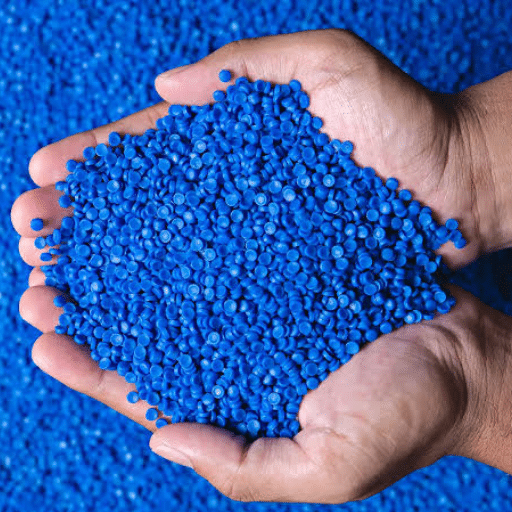
Rotomolding defects almost always trace back to one of four causes: trapped gas, moisture, poor heat control, or non-uniform cooling. Here is the troubleshooting matrix:
| Defect | Root Cause | Process Fix | Material Fix |
|---|---|---|---|
| Porosity, internal bubbles | Trapped gas, high melt viscosity, recycled content | Pressurize the mold interior to about 0.5 bar after melt; raise oven temperature | Narrow particle size distribution; dry powder; rotomolding-grade resin |
| Pinholes, surface bubbles | Moisture vaporization, poor venting, fine particles | Improve mold venting; dry and store powder correctly | Avoid excessive fines; clean mold surfaces |
| Inner-wall roughness | Excessive oven time or temperature | Reduce peak internal air temperature; shorten heating | Use antioxidant-stabilized grades |
| Warpage | Non-uniform cooling, high crystallinity | Cool slowly and uniformly; rotate during cooling; demold at 50 to 80 degrees Celsius | Adjust grade for lower crystallinity |
| Incomplete fusion | Oven too cold, cycle too short, coarse powder | Increase oven temperature and heating time | Refine particle size |
| Color streaking | Masterbatch dispersion, thermal degradation | Clean oven and mold; avoid overheating | Verify color masterbatch compatibility |
| Uneven walls | Non-uniform heating, wrong rotation ratio | Balance rotation speeds; reposition mold | Correct charge weight and oven profile |
Research on bubble removal in rotationally molded parts confirms that internal mold pressurization around 0.5 bar after the melt removes most internal bubbles and can lift impact strength by roughly 25 percent. That single change has rescued more than one tank program.
Process Stability Best Practices
- Change one parameter at a time when trialing new formulations.
- Monitor internal air temperature with a PTFE-encased thermocouple for accurate cure tracking.
- Inspect powder storage. Moisture pickup causes pinholes on the next cycle.
- Schedule mold maintenance on seals, PTFE coatings, parting surfaces, and vents.
Rotomolding vs. Blow Molding vs. Injection Molding
All three processes produce parts from HDPE, but they serve different geometry, volume, and tolerance needs.
| Factor | Rotomolding | Blow Molding | Injection Molding |
|---|---|---|---|
| Part geometry | Large hollow, complex, seamless | Hollow containers | Solid precision parts |
| Weld lines | None | Present at pinch-off | Gate marks |
| Tooling cost | Lowest, about 10% of injection tooling | Medium | Highest |
| Cycle time | Minutes | Seconds | Seconds |
| Wall thickness control | About +/-10% | Tighter | Tightest |
| Typical HDPE MFI | 2 to 8 | 0.15 to 2.5 | 8 to 50 |
Choose rotomolding when the part is large and hollow, needs no weld lines, is stress-free, or when the tooling budget is tight. The molds cost a fraction of injection tooling, which makes rotomolding the practical route for new or low-to-medium volume products.
Choose blow molding when you need high production volume of uniform-walled containers, from bottles to jerrycans and drums. For the specifics, our HDPE blow molding guide covers parison control, MFI ranges, and defect fixes.
Choose injection molding for solid precision parts with tight tolerances and high surface finish. Our HDPE injection molding guide covers the parameters that matter there. To gain a deeper understanding of HDPE Extrusion: Complete Guide to Process, Grades, and Material Selection, please click to refer to our accompanying guide.
Running Recycled HDPE in Rotomolding
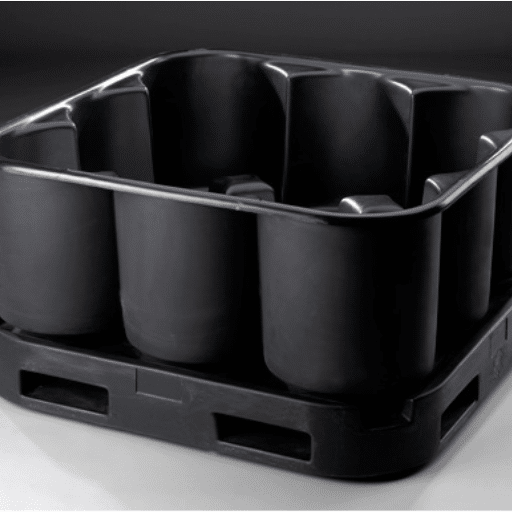
Sustainability mandates are pushing recycled content into rotomolding, and it works, but it needs a different process window.
Recycled rotomolding or injection-molding HDPE usually retains a usable MFI. Recycled blow-molding HDPE is often too low in MFI for rotomolding. Recyclate powders also show 11 to 17 percent lower bulk density and higher zero-shear viscosity, which makes them harder to consolidate and more prone to bubbles. The fixes:
- Process at higher temperature to promote bubble removal.
- Consider internal mold pressurization for recycled-content parts.
- Reserve high PCR percentages for non-critical applications.
- Verify the recyclate’s MFI and particle size per lot, exactly as you would for virgin powder.
For a fuller treatment of PCR and recycling infrastructure, see our HDPE recycling guide.
HDPE Rotomolding in 2026: Market Context
The global rotomolding market is valued at roughly USD 5.76 billion in 2026 and is projected to grow to about USD 7.40 billion by 2031, a compound annual growth rate near 5.14 percent, according to Mordor Intelligence. Polyethylene holds about 73 percent of rotomolding material use, and Asia-Pacific is the largest regional market at roughly 40 percent share and the fastest growing.
Growth is coming from substitution of steel and fiberglass with lightweight polymers, water storage and agriculture demand, EV applications, automated rotomolding machines, and recyclable and bio-based polymer formulations. The key near-term challenge is raw material price volatility, which is exactly why lot-to-lot consistency and supplier documentation matter more than a low per-ton price.
Sourcing Rotomolding-Grade HDPE Powder
Rotomolding powder is a commodity until it is not. The difference between a great run and a scrap bin is often traceable to the document that came with the powder, or the one that did not.
Branded Prime vs. Generic Powder
Lot-to-lot swings in MFI and particle size cause porosity, incomplete fusion, and warpage because the process window was tuned for a specific powder behavior. Branded prime grades carry manufacturer-controlled MFI distributions, published COA values, and full batch traceability. Generic or compound powders may be cheaper per ton, but the scrap and rework from inconsistent consolidation usually exceed the price difference.
Verifying Powder via Certificate of Analysis
When you request branded prime HDPE rotomolding powder, the COA should be issued by the manufacturer against a specific production lot, and it should state:
- Grade designation
- MFI at 190 degrees Celsius and 2.16 kg (ASTM D1238)
- Density (ASTM D792)
- Particle size distribution
- Bulk density
- ESCR where applicable (ASTM D1693)
- Compliance statements (FDA, RoHS, REACH)
Cross-reference every field against the manufacturer’s published datasheet. Confirm the COA is on manufacturer letterhead, not a supplier-generated internal document. Confirm the powder form and particle size match what your rotomolding line needs.
Red Flags in Unverified Powder Supply
- A generic grade designation, such as “rotomolding powder” with no brand and grade number.
- A supplier-generated COA with no manufacturer letterhead or lot-specific values.
- MFI reported at the wrong test condition.
- No particle size distribution or bulk density data.
- Lot-to-lot MFI swings beyond about +/-15 percent.
- A price far below the regional benchmark with no valid explanation.
When Priya, a procurement lead in Dubai, began qualifying rotomolding powder for a water tank program, she ran every lot against three COA fields before release: MFI, density, and particle size. On the fourth lot, the MFI came back 30 percent above the datasheet range.
One production shift on that powder would have produced the same internal bubbles that scrapped the 60 tanks in the story at the top of this article. The COA check caught it before it ever reached the oven.
Sourcing From Yifuhui
Yifuhui is a Suzhou-based distributor of branded prime resins, and rotomolding-grade HDPE powder is part of that portfolio. We supply grades such as the LyondellBasell Lupolen rotomolding family, SABIC, and GAIL HDPE powders with manufacturer-issued COA, lot-specific MFI, density, and particle size data, and full export documentation from Port of Shanghai. For sourcing guidance and supplier qualification, our guide to sourcing HDPE from China walks through the process step by step, and you can request certified HDPE resin for current availability.
Conclusion
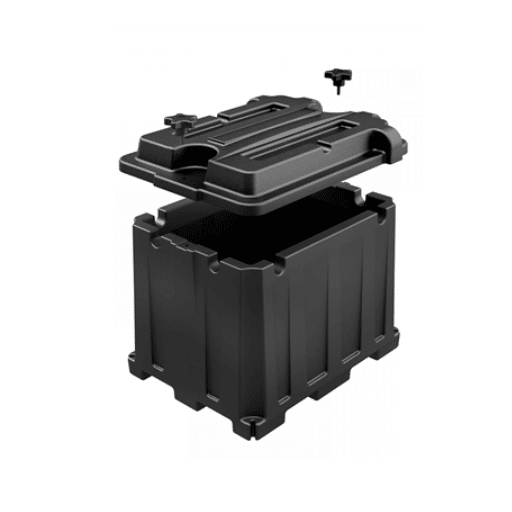
Successful HDPE rotomolding comes down to matching powder grade to part geometry, then controlling the process window. Match MFI and density to wall thickness and service environment.
Hold oven temperature and rotation within the window for uniform fusion. Design cooling for uniform shrinkage. Verify ESCR and UV stabilization against the exposure environment. Confirm powder consistency on the COA for every lot you bring in.
The 60-tank scrap event from the opening of this article was avoidable. It was avoidable with a defined grade, a specified particle size range, and a COA checked against the datasheet before the powder was loaded. That is the standard we hold every shipment to.
Need branded prime HDPE rotomolding powder with full COA documentation? We supply from 25 kg trial runs to container loads, FOB Shanghai, with manufacturer lot traceability on every bag. Contact our technical team with your part size, wall thickness, and service environment, and we will recommend the right grade for your line.
Frequently Asked Questions
What is HDPE rotomolding?
Rotomolding, or rotational molding, is a low-pressure process that produces seamless, hollow plastic parts by rotating HDPE powder inside a heated mold on two axes until it melts and coats the mold walls. It is the standard process for large tanks, playground equipment, marine buoys, and outdoor furniture.
Why is HDPE good for rotomolding?
HDPE offers the highest stiffness of the polyethylenes, excellent chemical and permeation resistance, good impact strength, FDA-compliant food-contact grades, and low cost. Combined with low-cost tooling and the ability to form large seamless parts, it is the workhorse material of the rotomolding industry.
What is the difference between HDPE and LLDPE for rotomolding?
HDPE is stiffer and stronger, better for structural tanks and bins that need rigidity and permeation resistance. LLDPE is tougher and more ESCR-resistant with better warpage control, better for coolers, playground equipment, and agricultural parts exposed to thermal cycling and impact.
What MFI should HDPE be for rotomolding?
Rotomolding-grade HDPE typically has an MFI of 2 to 4 g/10 min measured at 190 degrees Celsius and 2.16 kg. This range balances uniform powder sintering against mechanical properties. Higher MFI flows better but lowers strength and ESCR.
What temperature is used for HDPE rotomolding?
Oven temperature for HDPE rotomolding is typically 220 to 240 degrees Celsius. Large tanks with thick walls may use higher oven profiles for 20 to 50 minutes; thin-wall parts need only 5 to 15 minutes. Parts are cooled to 50 to 80 degrees Celsius before demolding.
What are the most common rotomolding defects?
The most frequent defects are porosity and internal bubbles from trapped gas, pinholes from moisture or poor venting, inner-wall roughness from overheating, warpage from non-uniform cooling, and incomplete fusion from insufficient heat or coarse powder.
How is rotomolding different from injection molding?
Rotomolding uses heat and biaxial rotation with no pressure to produce large seamless hollow parts with low-cost tooling but long cycle times. Injection molding uses high pressure to produce solid precision parts with tight tolerances, high surface finish, and short cycles but much higher tooling cost.
How do I verify that HDPE powder matches the rotomolding grade I specified?
Request a Certificate of Analysis issued on the manufacturer’s letterhead for each lot. Verify grade designation, MFI at 190 degrees Celsius and 2.16 kg, density, particle size distribution, and bulk density against the manufacturer’s published datasheet. Reject supplier-generated internal COAs without manufacturer documentation.