

Is HDPE UV resistant? Yes, but only for a few months. Left unstabilized in direct sunlight, HDPE loses roughly 98% of its toughness after about 300 hours of accelerated weathering.
The polyethylene that survives 50 years underground or decades on a landfill slope is not the same resin. It’s a UV-stabilized grade, engineered to last.
Here’s what most people miss about HDPE UV resistance: it’s not a property of the resin alone. It’s designed in, through carbon black, hindered amine light stabilizers (HALS), and UV absorbers. Choose the wrong stabilizer package for your application, and even a premium-grade part can chalk, fade, crack, and fail within a single season.
Consider what happened at Coastal Outdoor Products in Tampa. The manufacturer sourced a low-cost “UV resistant” HDPE for a new line of patio furniture in early 2025. By September, chairs were chalking white, and the polymer had become brittle enough to crack under finger pressure.
The resin was not UV-stabilized at all. The COA would have exposed it instantly.
This guide covers how UV degrades HDPE at the molecular level, plus the four stabilizer families and when to use each. You’ll also learn the weathering test standards that prove weatherability, application-by-application grade selection, and how to verify a UV-stabilized grade from a supplier. By the end, you’ll know exactly how to specify HDPE for outdoor service, and how to avoid the failures that cost money, time, and warranty claims.
If you’re choosing a grade right now, our technical team will match a UV-stabilized HDPE to your outdoor service life and color requirements, no obligation. Contact Yifuhui’s technical team or read the full HDPE material guide first.
How UV Degrades HDPE: The Photo-Oxidation Mechanism

What UV Radiation Does to the Polymer Chain
Ultraviolet light damages HDPE through photo-oxidation, a chain reaction that starts at the surface and works inward. UV-B radiation, the 290 to 320 nanometer band, is the most destructive. Photons in this range carry enough energy to break carbon-carbon bonds in the polyethylene backbone.
Once a bond breaks, the freed radical reacts with atmospheric oxygen to form carbonyl groups, ketones and carboxylic acids. Fourier-transform infrared (FTIR) spectroscopy detects these as the carbonyl index, the standard fingerprint of UV degradation. Each reaction creates new radicals, so the damage accelerates over time instead of slowing down.
The result is a cascade of failures. Molecular weight drops, the polymer embrittles, and the surface microcracks. Tensile strength, elongation at break, and impact strength all fall.
Degradation concentrates in the outer 0.1 to 1 millimeter of the part, and heat and humidity make it worse. A hot, humid outdoor environment ages HDPE far faster than a cool, dry one, which is why HDPE UV resistance can never be quoted as a single number without a climate assumption.
Quantifying the Damage
Real test data makes the stakes concrete. A study of HDPE under UV exposure measured the difference between virgin and carbon-black-stabilized resin over 1,152 hours:
| Condition | Tensile Strength | Elongation at Break | Note |
|---|---|---|---|
| Virgin HDPE, baseline | ~25.3 MPa | High | Reference point |
| Virgin HDPE after 1,152 h UV | ~14.64 MPa | ~12.48% | About 42% tensile loss |
| Carbon-black-filled HDPE after 1,152 h UV | ~22.24 MPa | ~39.28% | Most properties retained |
The pattern repeats across the literature. Unstabilized HDPE loses roughly 98% of its toughness after about 300 hours of artificial weathering, becoming what researchers describe as “mechanically dead.” In saltwater, the damage arrives faster, with tensile strength dropping about 30% after just 28 days of combined UV and marine exposure.
UV-aged HDPE also loses recyclability value, because reduced molecular weight and oxidation byproducts contaminate the reprocessing stream, an issue our HDPE recycling guide examines in detail.
Failure Modes in the Field
Field failures follow a predictable sequence. Chalking and surface erosion are the first visible signs, the polymer surface turning to powder as it degrades.
Microcracks follow, starting at the surface and propagating inward until the part shatters under load. Stress cracking appears where a UV-weakened surface meets an applied force, often at corners and weld lines. Color fading signals that the UV absorbers themselves are being consumed.
None of this is inevitable. The right stabilizer package delays photo-oxidation by years or decades, which is why the entire outdoor HDPE industry runs on one question: which UV stabilization system does this part need?
How HDPE Is Made UV Resistant: Stabilizer Chemistry
Five stabilizer families protect HDPE from UV. The right one depends on the part’s color, cost, and target service life:
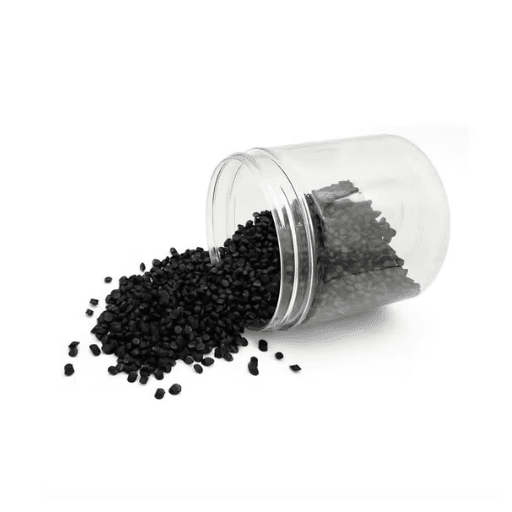
- Carbon black – A UV screen, absorber, and radical trap, and the benchmark for black parts at 2 to 3 percent loading.
- Hindered amine light stabilizers (HALS) – Regenerating radical quenchers for colored and natural parts.
- UV absorbers (UVAs) – Benzophenones and benzotriazoles that intercept UV in films and sheets.
- Titanium dioxide (TiO2) – Reflects and scatters UV below roughly 385 nanometers for light-colored parts.
- Inorganic pigments – Copper phthalocyanine blue approaches light-stabilizer performance; chrome oxide and ultramarine age poorly.
Each family is covered in detail below.
Carbon Black: The Gold Standard for Black Parts
Carbon black is the most effective and economical UV stabilizer for HDPE. It works through three mechanisms at once: it screens UV physically, absorbs radiation before it reaches the polymer, and traps the free radicals that drive degradation. Finer particle sizes are more effective.
For HDPE pipe, ASTM D3350 specifies a carbon black content of 2 to 3 percent. Demanding parts, such as oilfield thread protectors, use 2.5 to 4.5 percent. This loading is the benchmark for HDPE UV resistance, and it explains why virtually every commercial HDPE pipe and geomembrane is black.
The limitation is obvious but easy to overlook: carbon black only works for dark products. If your part needs to be white, blue, or natural, you need a different stabilizer.
HALS: The Stabilizer for Colored Parts
Hindered amine light stabilizers, HALS, protect HDPE by a completely different route. They quench the radicals that propagate photo-oxidation, and unlike most stabilizers, they can regenerate. A single HALS molecule neutralizes thousands of radicals over its lifetime.
Molecular weight matters. Low-molecular-weight HALS migrates to the surface and protects early, but gets consumed quickly. High-molecular-weight HALS stays dispersed in the matrix and protects for years, which is why it dominates long-life colored applications.
Combining carbon black with HALS produces a documented synergy. In a 2014 study published in the Iranian Polymer Journal, Javadi and colleagues found that hybrid carbon black/HALS systems delivered the lowest carbonyl index and the best mechanical retention of all formulations tested, after simulated 4 and 8 years of solar exposure. For maximum-life infrastructure parts, the hybrid is the state of the art.
UV Absorbers, TiO2, and Pigments
UV absorbers (UVAs) such as benzophenones and benzotriazoles intercept UV before it reaches the polymer. They are effective in films and sheets, but alone they are less durable over long service lives because they are consumed steadily. Most formulators pair them with HALS.
Titanium dioxide protects by reflecting, scattering, and absorbing UV below roughly 385 nanometers, and it reduces heat buildup in light-colored parts. Studies report tensile strength improvements of about 28.5 percent at 10 percent TiO2 loading. The trade-off is surface blistering risk at high loadings.
Pigment choice also shifts UV performance. Copper phthalocyanine blue provides superior aging resistance, approaching light-stabilizer performance. Chrome oxide and ultramarine perform poorly, aging within about 500 hours of exposure.
Inorganic pigments, carbon black and TiO2 included, generally outperform organics in HDPE. One caveat: a pigment’s lightfastness does not automatically improve the matrix’s lightfastness, and a few pigments generate radicals that accelerate degradation instead.
Stabilizer Comparison Table
| Stabilizer | Mechanism | Best For | Limitations | Typical Loading |
|---|---|---|---|---|
| Carbon black | UV screen/absorber + radical trap | Black pipes, geomembranes, tanks | Dark color only | 2-3% (up to 2.5-4.5% demanding) |
| HALS | Radical quenching, regenerating | Colored and natural outdoor parts | Higher cost; color-sensitive formulations | 0.1-0.6% |
| UV absorbers (UVA) | Absorb UV before the polymer | Films, sheets, light-colored parts | Consumed over time; less durable alone | 0.2-1.0% |
| TiO2 | Reflect/scatter/absorb UV | Light-colored parts, heat reduction | Blistering risk at high loading | 2-10% |
| Carbon black + HALS hybrid | Screening + quenching synergy | Maximum-life infrastructure parts | Cost | e.g., 1.5% CB + 0.1% HALS |
Ready to test a UV-stabilized grade in your line? Request a 25 kg trial sample of branded prime resin, from black pipe compounds to HALS-stabilized colored grades, on the HDPE product page.
Weathering Test Standards & How to Read a UV Report
The Standard Tests
An HDPE weathering test claim means nothing without a standard behind it. The common accelerated tests, published by ASTM International, are:
- ASTM G154 / ASTM D4329: Fluorescent UV/condensation exposure, the QUV method most datasheets cite. ASTM D4329 is the plastics-specific procedure; ISO 4892-3 is the international equivalent.
- ISO 4892-2 / ASTM G155: Xenon-arc weathering, which matches the solar spectrum more closely but runs longer and costs more.
- ASTM D3350: HDPE cell classification, which includes a carbon black content cell for UV stabilization.
- ASTM D2513: The thermoplastic gas pipe standard, which requires black HDPE to withstand at least 2 years of outdoor storage.
- ASTM D1435 / ISO 877: Natural outdoor weathering, slower but the ground truth for real-world performance.
A common QUV cycle uses UVA-340 lamps at 8 hours of UV at 60°C, followed by 4 hours of condensation at 50°C. UVB-313 lamps are harsher, and their results are not directly comparable. Always confirm which lamp and cycle a datasheet used.
How to Read a UV Test Report
A credible UV report answers seven questions:
- What standard was used? Confirm ASTM G154/D4329, ISO 4892-2/-3, or xenon exposure, not a generic “UV tested” claim.
- How many hours? Good grades cite 1,000 to 3,000 hours. The common acceptance threshold is retaining at least 70 to 80 percent of tensile strength after 1,500 to 2,000 hours.
- Which lamp and spectrum? Prefer UVA-340 for sunlight simulation.
- What cycle? Check temperature, irradiance, and condensation or spray steps.
- What failure criteria? Look for quantitative data, tensile retention, elongation, color change, gloss loss, or cracking. “No visible change” is insufficient.
- Was a control run? A reference material confirms comparability.
- The critical caveat: accelerated hours do not convert linearly to calendar years. Lab data is a comparative ranking tool. Real lifespan depends on climate, formulation, and part geometry.
HDPE UV Resistance by Application: Grade Selection Guide
The right UV package depends entirely on the application. Pipe, geomembrane, rotomolded tank, furniture, and cable each demand a different formulation.
Pipes and Pipe Coatings
Black HDPE pipe carries 2 to 3 percent carbon black per ASTM D3350, which underpins its 50 to 100 year buried service life and its minimum 2-year outdoor storage rating per ASTM D2513. That is direct proof that HDPE pipe UV resistance is engineered into the compound, not inherited. LyondellBasell Lupolen 4552D BLACK, a 3LPE pipe coating grade per DIN 30670 rated up to 85°C, illustrates the specification depth of a serious pipe resin. For installation and field details, see the HDPE pipe applications guide.
Geomembranes
HDPE appears in roughly 95 percent of geomembrane applications, with mining as the largest segment. Black 1.5 to 2.5 millimeter HDPE geomembrane sheets rely on carbon black for UV resistance plus antioxidants for thermal aging, typically meeting GRI GM13. These liners sit in open sunlight for months before cover soil is placed, so UV stabilization is non-negotiable.
Rotomolded Tanks and Outdoor Parts
Above-ground tanks, septic tanks, spray tanks, and kayaks all need UV-stabilized rotomolding grades with the durability to sit in full sun for a decade. LyondellBasell Icorene 1480UV carries a UV20 package with impact strength rated to -40°C, while NOVA SURPASS RMs341-U(UG) offers UV18+ performance with NSF 24, 51, and 61 certifications for potable water. Chevron Phillips Marlex HMN TR-942 and TR-945 are workhorse UV-stabilized tank grades. Process details live in the HDPE rotomolding guide, but the UV selection step belongs here.
Amir’s rotomolding shop in Dubai learned this the hard way. He had used natural HDPE for above-ground water tanks for years, until a competitor’s tanks went chalky and brittle within two seasons in the Gulf sun. He switched to a UV-stabilized grade with a documented UV20 package and NSF 61 certification. The difference in surface quality after three years outdoors is visible at ten paces, and the tanks now carry a warranty his buyers trust.
Outdoor Furniture, Playground & Marine
UV-stabilized colored HDPE supports more than 10 years of outdoor service without brittleness, which is why it dominates patio furniture, playground decks, and marine cabinetry. Lotte Chemical Titanvene HD 6070 UA is an injection-molding grade used for crates, pallets, and seats. Vycom SEABOARD provides a UV-resistant HDPE sheet for marine use with UL 94 HB and RoHS compliance. Colored HDPE furniture outperforms polypropylene in long-term UV resistance, an advantage worth pricing into the buying decision.
Cable and Agricultural Applications
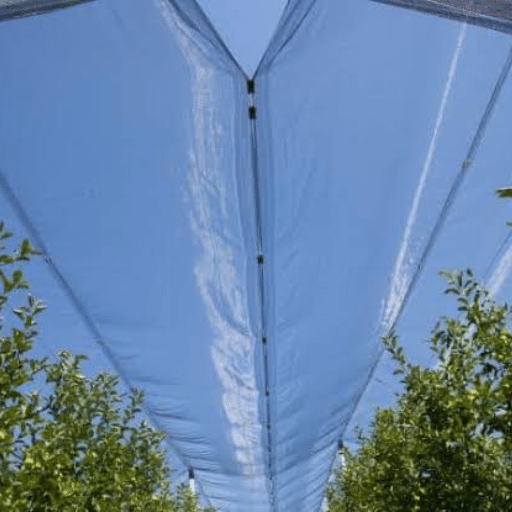
Cable jacketing needs a bimodal UV-stabilized HDPE that resists both UV radiation and thermal aging over decades of outdoor service, such as REPSOL ALCUDIA CAB4805UV. Agricultural netting and drip irrigation run on UV-stabilized HDPE, with netting documented in service for more than 5 years and black drip lines holding up under direct field exposure.
Application-to-Grade Quick Table
| Application | Process | UV System | Example Grades | Outdoor Service |
|---|---|---|---|---|
| Water/gas pipe | Extrusion | Carbon black 2-3% | Lupolen 4552D BLACK, PE4710/PE100 grades | 50-100 yr buried; 2+ yr storage |
| Geomembrane | Sheet extrusion | Carbon black | Black GRI GM13 HDPE | Decades (landfill/mining) |
| Rotomolded tank | Rotational molding | UV20 / HALS + AO | Icorene 1480UV, SURPASS RMs341-U | 10-15 yr |
| Furniture/marine | Injection/sheet | HALS (colored) | Titanvene HD 6070 UA, SEABOARD | 10+ yr |
| Cable jacket | Extrusion | HALS/UVA + AO | ALCUDIA CAB4805UV | 20+ yr |
| Agricultural netting | Extrusion/mono | HALS + UVA | UV-stabilized HDPE netting | 5+ yr |
HDPE UV Resistance vs. Other Plastics
HDPE vs. Polypropylene
HDPE is inherently more UV-tolerant than polypropylene. PP embrittles faster under prolonged sunlight and needs heavier stabilizer loadings for permanent outdoor use. For stiff outdoor parts where impact and chemical resistance matter, UV-stabilized HDPE is usually the better call. The full trade-off appears in our HDPE vs PP material selection guide.
HDPE vs. PVC and LDPE
Rigid PVC degrades by a different route, dehydrochlorination, which turns it yellow and brittle. It is typically protected with TiO2 and UV absorbers. Black HDPE’s carbon black system is simpler and more durable for buried and outdoor pipe. See the HDPE vs PVC comparison for the full picture.
Within the polyethylene family, HDPE photo-oxidizes similarly to LDPE and LLDPE, but its density and crystallinity make it the more durable choice for stiff outdoor parts, a point covered in our HDPE vs LDPE comparison.
When to Choose Something Else
HDPE UV resistance has honest limits, and we won’t pretend otherwise. If you need a light color held tightly for decades, painted metal or UV-stabilized ASA/PMMA capstock serves better. If you need transparent outdoor glazing, PC or acrylic is the answer, because HDPE can’t be transparent and UV-stable at the same time. In high-temperature UV environments, higher-performance engineering plastics such as POM UV grades or PC are worth evaluating.
Sourcing UV-Stabilized HDPE: Verification & Red Flags
Branded Prime vs. Generic Grades
Lot-to-lot variation in carbon black loading and stabilizer package is the hidden killer of outdoor HDPE parts. A compound that drifts from 2.5 percent down to 1.8 percent carbon black may look identical in the bag, but it can shave years off a pipe or tank’s service life. Inconsistent dosing shows up later as premature UV failure, uneven color, and warranty claims.
Branded prime resin closes that gap. Manufacturers control the carbon black loading and stabilizer package to tight tolerances, publish the ASTM cell classification, and provide full batch traceability. The premium over generic compound is small relative to the cost of field failures.
Elena, a procurement lead at a German outdoor furniture manufacturer, learned this after a broker’s generic black compound produced lounge chairs that faded unevenly and cracked at 14 months. The branded prime shipment she replaced it with carried carbon black content per ASTM D1603 and an ASTM G154 weathering report with tensile retention data. Her broker could never produce that documentation.
How to Verify UV-Stabilized HDPE via COA
A Certificate of Analysis is your primary verification tool. Request it on the manufacturer’s letterhead for every lot, and check these fields against the published datasheet:
- Grade designation
- Density per ASTM D792
- Melt flow index per ASTM D1238
- Carbon black content per ASTM D1603 or D4218, or the D3350 cell
- Stabilizer/antioxidant package statement
- Weatherability data, ASTM G154/D4329 or ISO 4892 hours plus tensile retention
- Compliance markings, such as NSF 61, FDA 21 CFR 177.1520, UL 94, or RoHS where applicable
If the COA does not carry a carbon black value or a stabilizer statement, or if it is a supplier-generated internal document without manufacturer letterhead, treat the shipment as unverified. For the broader supplier verification process, see our guide to sourcing HDPE from China and our HDPE properties guide for what each datasheet field controls.
Red Flags in Unverified UV-Stabilized HDPE Supply
- No carbon black content value or cell classification on the COA
- A generic “UV resistant” claim with no test standard or hours-to-retention data
- A supplier-generated COA without manufacturer letterhead or lot-specific values
- Batch-to-batch shade drift, which signals inconsistent pigment and stabilizer dosing
- A price far below the regional black HDPE benchmark with no valid explanation
Conclusion
Is HDPE UV resistant? Yes, but only with the right stabilizer system. That is the honest bottom line on HDPE UV resistance: UV degrades HDPE through chain scission and photo-oxidation, carbon black at 2 to 3 percent is the benchmark for black infrastructure parts, HALS protects colored parts, and hybrid systems deliver the longest service life. Specify the right grade by application, verify weathering test data per ASTM G154 or ISO 4892 with hours and tensile retention, and confirm carbon black loading and stabilizer package on the COA for every lot.
The outdoor HDPE market is only growing, with the global HDPE geomembrane segment expanding at roughly 9.7 percent annually and Asia-Pacific, led by China, driving about a third of demand. That growth will be won on durability, which comes down to one thing: verified UV stabilization. Choose the right package, and HDPE will outlast the application. Choose wrong, and you are buying a warranty claim. To learn more about HDPE Extrusion: Complete Guide to Process, Grades, and Material Selection, please click to refer to our accompanying guide.
At Yifuhui, we supply branded prime UV-stabilized HDPE from LyondellBasell, NOVA Chemicals, REPSOL, Chevron Phillips, DOW, and Lotte, with manufacturer-issued COA on every lot, a guarantee most UV-stabilized HDPE suppliers cannot offer. Request a quote for black pipe and geomembrane compounds or HALS-stabilized colored furniture and tank grades, from 25 kg trial runs to full container loads, FOB Shanghai.
Frequently Asked Questions
Is HDPE UV resistant?
HDPE has a natural baseline tolerance to UV but degrades under prolonged sunlight unless stabilized. Unstabilized HDPE can lose most of its toughness within months to a few years outdoors. UV-stabilized HDPE, using carbon black, HALS, or UV absorbers, is suitable for decades of outdoor service in pipes, geomembranes, tanks, and furniture.
How long does HDPE last in the sun?
It depends on formulation. Unstabilized HDPE may become brittle within 1 to 2 years. UV-stabilized colored HDPE supports 10 or more years without brittleness, and black carbon-black-stabilized pipe is rated for 50 to 100 years of service, with a minimum 2-year outdoor storage capability per ASTM D2513. Real-world life depends on climate, formulation, and part geometry.
What is the best UV stabilizer for HDPE?
Carbon black is the most effective and economical stabilizer, absorbing UV and trapping radicals, but it only works for black or dark products. For colored parts, hindered amine light stabilizers are preferred, often combined with UV absorbers. Carbon black plus HALS hybrid systems deliver the best long-term performance.
Does black HDPE protect against UV better than white or colored HDPE?
Yes. Carbon black at 2 to 3 percent loading per ASTM D3350 is the benchmark stabilizer, which is why most commercial HDPE pipe and geomembranes are black. Colored HDPE relies on HALS and UV absorbers, which can match black performance with the right loading but are typically used when a specific color is required.
How is HDPE UV resistance tested?
Accelerated weathering uses fluorescent UV (ASTM G154 / ASTM D4329, commonly UVA-340 at 8 hours UV at 60°C plus 4 hours condensation at 50°C) or xenon-arc (ISO 4892-2). Good grades retain at least 70 to 80 percent of tensile strength after 1,500 to 2,000 hours. Natural outdoor weathering per ASTM D1435 or ISO 877 is slower but more realistic. Lab hours do not convert linearly to calendar years.
Is HDPE better than PP for outdoor UV exposure?
Generally yes. HDPE is more UV-tolerant than polypropylene and retains its mechanical properties longer under sunlight. PP embrittles faster and typically needs higher stabilizer loadings for permanent outdoor use. For stiff outdoor parts where impact and chemical resistance matter, UV-stabilized HDPE is usually the better choice.
How do I verify a UV-stabilized HDPE grade from a supplier?
Request a Certificate of Analysis on the manufacturer’s letterhead for each lot. Verify grade designation, density, melt flow index, carbon black content per ASTM D1603/D4218 or the D3350 cell, stabilizer/antioxidant package, and weathering test data against the manufacturer’s published datasheet. Reject supplier-generated internal COAs without manufacturer documentation.